Touch™ Architectural Door Hardware
Architectural door hardware coordinated around the complete door system.
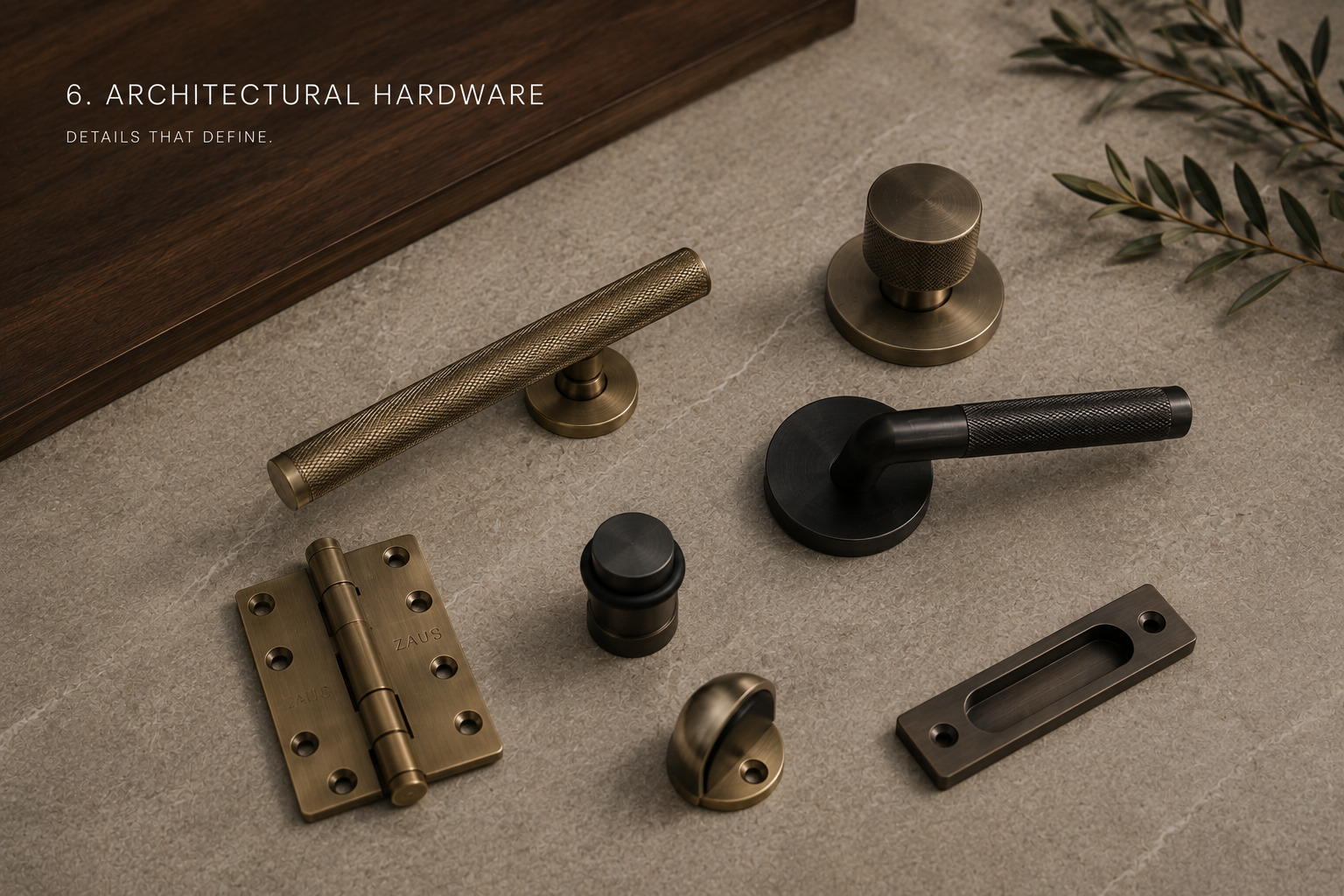
ZAUS Touch™ Architectural Door Hardware brings together the functional, tactile and architectural components required to complete a coordinated door package.
Each hardware specification can be developed around the project door schedule and selected door system, allowing handles, hinges, locks, latches, sliding mechanisms, door controls and associated accessories to be selected according to the dimensions, weight, operation and intended application of each opening.
From understated lever handles and concealed hinges through to large-format pull handles, pocket-door mechanisms and specialist door-control hardware, Touch™ allows the hardware to be considered alongside the door and frame rather than selected as an isolated finishing item.
Complete Architectural Hardware System
Different door types place different requirements on their operating hardware.
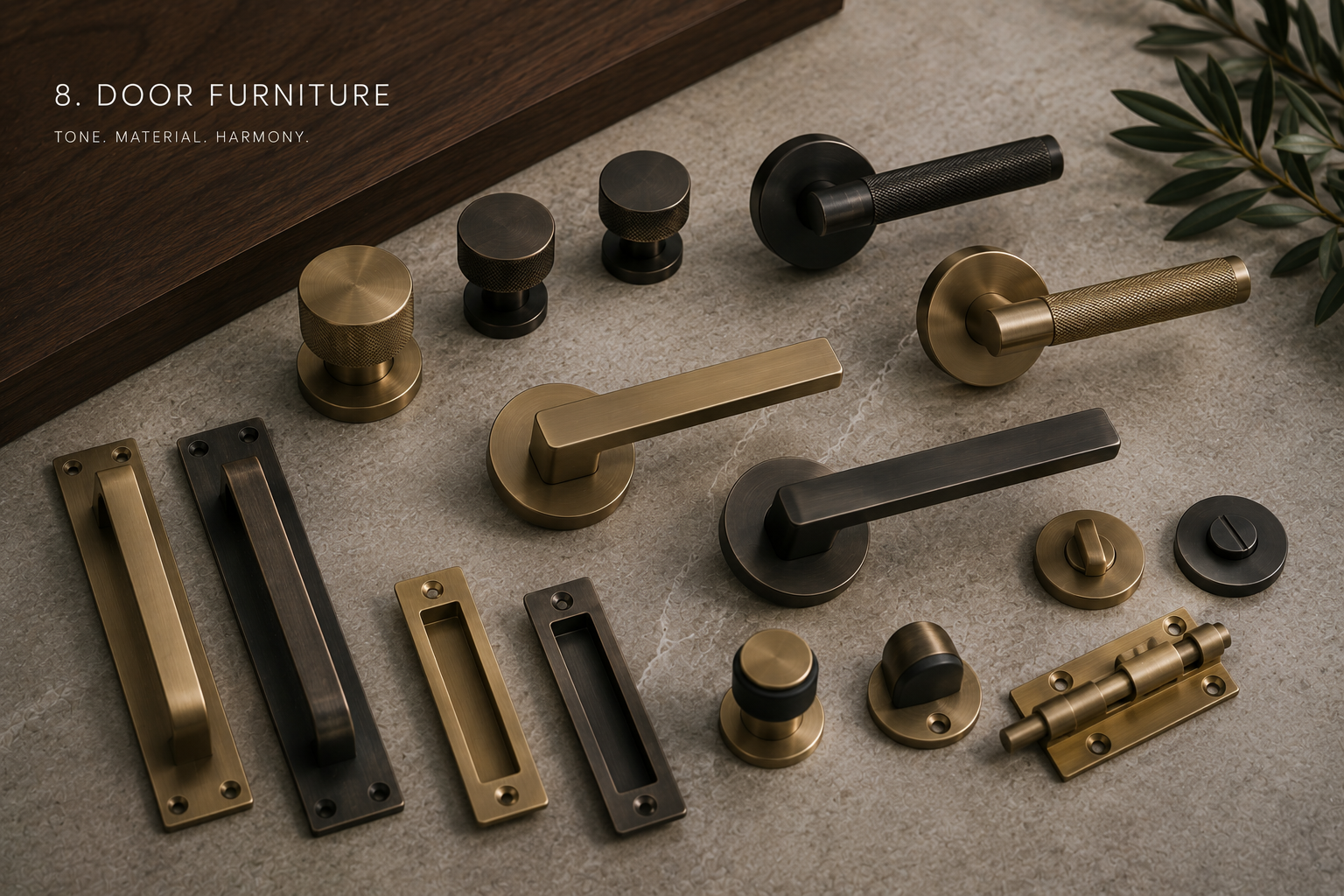
Touch™ can coordinate components including:
Lever handles
Pull handles
Flush and recessed pulls
Hinges
Concealed hinges
Locks and latches
Sliding and pocket-door mechanisms
Door closers
Door stops and catches
Flush bolts
Door seals
Associated operating hardware
The final hardware combination is selected according to the construction and functional requirements of the individual door.
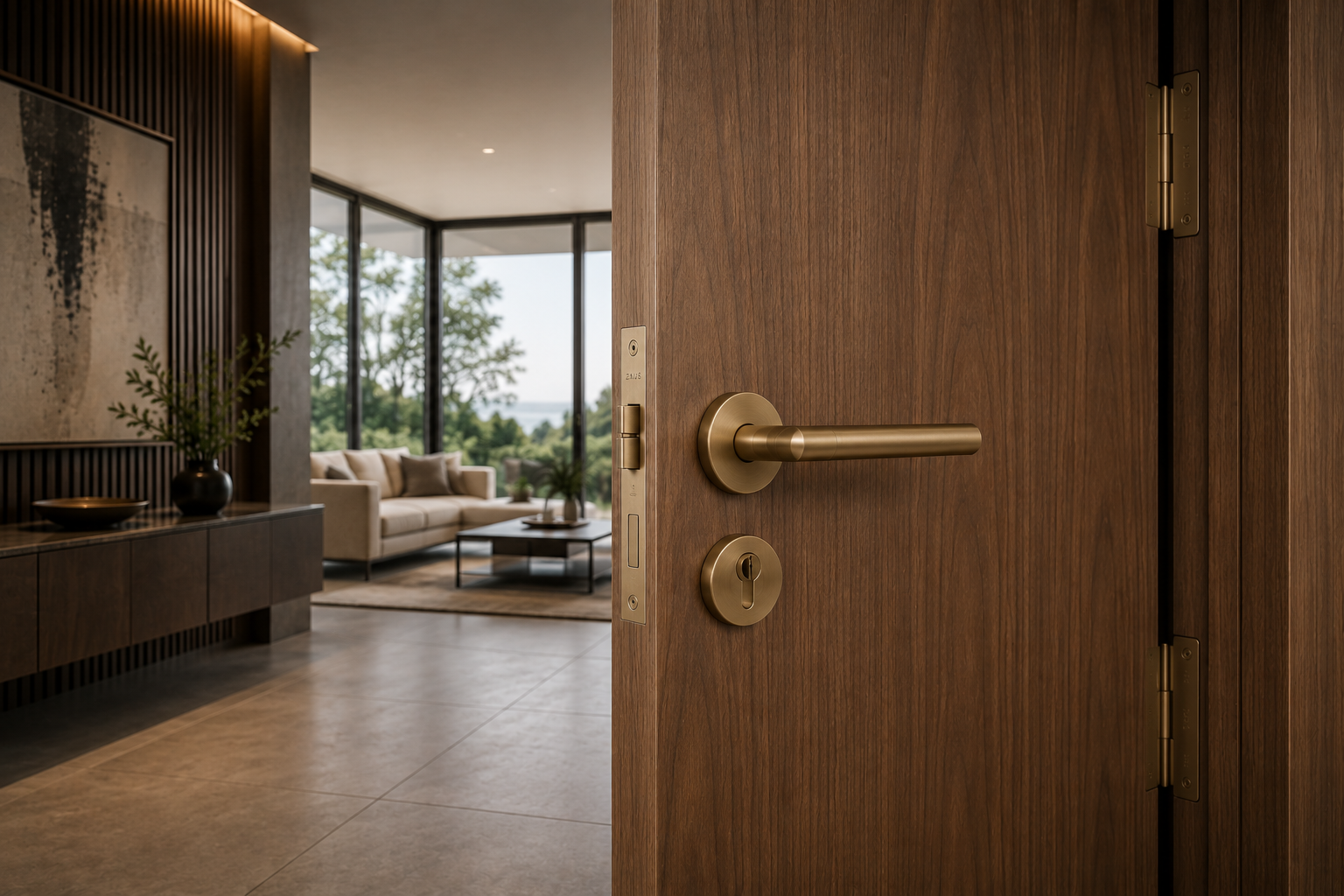
Lever Handles
Architectural lever handles provide the primary operating interface for conventional hinged doors.
Different profiles, proportions and finishes can be selected according to the architectural character of the project and the intended application of the opening.
Lever hardware can be coordinated across:
Internal doors
Bedroom doors
Bathroom and ensuite doors
Home offices
Living areas
Selected entry applications
Hospitality and commercial interiors
Handle selection should be considered together with the required latch, lock and door construction.
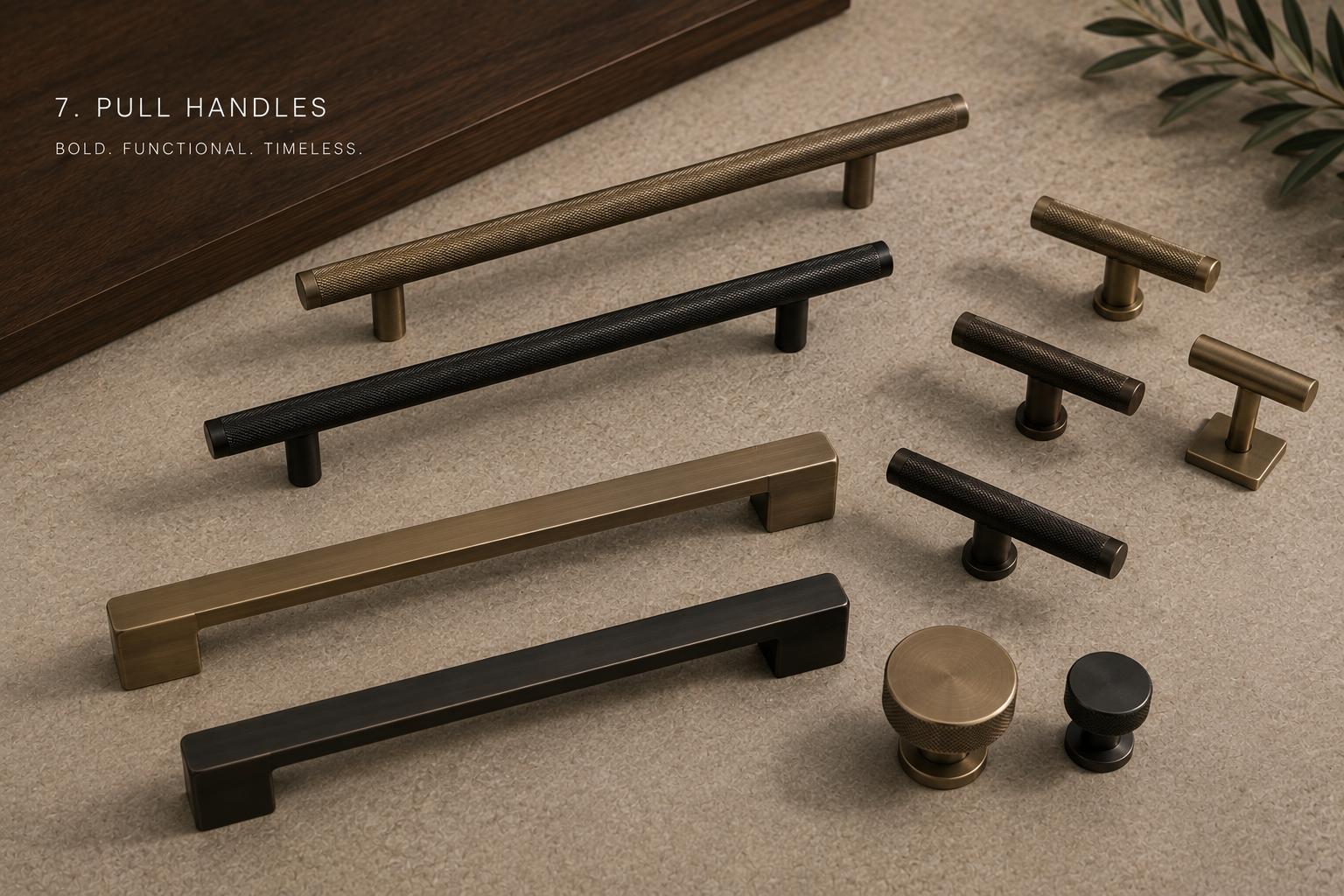
Pull Handles
Pull handles can provide either a restrained architectural detail or a more prominent feature depending on their scale and design.
They are particularly suited to:
Entry doors
Feature doors
Glass doors
Large-format doors
Selected sliding systems
Architectural openings
Longer-format pulls can establish stronger vertical lines across oversized doors, while smaller profiles can provide a more understated appearance.
Final handle dimensions, fixing requirements and compatibility should be coordinated with the selected door construction before manufacture.
Flush & Recessed Pulls
Flush and recessed pulls provide a low-profile operating solution where projecting hardware would interfere with the movement or appearance of the door.
Applications can include:
Pocket doors
Sliding doors
Concealed sliding systems
Selected wardrobe and dressing-room openings
Minimal architectural interiors
The pull depth and installation requirements should be coordinated with the door thickness and sliding configuration.
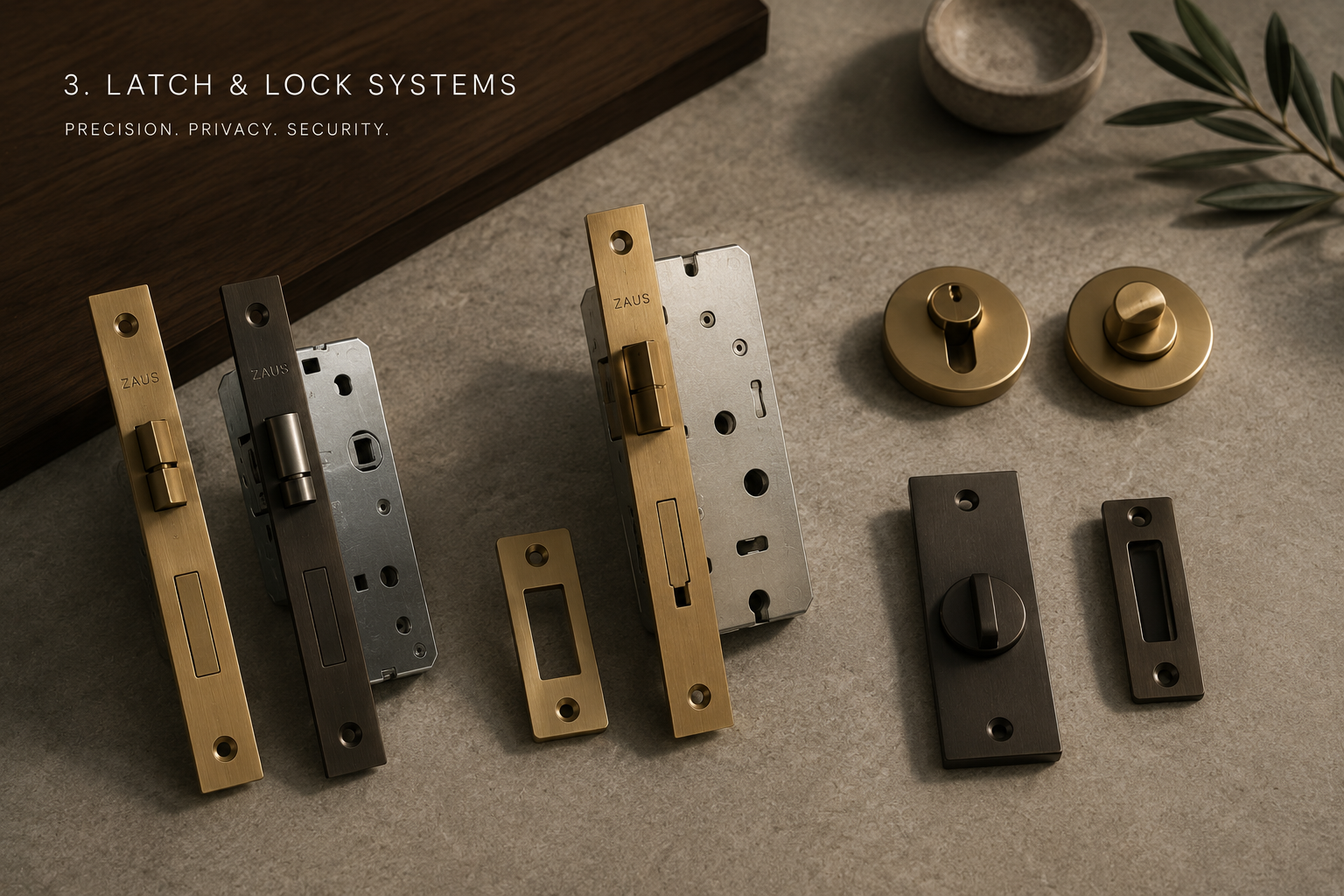
Locks & Latches
Mechanical locking and latching hardware can be selected according to the function and security requirements of each opening.
Depending on the applicable hardware collection, configurations can include:
Mortise locks
Passage latches
Privacy locks
Mechanical entry locks
Sliding-door locks
Flush bolts
Associated locking components
Bedrooms, bathrooms, general circulation doors, entry doors and other openings can therefore receive hardware appropriate to their individual use rather than applying one locking configuration throughout the project.
Smart and electronic access systems are coordinated separately through the ZAUS Portal™ Smart Access collection.
Standard Architectural Hinges
Conventional architectural hinges provide a reliable solution for standard hinged-door applications.
Hinge selection should consider:
Door dimensions
Door thickness
Door weight
Door construction
Opening direction
Required movement
Frequency of use
Environmental conditions
The quantity, dimensions and capacity of the hinges are determined according to the requirements of the individual door.
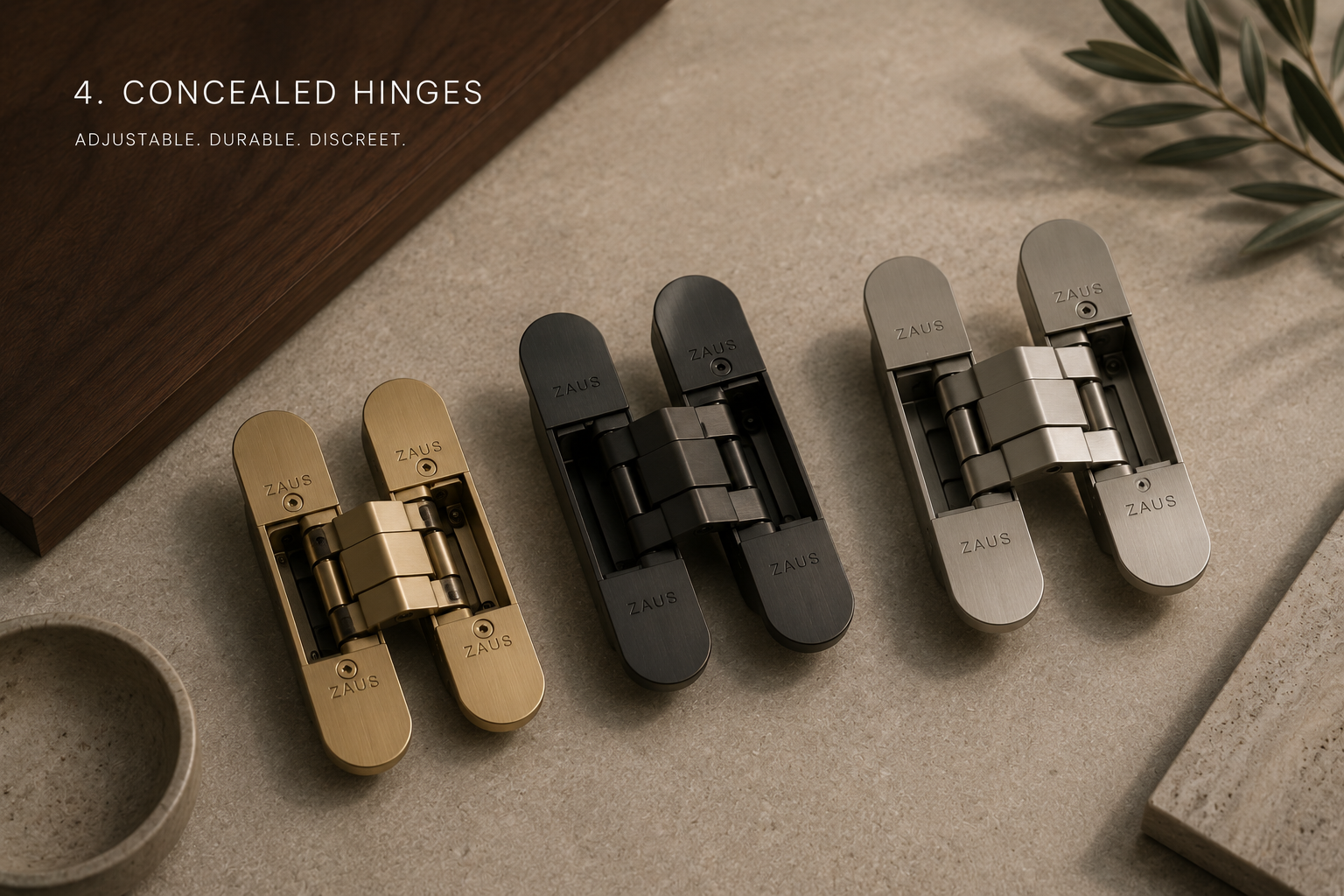
Concealed Hinges
Concealed hinges are recessed into the door and frame so the hinge mechanism is substantially hidden when the door is closed.
This creates a cleaner relationship between the door leaf and frame and can be particularly effective across contemporary architectural interiors.
Concealed hinges can be coordinated with selected ZAUS door systems where compatible with the door construction and frame configuration.
3D Adjustable Concealed Hinges
Selected concealed hinge systems provide multi-axis adjustment during installation.
This allows the position of the door leaf to be fine-tuned relative to the frame, assisting with consistent margins and alignment across the opening.
Adjustment capability and load capacity vary according to the selected hinge system and should be matched to the dimensions and weight of the door.
Hydraulic Hinges
Selected architectural hinge systems can incorporate hydraulic or controlled-closing functionality.
These mechanisms can provide more controlled door movement while maintaining a discreet hardware arrangement.
Final suitability depends on door dimensions, weight, frame construction, opening angle and required closing behaviour.
Heavy-Duty Hinges
Larger and heavier architectural doors can require higher-capacity hinge systems.
Heavy-duty hardware can be considered for:
Oversized doors
Thick door leaves
Solid or high-density door constructions
Large feature doors
Selected concealed-door systems
High-use openings
Hinge capacity should always be matched to the actual door specification rather than selected according to appearance alone.
Sliding Door Hardware
Touch™ can provide the operating hardware required for compatible architectural sliding-door systems.
Depending on the selected system, components can include:
Sliding tracks
Hanging wheels and rollers
Floor guides
Soft-close mechanisms
Flush pulls
Edge pulls
Sliding locks
Stops
Multi-panel hardware
Track and hardware selection depends on the panel dimensions, weight, movement and required opening configuration.
Pocket-Door Hardware
Pocket-door systems require dedicated hardware that allows the door leaf to retract into the wall cavity.
A coordinated system can incorporate:
Pocket-door tracks
Hanging hardware
Rollers
Floor guides
Soft-close mechanisms where supported
Flush and edge pulls
Compatible locking hardware
Door stops and operating components
The pocket structure, door dimensions, hardware and surrounding wall construction should be developed together before manufacture and installation.
Door Closers & Control Hardware
Selected openings can incorporate door-control hardware where controlled closing or movement is required.
Depending on the application and applicable hardware system, this can include:
Surface-mounted door closers
Concealed door closers
Controlled-closing mechanisms
Hydraulic hardware
Other compatible door-control components
Final selection should consider door weight, opening angle, required closing behaviour and project performance requirements.
Door Stops, Catches & Accessories
Smaller hardware components play an important role in the operation and protection of the complete door system.
Touch™ can coordinate selected:
Floor-mounted door stops
Wall-mounted door stops
Magnetic stops
Magnetic catches
Flush bolts
Door seals
Associated fixing hardware
These components can be scheduled alongside the primary handles, hinges and locks so the complete opening is considered together.
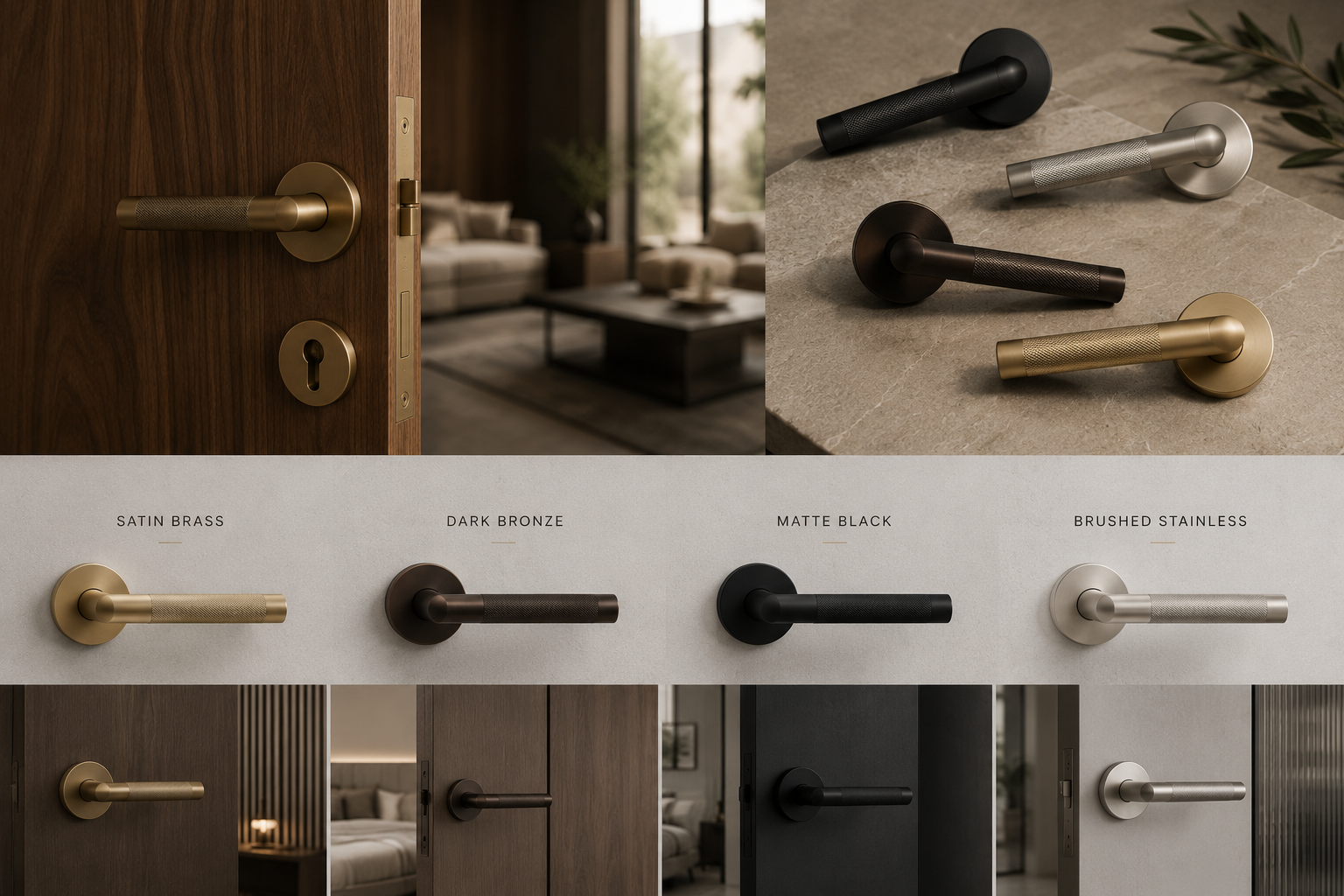
Architectural Finishes
Hardware finishes can be coordinated with the surrounding architectural material palette.
Depending on the selected component and applicable manufacturer collection, finish directions can include:
Matte black
Brushed stainless
Satin metallic
Brushed brass and warm metallic finishes
Dark bronze
Selected polished finishes
Project-specific finishes where supported
Exact finish names, colours and surface treatments remain tied to the applicable manufacturer range and physical samples rather than being treated as universal options across every Touch™ component.
Hardware Specification
Hardware should be selected against the actual door construction and operating requirements.
Specification can consider:
Door dimensions
Door thickness
Door weight
Door material
Frame construction
Opening direction
Opening method
Required security
Privacy requirements
Frequency of use
Sliding or pocket configuration
Architectural finish
This allows each opening to receive hardware appropriate to its function while maintaining a coordinated architectural language across the project.
Door System Coordination
Touch™ can be coordinated across the broader ZAUS architectural door collection.
Custom Entry Doors • Linear™ Precision Interior Doors • Atelier™ Collection Interior Doors • Eclipse™ Concealed Interior Doors • Glide™ Pocket & Sliding Door Systems • AquaShield™ Series Interior Doors • GlassLine™ Hinged Glass Doors • GlassLine™ Sliding Glass Doors • FrameLine™ Architectural Door Frames
Different hardware can therefore be specified for different door systems while remaining part of one coordinated project hardware schedule.
FrameLine™ Coordination
Touch™ hardware can be developed alongside FrameLine™ Architectural Door Frames so hinge preparation, locks, latches, striker locations and other hardware requirements are resolved with the frame before manufacture.
This is particularly important for concealed hinges, specialist locks and other systems requiring precise machining of both the door leaf and frame.
Eclipse™ Coordination
Eclipse™ Concealed Interior Doors can require specialist concealed hardware to maintain their flush architectural appearance.
Compatible concealed hinges, hydraulic hinges, locks, seals and minimalist operating hardware can be selected according to the dimensions, weight and construction of the Eclipse™ door.
Glide™ Coordination
Glide™ Pocket & Sliding Door Systems can be coordinated with Touch™ tracks, rollers, guides, soft-close mechanisms, pulls and compatible locks.
Considering these components together allows the door leaf, pocket or sliding arrangement and operating hardware to be developed as one system.
GlassLine™ Coordination
GlassLine™ Hinged and Sliding Glass Doors require hardware compatible with their aluminium-framed glazed construction.
Handles, hinges, sliding mechanisms, guides and locking components can be selected according to the applicable GlassLine™ profile and door configuration.
Final compatibility should be confirmed against the selected manufacturer-supported system before production.
Smart Access Coordination
Where intelligent access is required, compatible entry doors can be coordinated with the separate ZAUS Portal™ Smart Access collection.
Portal™ systems provide electronic and biometric access functionality, while Touch™ remains the architectural hardware collection for mechanical, functional and operating components across the broader door package.
Compatibility between the smart lock, door construction and required mechanical hardware should be confirmed during specification.
Whole-of-Project Hardware Coordination
Touch™ can be scheduled across an entire project rather than selecting hardware opening by opening during construction.
A coordinated hardware schedule can establish:
Handle families
Hardware finishes
Hinge types
Lock functions
Privacy requirements
Sliding hardware
Door-control requirements
Accessories
Compatibility with individual door systems
This can improve consistency while still allowing individual openings to receive hardware appropriate to their specific function.
Project Development & Coordination
ZAUS develops Touch™ hardware packages around the architectural drawings, project door schedule and selected door systems.
The process can incorporate:
Review Door Schedule • Identify Door Types • Confirm Dimensions & Weight • Determine Opening Functions • Select Handles & Pulls • Select Hinges • Determine Lock & Latch Functions • Coordinate Sliding & Pocket Hardware • Determine Door-Control Requirements • Coordinate Finishes • Confirm Door & Frame Preparation • Finalise Hardware Schedule • Manufacture & Supply • Coordinate Installation
Final hardware models, dimensions, capacities, finishes and compatibility are confirmed against the applicable manufacturer-supported systems before procurement and production.
Applications
Custom Homes • Luxury Residences • Apartments • Multi-Residential Developments • Architectural Renovations • Hospitality • Offices • Interior Fit-Outs • Boutique Developments • Builder & Developer Door Packages
Door. Frame. Hardware. One Coordinated Package.
ZAUS Touch™ Architectural Door Hardware completes the functional and tactile layer of the architectural door system.
Select the Door • Define the Function • Select the Hardware • Coordinate the Frame • Confirm the Finish • Resolve Door Preparation • Finalise the Hardware Schedule • Supply & Install
The result is a coordinated architectural hardware package developed around the performance, operation and design requirements of each individual opening.
Architectural door hardware coordinated around the complete door system.
ZAUS Touch™ Architectural Door Hardware brings together the functional, tactile and architectural components required to complete a coordinated door package.
Each hardware specification can be developed around the project door schedule and selected door system, allowing handles, hinges, locks, latches, sliding mechanisms, door controls and associated accessories to be selected according to the dimensions, weight, operation and intended application of each opening.
From understated lever handles and concealed hinges through to large-format pull handles, pocket-door mechanisms and specialist door-control hardware, Touch™ allows the hardware to be considered alongside the door and frame rather than selected as an isolated finishing item.
Complete Architectural Hardware System
Different door types place different requirements on their operating hardware.
Touch™ can coordinate components including:
Lever handles
Pull handles
Flush and recessed pulls
Hinges
Concealed hinges
Locks and latches
Sliding and pocket-door mechanisms
Door closers
Door stops and catches
Flush bolts
Door seals
Associated operating hardware
The final hardware combination is selected according to the construction and functional requirements of the individual door.
Lever Handles
Architectural lever handles provide the primary operating interface for conventional hinged doors.
Different profiles, proportions and finishes can be selected according to the architectural character of the project and the intended application of the opening.
Lever hardware can be coordinated across:
Internal doors
Bedroom doors
Bathroom and ensuite doors
Home offices
Living areas
Selected entry applications
Hospitality and commercial interiors
Handle selection should be considered together with the required latch, lock and door construction.
Pull Handles
Pull handles can provide either a restrained architectural detail or a more prominent feature depending on their scale and design.
They are particularly suited to:
Entry doors
Feature doors
Glass doors
Large-format doors
Selected sliding systems
Architectural openings
Longer-format pulls can establish stronger vertical lines across oversized doors, while smaller profiles can provide a more understated appearance.
Final handle dimensions, fixing requirements and compatibility should be coordinated with the selected door construction before manufacture.
Flush & Recessed Pulls
Flush and recessed pulls provide a low-profile operating solution where projecting hardware would interfere with the movement or appearance of the door.
Applications can include:
Pocket doors
Sliding doors
Concealed sliding systems
Selected wardrobe and dressing-room openings
Minimal architectural interiors
The pull depth and installation requirements should be coordinated with the door thickness and sliding configuration.
Locks & Latches
Mechanical locking and latching hardware can be selected according to the function and security requirements of each opening.
Depending on the applicable hardware collection, configurations can include:
Mortise locks
Passage latches
Privacy locks
Mechanical entry locks
Sliding-door locks
Flush bolts
Associated locking components
Bedrooms, bathrooms, general circulation doors, entry doors and other openings can therefore receive hardware appropriate to their individual use rather than applying one locking configuration throughout the project.
Smart and electronic access systems are coordinated separately through the ZAUS Portal™ Smart Access collection.
Standard Architectural Hinges
Conventional architectural hinges provide a reliable solution for standard hinged-door applications.
Hinge selection should consider:
Door dimensions
Door thickness
Door weight
Door construction
Opening direction
Required movement
Frequency of use
Environmental conditions
The quantity, dimensions and capacity of the hinges are determined according to the requirements of the individual door.
Concealed Hinges
Concealed hinges are recessed into the door and frame so the hinge mechanism is substantially hidden when the door is closed.
This creates a cleaner relationship between the door leaf and frame and can be particularly effective across contemporary architectural interiors.
Concealed hinges can be coordinated with selected ZAUS door systems where compatible with the door construction and frame configuration.
3D Adjustable Concealed Hinges
Selected concealed hinge systems provide multi-axis adjustment during installation.
This allows the position of the door leaf to be fine-tuned relative to the frame, assisting with consistent margins and alignment across the opening.
Adjustment capability and load capacity vary according to the selected hinge system and should be matched to the dimensions and weight of the door.
Hydraulic Hinges
Selected architectural hinge systems can incorporate hydraulic or controlled-closing functionality.
These mechanisms can provide more controlled door movement while maintaining a discreet hardware arrangement.
Final suitability depends on door dimensions, weight, frame construction, opening angle and required closing behaviour.
Heavy-Duty Hinges
Larger and heavier architectural doors can require higher-capacity hinge systems.
Heavy-duty hardware can be considered for:
Oversized doors
Thick door leaves
Solid or high-density door constructions
Large feature doors
Selected concealed-door systems
High-use openings
Hinge capacity should always be matched to the actual door specification rather than selected according to appearance alone.
Sliding Door Hardware
Touch™ can provide the operating hardware required for compatible architectural sliding-door systems.
Depending on the selected system, components can include:
Sliding tracks
Hanging wheels and rollers
Floor guides
Soft-close mechanisms
Flush pulls
Edge pulls
Sliding locks
Stops
Multi-panel hardware
Track and hardware selection depends on the panel dimensions, weight, movement and required opening configuration.
Pocket-Door Hardware
Pocket-door systems require dedicated hardware that allows the door leaf to retract into the wall cavity.
A coordinated system can incorporate:
Pocket-door tracks
Hanging hardware
Rollers
Floor guides
Soft-close mechanisms where supported
Flush and edge pulls
Compatible locking hardware
Door stops and operating components
The pocket structure, door dimensions, hardware and surrounding wall construction should be developed together before manufacture and installation.
Door Closers & Control Hardware
Selected openings can incorporate door-control hardware where controlled closing or movement is required.
Depending on the application and applicable hardware system, this can include:
Surface-mounted door closers
Concealed door closers
Controlled-closing mechanisms
Hydraulic hardware
Other compatible door-control components
Final selection should consider door weight, opening angle, required closing behaviour and project performance requirements.
Door Stops, Catches & Accessories
Smaller hardware components play an important role in the operation and protection of the complete door system.
Touch™ can coordinate selected:
Floor-mounted door stops
Wall-mounted door stops
Magnetic stops
Magnetic catches
Flush bolts
Door seals
Associated fixing hardware
These components can be scheduled alongside the primary handles, hinges and locks so the complete opening is considered together.
Architectural Finishes
Hardware finishes can be coordinated with the surrounding architectural material palette.
Depending on the selected component and applicable manufacturer collection, finish directions can include:
Matte black
Brushed stainless
Satin metallic
Brushed brass and warm metallic finishes
Dark bronze
Selected polished finishes
Project-specific finishes where supported
Exact finish names, colours and surface treatments remain tied to the applicable manufacturer range and physical samples rather than being treated as universal options across every Touch™ component.
Hardware Specification
Hardware should be selected against the actual door construction and operating requirements.
Specification can consider:
Door dimensions
Door thickness
Door weight
Door material
Frame construction
Opening direction
Opening method
Required security
Privacy requirements
Frequency of use
Sliding or pocket configuration
Architectural finish
This allows each opening to receive hardware appropriate to its function while maintaining a coordinated architectural language across the project.
Door System Coordination
Touch™ can be coordinated across the broader ZAUS architectural door collection.
Custom Entry Doors • Linear™ Precision Interior Doors • Atelier™ Collection Interior Doors • Eclipse™ Concealed Interior Doors • Glide™ Pocket & Sliding Door Systems • AquaShield™ Series Interior Doors • GlassLine™ Hinged Glass Doors • GlassLine™ Sliding Glass Doors • FrameLine™ Architectural Door Frames
Different hardware can therefore be specified for different door systems while remaining part of one coordinated project hardware schedule.
FrameLine™ Coordination
Touch™ hardware can be developed alongside FrameLine™ Architectural Door Frames so hinge preparation, locks, latches, striker locations and other hardware requirements are resolved with the frame before manufacture.
This is particularly important for concealed hinges, specialist locks and other systems requiring precise machining of both the door leaf and frame.
Eclipse™ Coordination
Eclipse™ Concealed Interior Doors can require specialist concealed hardware to maintain their flush architectural appearance.
Compatible concealed hinges, hydraulic hinges, locks, seals and minimalist operating hardware can be selected according to the dimensions, weight and construction of the Eclipse™ door.
Glide™ Coordination
Glide™ Pocket & Sliding Door Systems can be coordinated with Touch™ tracks, rollers, guides, soft-close mechanisms, pulls and compatible locks.
Considering these components together allows the door leaf, pocket or sliding arrangement and operating hardware to be developed as one system.
GlassLine™ Coordination
GlassLine™ Hinged and Sliding Glass Doors require hardware compatible with their aluminium-framed glazed construction.
Handles, hinges, sliding mechanisms, guides and locking components can be selected according to the applicable GlassLine™ profile and door configuration.
Final compatibility should be confirmed against the selected manufacturer-supported system before production.
Smart Access Coordination
Where intelligent access is required, compatible entry doors can be coordinated with the separate ZAUS Portal™ Smart Access collection.
Portal™ systems provide electronic and biometric access functionality, while Touch™ remains the architectural hardware collection for mechanical, functional and operating components across the broader door package.
Compatibility between the smart lock, door construction and required mechanical hardware should be confirmed during specification.
Whole-of-Project Hardware Coordination
Touch™ can be scheduled across an entire project rather than selecting hardware opening by opening during construction.
A coordinated hardware schedule can establish:
Handle families
Hardware finishes
Hinge types
Lock functions
Privacy requirements
Sliding hardware
Door-control requirements
Accessories
Compatibility with individual door systems
This can improve consistency while still allowing individual openings to receive hardware appropriate to their specific function.
Project Development & Coordination
ZAUS develops Touch™ hardware packages around the architectural drawings, project door schedule and selected door systems.
The process can incorporate:
Review Door Schedule • Identify Door Types • Confirm Dimensions & Weight • Determine Opening Functions • Select Handles & Pulls • Select Hinges • Determine Lock & Latch Functions • Coordinate Sliding & Pocket Hardware • Determine Door-Control Requirements • Coordinate Finishes • Confirm Door & Frame Preparation • Finalise Hardware Schedule • Manufacture & Supply • Coordinate Installation
Final hardware models, dimensions, capacities, finishes and compatibility are confirmed against the applicable manufacturer-supported systems before procurement and production.
Applications
Custom Homes • Luxury Residences • Apartments • Multi-Residential Developments • Architectural Renovations • Hospitality • Offices • Interior Fit-Outs • Boutique Developments • Builder & Developer Door Packages
Door. Frame. Hardware. One Coordinated Package.
ZAUS Touch™ Architectural Door Hardware completes the functional and tactile layer of the architectural door system.
Select the Door • Define the Function • Select the Hardware • Coordinate the Frame • Confirm the Finish • Resolve Door Preparation • Finalise the Hardware Schedule • Supply & Install
The result is a coordinated architectural hardware package developed around the performance, operation and design requirements of each individual opening.