
Professional Timber Sports Flooring System
High-performance timber sports flooring systems engineered for professional competition and multi-purpose indoor sporting environments.
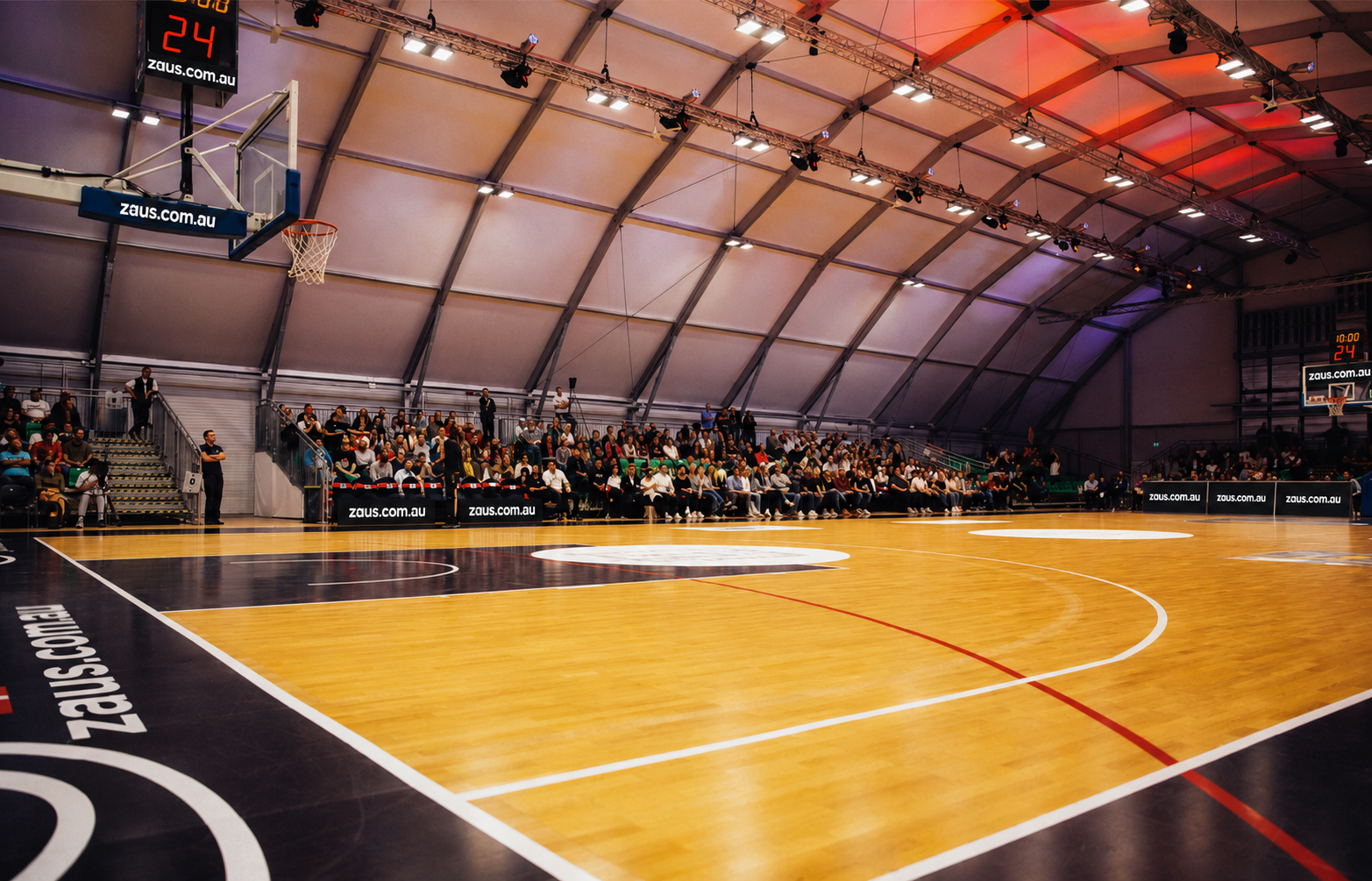
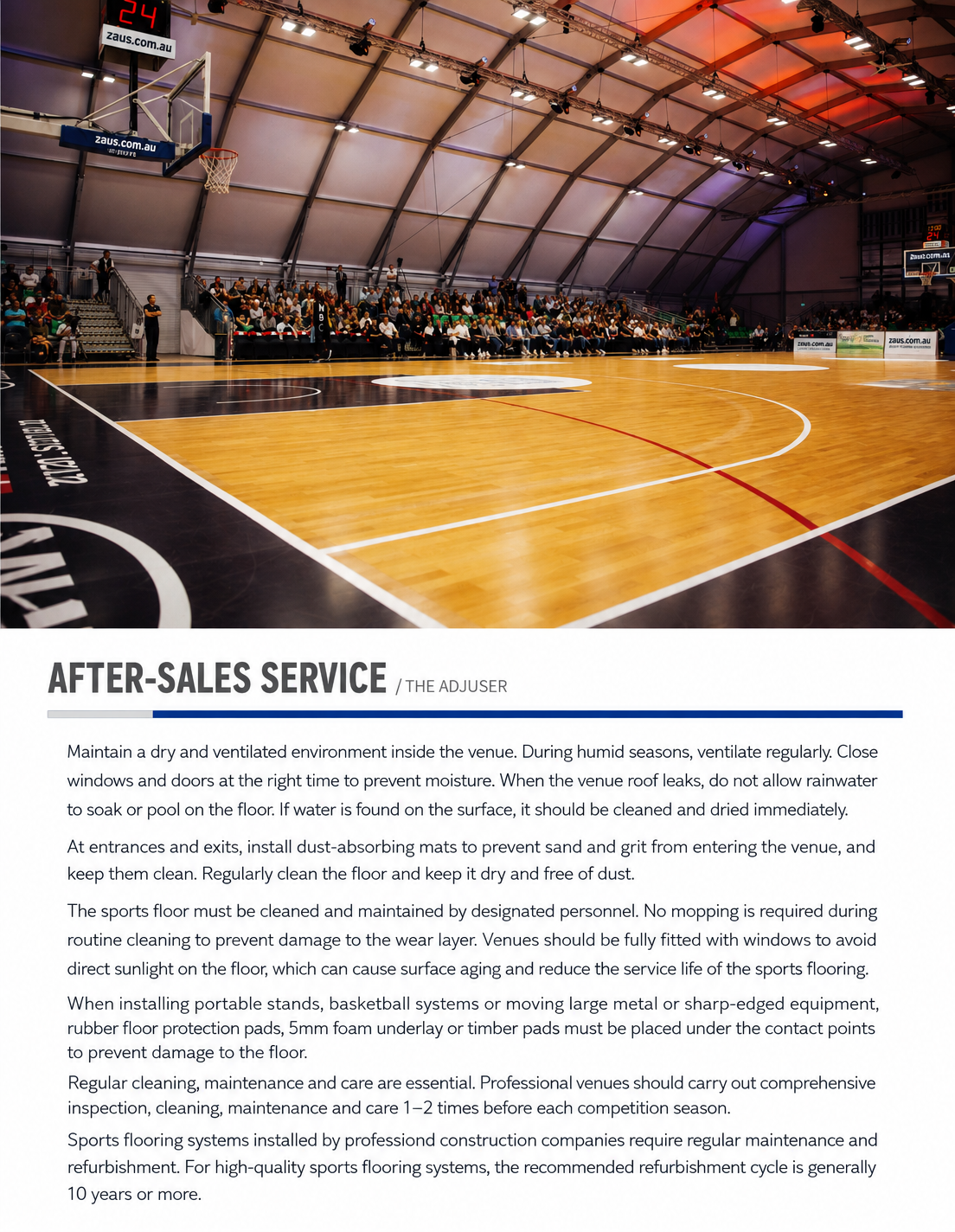
ZAUS Professional Sports Flooring provides engineered timber court systems developed around the performance requirements of basketball, volleyball, badminton and other indoor sports.
Each flooring system combines a selected solid timber playing surface with an engineered subfloor structure designed to provide controlled shock absorption, vertical deformation, ball rebound, surface friction and structural stability.
From professional competition venues and dedicated basketball courts through to schools, universities, training facilities and multi-purpose sports centres, the system can be configured according to the sport, required performance level, venue design and project budget.
Sports Timber Surfaces
The playing surface forms the visible and functional upper layer of the sports flooring system.
Available manufacturer-supported timber directions include:
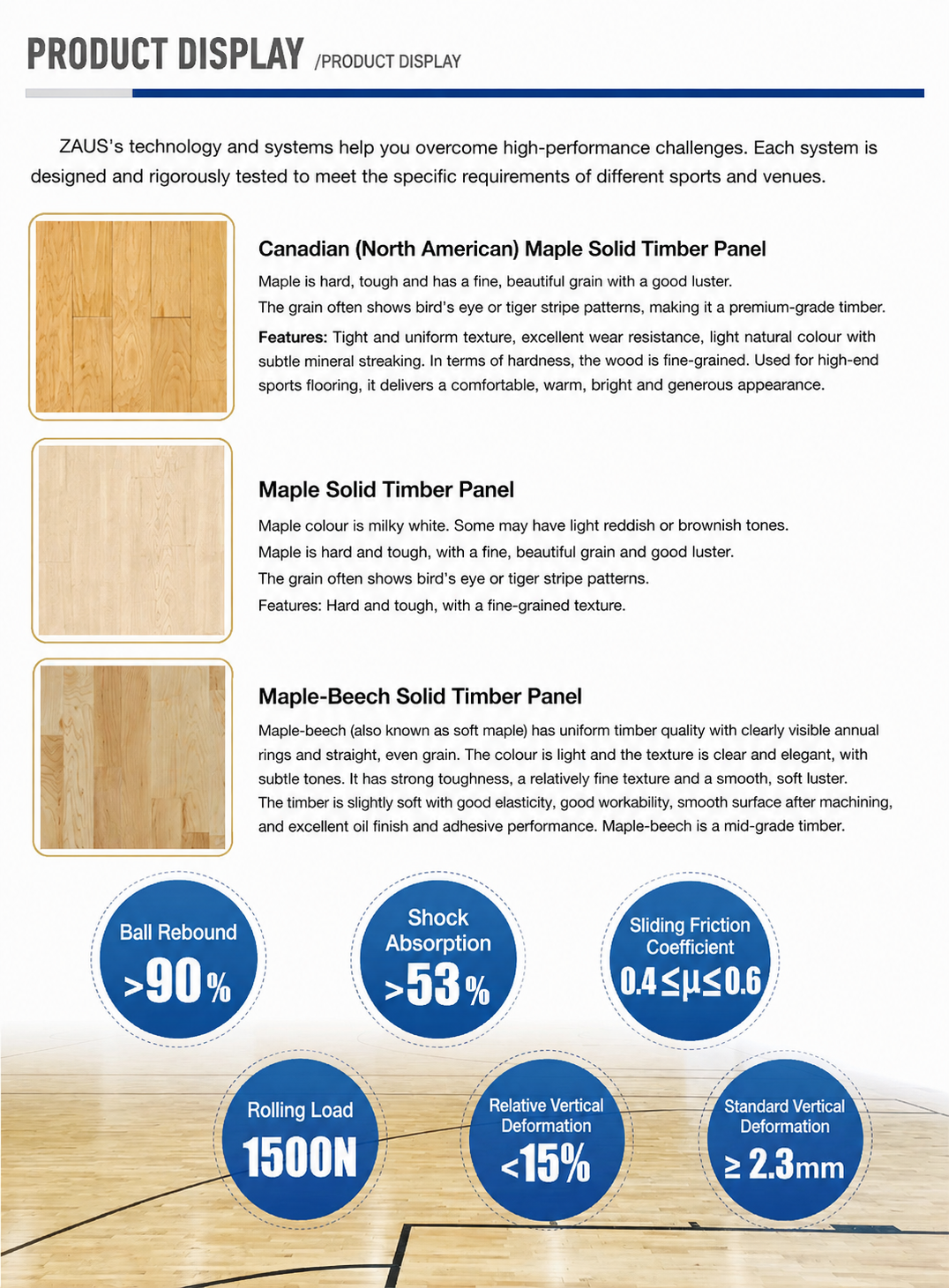
Canadian / North American Maple
Maple
Maple-Birch
Solid timber sports flooring panels
Sports-specific factory-finished surfaces
These timbers are selected for characteristics including strength, fine grain, dimensional stability, resilience and suitability for intensive indoor sporting environments.
Final timber species, grade, board construction, dimensions and surface finish should be confirmed against the selected manufacturer-supported system before specification.
Engineered Sports Flooring Construction
Professional sports flooring operates as a complete structural system rather than simply a timber finish installed over a conventional subfloor.
Depending on the selected configuration, the system can incorporate:
Solid timber playing surface
Sports-specific UV-finished surface
Load-distribution layers
Timber joist structure
Rubber shock-absorption pads
Moisture isolation layer
Supporting structural components
Project-specific subfloor preparation
Each layer contributes to the performance, stability and durability of the completed playing surface.
Single-Joist System
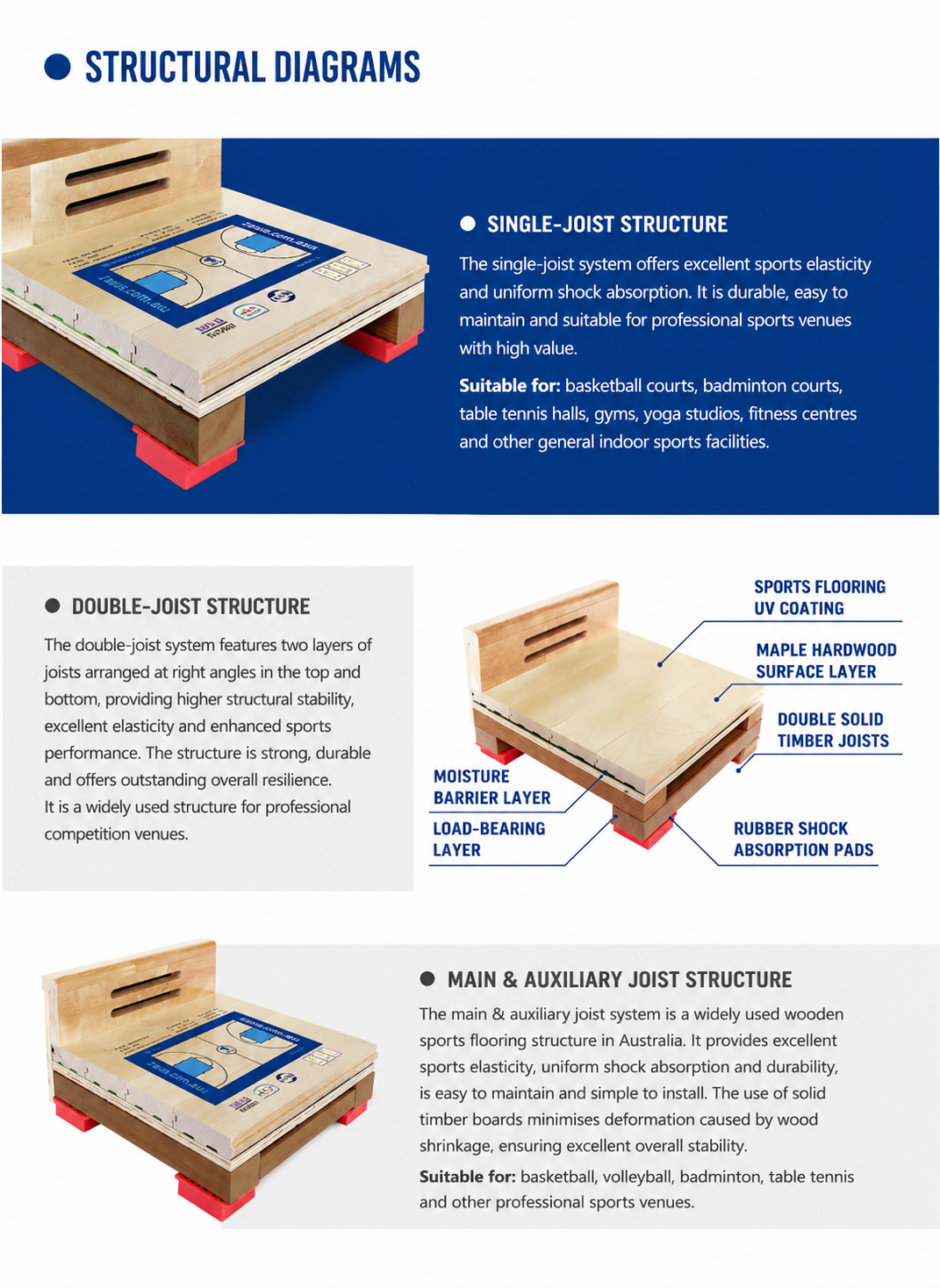
The Single-Joist System provides a practical engineered sports flooring structure for facilities requiring resilience, uniform support and reliable everyday performance.
A single supporting joist structure works with the timber playing surface and resilient components to create a sprung flooring system suitable for a broad range of indoor sporting environments.
Applications can include:
Basketball courts
Badminton courts
Table tennis facilities
Gymnasiums
Training facilities
Activity centres
Multi-purpose sports spaces
The system can provide a cost-effective solution where professional sports-floor construction is required without the additional structural complexity of a double-joist system.
Double-Joist System
The Double-Joist System provides a higher-performance structural configuration using two perpendicular layers of timber joists beneath the playing surface.
The additional structural layer is designed to improve stability, load distribution, elasticity and overall sporting performance.
Depending on the selected manufacturer-supported configuration, the system can incorporate:
Solid Maple or Maple-Birch playing surface
Sports-specific UV finish
Double-layer solid timber joist structure
Load-bearing layer
Moisture isolation layer
Rubber shock-absorption pads
This configuration is particularly suited to professional sporting facilities and competition environments requiring a higher-performance timber court system.
Main & Auxiliary Joist System
The Main & Auxiliary Joist System uses a coordinated primary and secondary support structure to provide a stable and resilient sports floor.
The configuration is designed to improve structural stability while controlling movement and deformation within the supporting timber system.
Applications can include:
Professional basketball courts
Volleyball courts
Badminton courts
Table tennis facilities
Training venues
Indoor sports centres
Final structural configuration is selected according to the required sporting performance and project conditions.
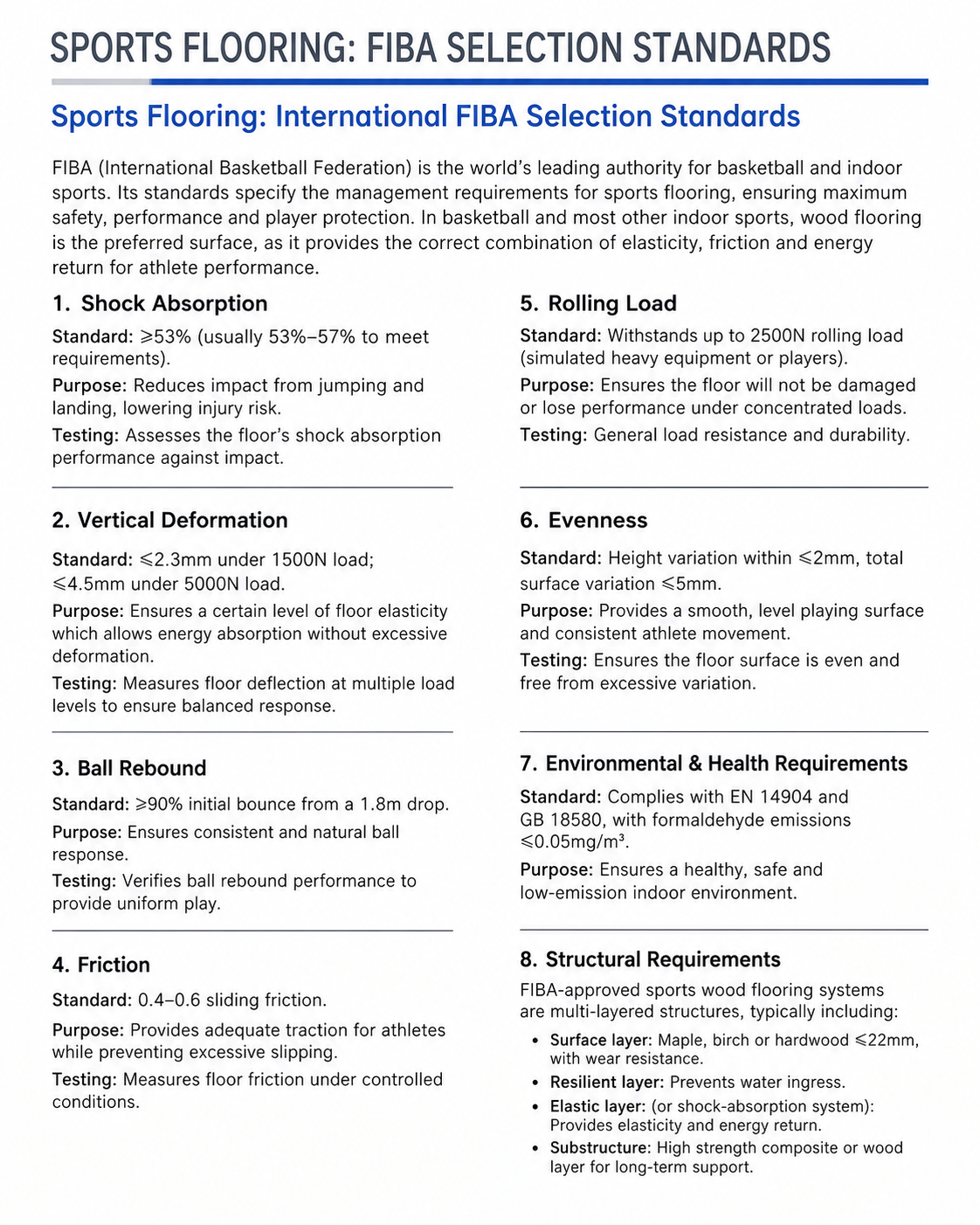
Shock Absorption
Shock absorption describes the ability of the flooring system to reduce the impact transmitted back through an athlete's body during running, jumping and landing.
Selected systems within the documented range indicate shock-absorption performance above 53%.
Actual performance depends on the complete tested flooring configuration rather than the timber surface alone and should therefore be confirmed against the selected system.
Vertical Deformation
A professional sports floor must provide controlled movement under athletic load.
The supporting structure and resilient components are engineered to allow the floor to deform within the intended performance range, providing resilience without creating an excessively soft or unstable playing surface.
Vertical deformation requirements should be assessed against the selected flooring system and intended sporting application.
Ball Rebound
Consistent ball behaviour is particularly important for basketball and other ball sports.
Selected systems within the range indicate ball-rebound performance above 90%, supporting predictable response across the playing surface.
Final ball-rebound performance should be confirmed against the applicable tested system and project specification.
Surface Friction
Surface friction influences traction during acceleration, stopping, turning and rapid directional changes.
Selected systems within the range indicate a sliding friction coefficient of 0.4–0.6.
The surface finish is designed to balance player grip and movement while maintaining the characteristics required of an indoor sporting surface.
Rolling Load Resistance
Sports floors can be exposed to loads extending beyond normal athlete movement.
These can include:
Portable basketball systems
Sporting equipment
Seating and venue equipment
Cleaning equipment
Maintenance equipment
Other concentrated rolling loads
The complete flooring construction should therefore be selected with consideration for both athletic performance and the operational requirements of the venue.
Floor Evenness
A consistent and level playing surface is fundamental to professional sporting performance.
The finished floor depends on correct preparation and installation of the supporting structure, resilient components and timber playing surface.
Subfloor condition, levels and installation tolerances should therefore be reviewed as part of the project before installation begins.
FIBA-Approved Systems
Selected timber sports flooring systems within the available range have FIBA Approved Equipment certification for wooden flooring.
FIBA approval applies to specific tested products and system configurations rather than automatically applying to every ZAUS sports flooring option.
Where FIBA certification is required for a project, the exact flooring model, construction system and current certification should be confirmed during specification before procurement.
Competition Basketball Courts
For professional basketball environments, flooring selection should consider the complete relationship between the playing surface and supporting structure.
Project requirements can include:
Ball rebound
Shock absorption
Vertical deformation
Surface friction
Rolling-load resistance
Floor evenness
Court marking requirements
Sporting equipment integration
Applicable competition standards
Where a FIBA-approved system is required, ZAUS can coordinate the appropriate certified configuration against the project requirements.
Multi-Sport Facilities
Not every indoor sporting venue requires the same flooring specification.
Multi-purpose facilities can require a balance between sporting performance, durability, maintenance and flexibility across different activities.
Systems can be configured for facilities accommodating combinations of:
Basketball
Volleyball
Badminton
Table tennis
Training
Physical education
Recreational sport
General indoor activities
The flooring structure and timber surface can therefore be selected according to the actual use and performance requirements of the facility.
Schools & Universities
Educational sporting facilities often require flooring capable of supporting regular use across multiple activities.
A project-specific system can consider:
Sporting requirements
Daily usage
Durability
Maintenance
Equipment movement
Multi-purpose operation
Project budget
Single-joist and other suitable configurations can provide practical solutions where professional sports-floor construction is required without specifying a competition-level system unnecessarily.
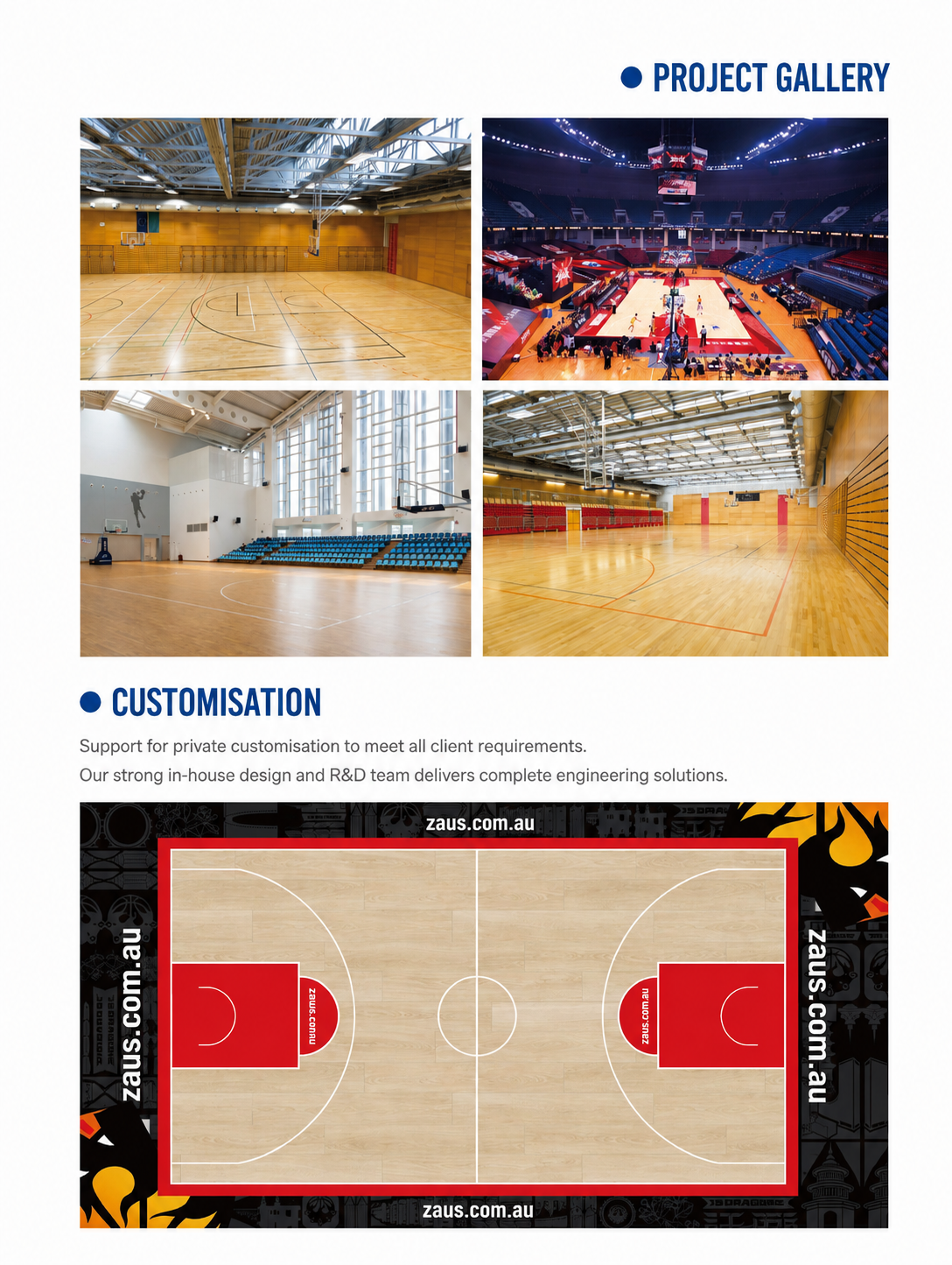
Surface Finish & Court Markings
The timber playing surface can be coordinated with the finishing requirements of the selected sports flooring system.
Depending on the applicable manufacturer-supported system and project requirements, this can include:
Sports-specific UV finishes
Protective surface coatings
Court markings
Multi-sport line marking
Project-specific court layouts
Final coating and marking requirements should be coordinated with the selected timber surface and sporting application before installation.
Subfloor & Moisture Coordination
The performance of a timber sports floor depends on the condition of the supporting substrate and surrounding environment.
Project coordination should consider:
Existing substrate
Finished floor levels
Moisture conditions
Moisture isolation requirements
Structural loads
Floor penetrations
Sporting equipment
Perimeter conditions
Environmental conditions
These requirements should be reviewed before the flooring system is manufactured and installed.
System Selection
The appropriate ZAUS sports flooring system is selected according to the requirements of the individual venue rather than applying one construction to every project.
Selection can consider:
Primary sport
Competition level
Multi-sport requirements
Required performance characteristics
Venue type
Timber preference
Structural requirements
Available floor build-up
Certification requirements
Project budget
This allows the flooring specification to be aligned with the actual operational and sporting requirements of the facility.
Project Development & Coordination
ZAUS develops Professional Sports Flooring packages around the venue design, sporting application and required performance level.
The process can incorporate:
Review Venue Requirements • Identify Sporting Applications • Confirm Performance Requirements • Review Certification Requirements • Select Timber Surface • Select Structural System • Review Subfloor Conditions • Coordinate Floor Build-Up • Confirm Court Layout • Coordinate Sporting Equipment • Finalise Flooring Specification • Manufacture • Deliver • Coordinate Installation
Final timber species, construction system, dimensions, performance characteristics and certification requirements are confirmed against the applicable manufacturer-supported system before procurement and installation.
Applications
Basketball Courts • Volleyball Courts • Badminton Courts • Table Tennis Facilities • Professional Competition Venues • Indoor Sports Centres • Gymnasiums • Training Facilities • Schools • Universities • Recreation Centres • Multi-Purpose Sporting Facilities
Performance. Resilience. Competition-Ready Engineering.
ZAUS Professional Sports Flooring combines selected timber playing surfaces with engineered structural systems designed around the performance requirements of indoor sport.
Define the Sport • Establish Performance Requirements • Select the Timber Surface • Select the Structural System • Confirm Certification Where Required • Coordinate the Subfloor • Manufacture & Install
The result is a project-specific timber sports flooring system developed around athletic performance, durability, player comfort and the operational requirements of the venue.
High-performance timber sports flooring systems engineered for professional competition and multi-purpose indoor sporting environments.
ZAUS Professional Sports Flooring provides engineered timber court systems developed around the performance requirements of basketball, volleyball, badminton and other indoor sports.
Each flooring system combines a selected solid timber playing surface with an engineered subfloor structure designed to provide controlled shock absorption, vertical deformation, ball rebound, surface friction and structural stability.
From professional competition venues and dedicated basketball courts through to schools, universities, training facilities and multi-purpose sports centres, the system can be configured according to the sport, required performance level, venue design and project budget.
Sports Timber Surfaces
The playing surface forms the visible and functional upper layer of the sports flooring system.
Available manufacturer-supported timber directions include:
Canadian / North American Maple
Maple
Maple-Birch
Solid timber sports flooring panels
Sports-specific factory-finished surfaces
These timbers are selected for characteristics including strength, fine grain, dimensional stability, resilience and suitability for intensive indoor sporting environments.
Final timber species, grade, board construction, dimensions and surface finish should be confirmed against the selected manufacturer-supported system before specification.
Engineered Sports Flooring Construction
Professional sports flooring operates as a complete structural system rather than simply a timber finish installed over a conventional subfloor.
Depending on the selected configuration, the system can incorporate:
Solid timber playing surface
Sports-specific UV-finished surface
Load-distribution layers
Timber joist structure
Rubber shock-absorption pads
Moisture isolation layer
Supporting structural components
Project-specific subfloor preparation
Each layer contributes to the performance, stability and durability of the completed playing surface.
Single-Joist System
The Single-Joist System provides a practical engineered sports flooring structure for facilities requiring resilience, uniform support and reliable everyday performance.
A single supporting joist structure works with the timber playing surface and resilient components to create a sprung flooring system suitable for a broad range of indoor sporting environments.
Applications can include:
Basketball courts
Badminton courts
Table tennis facilities
Gymnasiums
Training facilities
Activity centres
Multi-purpose sports spaces
The system can provide a cost-effective solution where professional sports-floor construction is required without the additional structural complexity of a double-joist system.
Double-Joist System
The Double-Joist System provides a higher-performance structural configuration using two perpendicular layers of timber joists beneath the playing surface.
The additional structural layer is designed to improve stability, load distribution, elasticity and overall sporting performance.
Depending on the selected manufacturer-supported configuration, the system can incorporate:
Solid Maple or Maple-Birch playing surface
Sports-specific UV finish
Double-layer solid timber joist structure
Load-bearing layer
Moisture isolation layer
Rubber shock-absorption pads
This configuration is particularly suited to professional sporting facilities and competition environments requiring a higher-performance timber court system.
Main & Auxiliary Joist System
The Main & Auxiliary Joist System uses a coordinated primary and secondary support structure to provide a stable and resilient sports floor.
The configuration is designed to improve structural stability while controlling movement and deformation within the supporting timber system.
Applications can include:
Professional basketball courts
Volleyball courts
Badminton courts
Table tennis facilities
Training venues
Indoor sports centres
Final structural configuration is selected according to the required sporting performance and project conditions.
Shock Absorption
Shock absorption describes the ability of the flooring system to reduce the impact transmitted back through an athlete's body during running, jumping and landing.
Selected systems within the documented range indicate shock-absorption performance above 53%.
Actual performance depends on the complete tested flooring configuration rather than the timber surface alone and should therefore be confirmed against the selected system.
Vertical Deformation
A professional sports floor must provide controlled movement under athletic load.
The supporting structure and resilient components are engineered to allow the floor to deform within the intended performance range, providing resilience without creating an excessively soft or unstable playing surface.
Vertical deformation requirements should be assessed against the selected flooring system and intended sporting application.
Ball Rebound
Consistent ball behaviour is particularly important for basketball and other ball sports.
Selected systems within the range indicate ball-rebound performance above 90%, supporting predictable response across the playing surface.
Final ball-rebound performance should be confirmed against the applicable tested system and project specification.
Surface Friction
Surface friction influences traction during acceleration, stopping, turning and rapid directional changes.
Selected systems within the range indicate a sliding friction coefficient of 0.4–0.6.
The surface finish is designed to balance player grip and movement while maintaining the characteristics required of an indoor sporting surface.
Rolling Load Resistance
Sports floors can be exposed to loads extending beyond normal athlete movement.
These can include:
Portable basketball systems
Sporting equipment
Seating and venue equipment
Cleaning equipment
Maintenance equipment
Other concentrated rolling loads
The complete flooring construction should therefore be selected with consideration for both athletic performance and the operational requirements of the venue.
Floor Evenness
A consistent and level playing surface is fundamental to professional sporting performance.
The finished floor depends on correct preparation and installation of the supporting structure, resilient components and timber playing surface.
Subfloor condition, levels and installation tolerances should therefore be reviewed as part of the project before installation begins.
FIBA-Approved Systems
Selected timber sports flooring systems within the available range have FIBA Approved Equipment certification for wooden flooring.
FIBA approval applies to specific tested products and system configurations rather than automatically applying to every ZAUS sports flooring option.
Where FIBA certification is required for a project, the exact flooring model, construction system and current certification should be confirmed during specification before procurement.
Competition Basketball Courts
For professional basketball environments, flooring selection should consider the complete relationship between the playing surface and supporting structure.
Project requirements can include:
Ball rebound
Shock absorption
Vertical deformation
Surface friction
Rolling-load resistance
Floor evenness
Court marking requirements
Sporting equipment integration
Applicable competition standards
Where a FIBA-approved system is required, ZAUS can coordinate the appropriate certified configuration against the project requirements.
Multi-Sport Facilities
Not every indoor sporting venue requires the same flooring specification.
Multi-purpose facilities can require a balance between sporting performance, durability, maintenance and flexibility across different activities.
Systems can be configured for facilities accommodating combinations of:
Basketball
Volleyball
Badminton
Table tennis
Training
Physical education
Recreational sport
General indoor activities
The flooring structure and timber surface can therefore be selected according to the actual use and performance requirements of the facility.
Schools & Universities
Educational sporting facilities often require flooring capable of supporting regular use across multiple activities.
A project-specific system can consider:
Sporting requirements
Daily usage
Durability
Maintenance
Equipment movement
Multi-purpose operation
Project budget
Single-joist and other suitable configurations can provide practical solutions where professional sports-floor construction is required without specifying a competition-level system unnecessarily.
Surface Finish & Court Markings
The timber playing surface can be coordinated with the finishing requirements of the selected sports flooring system.
Depending on the applicable manufacturer-supported system and project requirements, this can include:
Sports-specific UV finishes
Protective surface coatings
Court markings
Multi-sport line marking
Project-specific court layouts
Final coating and marking requirements should be coordinated with the selected timber surface and sporting application before installation.
Subfloor & Moisture Coordination
The performance of a timber sports floor depends on the condition of the supporting substrate and surrounding environment.
Project coordination should consider:
Existing substrate
Finished floor levels
Moisture conditions
Moisture isolation requirements
Structural loads
Floor penetrations
Sporting equipment
Perimeter conditions
Environmental conditions
These requirements should be reviewed before the flooring system is manufactured and installed.
System Selection
The appropriate ZAUS sports flooring system is selected according to the requirements of the individual venue rather than applying one construction to every project.
Selection can consider:
Primary sport
Competition level
Multi-sport requirements
Required performance characteristics
Venue type
Timber preference
Structural requirements
Available floor build-up
Certification requirements
Project budget
This allows the flooring specification to be aligned with the actual operational and sporting requirements of the facility.
Project Development & Coordination
ZAUS develops Professional Sports Flooring packages around the venue design, sporting application and required performance level.
The process can incorporate:
Review Venue Requirements • Identify Sporting Applications • Confirm Performance Requirements • Review Certification Requirements • Select Timber Surface • Select Structural System • Review Subfloor Conditions • Coordinate Floor Build-Up • Confirm Court Layout • Coordinate Sporting Equipment • Finalise Flooring Specification • Manufacture • Deliver • Coordinate Installation
Final timber species, construction system, dimensions, performance characteristics and certification requirements are confirmed against the applicable manufacturer-supported system before procurement and installation.
Applications
Basketball Courts • Volleyball Courts • Badminton Courts • Table Tennis Facilities • Professional Competition Venues • Indoor Sports Centres • Gymnasiums • Training Facilities • Schools • Universities • Recreation Centres • Multi-Purpose Sporting Facilities
Performance. Resilience. Competition-Ready Engineering.
ZAUS Professional Sports Flooring combines selected timber playing surfaces with engineered structural systems designed around the performance requirements of indoor sport.
Define the Sport • Establish Performance Requirements • Select the Timber Surface • Select the Structural System • Confirm Certification Where Required • Coordinate the Subfloor • Manufacture & Install
The result is a project-specific timber sports flooring system developed around athletic performance, durability, player comfort and the operational requirements of the venue.