Precision Joinery Hardware & Architectural Cabinet Mechanisms
Precision joinery hardware, engineered for smooth movement, reliable performance and architectural integration.
ZAUS Premium Joinery Hardware brings together the functional hardware and specialised movement systems required across bespoke kitchens, wardrobes, bathroom vanities and custom residential joinery.
Each hardware package can be developed alongside the cabinetry itself, allowing hinges, drawer runners, opening mechanisms, pocket systems, lift systems and specialised architectural hardware to be selected according to the cabinet construction, door dimensions, front material, loading requirements and intended movement.
From concealed soft-close hinges and precision drawer runners through to retractable kitchens, pocket doors and space-transforming cabinetry, hardware is coordinated as an integral part of the joinery rather than treated as a collection of components selected after manufacture.
Cabinet Hinges
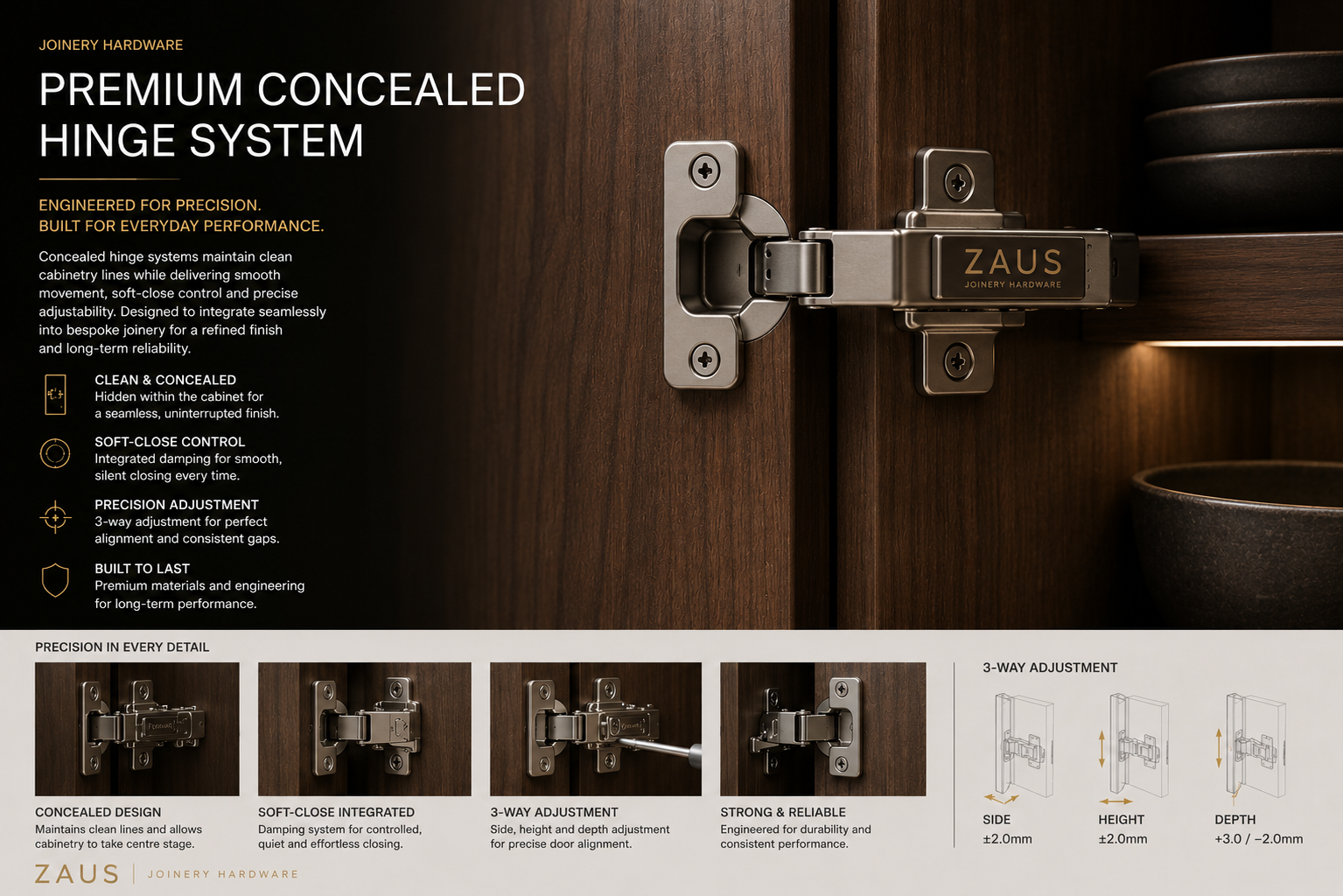
Concealed hinge systems allow cabinet doors to operate while maintaining clean external cabinetry lines.
Depending on the cabinetry design and selected manufacturer-supported system, configurations can include:
Concealed cabinet hinges
Soft-close hinge systems
Push-to-open applications
Wide-angle hinges
Specialised opening-angle hinges
Adjustable hinge systems
Hinges for different cabinet configurations
Compatible hardware for selected glass and aluminium-framed fronts
Final hinge selection is determined by the cabinet construction, door dimensions, front material, front weight, required opening angle and intended application.
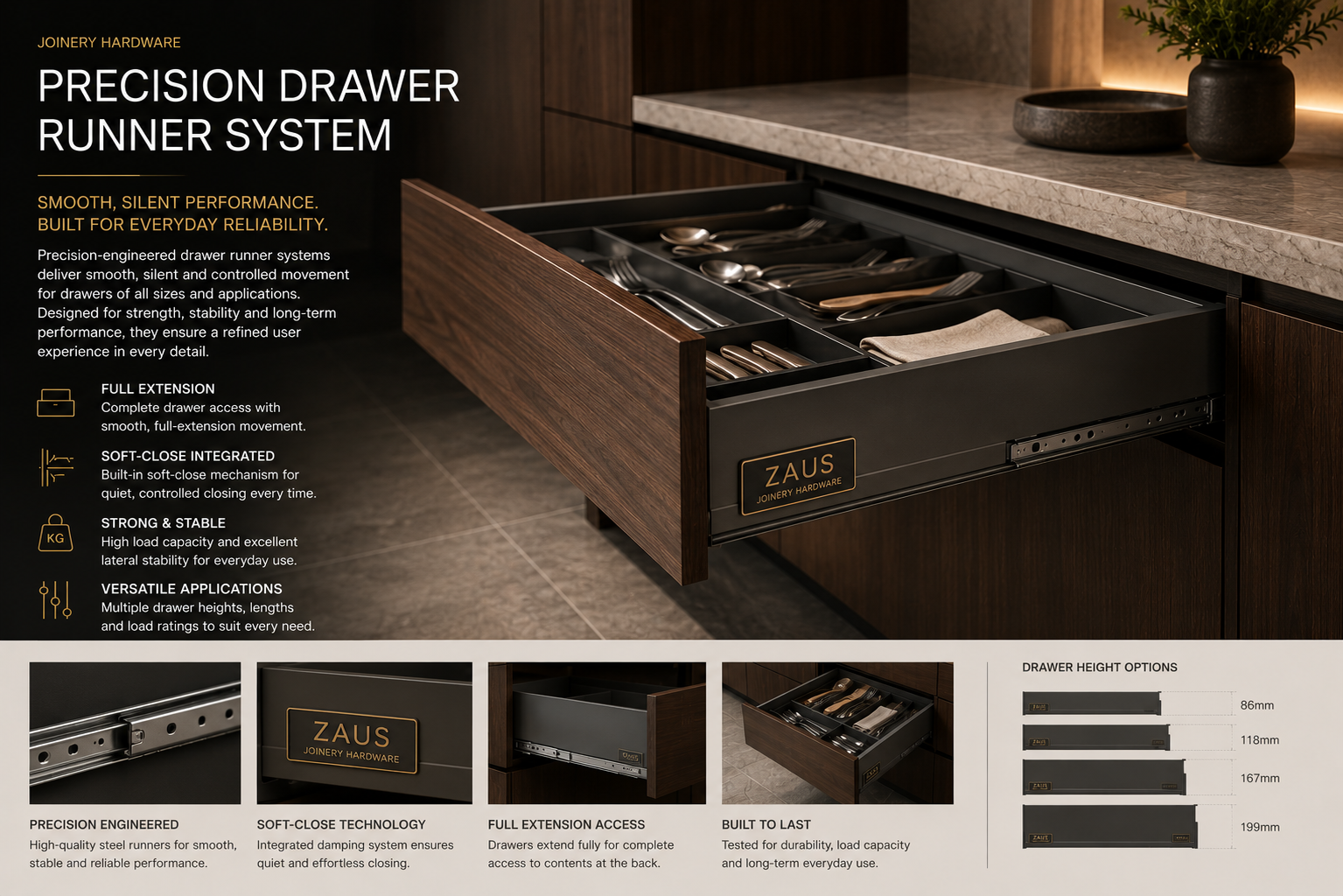
Drawer Runners & Drawer Systems
Drawer hardware can be selected according to the dimensions, loading and intended function of each drawer.
Manufacturer-supported solutions can include:
Concealed drawer runners
Full-extension runner systems
Soft-close mechanisms
Push-to-open systems
Drawer-box systems
Internal and nested drawers
Heavy-duty configurations where supported
Compatible internal organisation accessories
This allows different areas of the same joinery package to use hardware appropriate to their individual performance requirements.
Kitchen cookware drawers, wardrobe accessory drawers, bathroom vanity storage and lighter internal drawers do not necessarily require the same hardware configuration.
Soft-Close & Push-to-Open Systems
Soft-close and push-to-open mechanisms can be incorporated according to the intended cabinetry design and opening method.
Soft-close systems provide controlled closing movement for doors and drawers, while push-to-open systems allow selected cabinetry to operate without conventional external handles.
Depending on the application, these systems can support:
Handleless cabinetry
Concealed storage
Minimal cabinet elevations
Kitchen cabinetry
Wardrobe cabinetry
Bathroom vanities
Entertainment units
Residential built-ins
The appropriate mechanism is selected according to the door or drawer configuration and compatible manufacturer-supported hardware system.
Architectural Cabinet Mechanisms
Specialised architectural hardware can allow sections of cabinetry to lift, fold, slide, retract, pivot or otherwise transform according to how the space is being used.
Depending on the application and selected manufacturer-supported system, configurations can include:
Pocket and retractable door systems
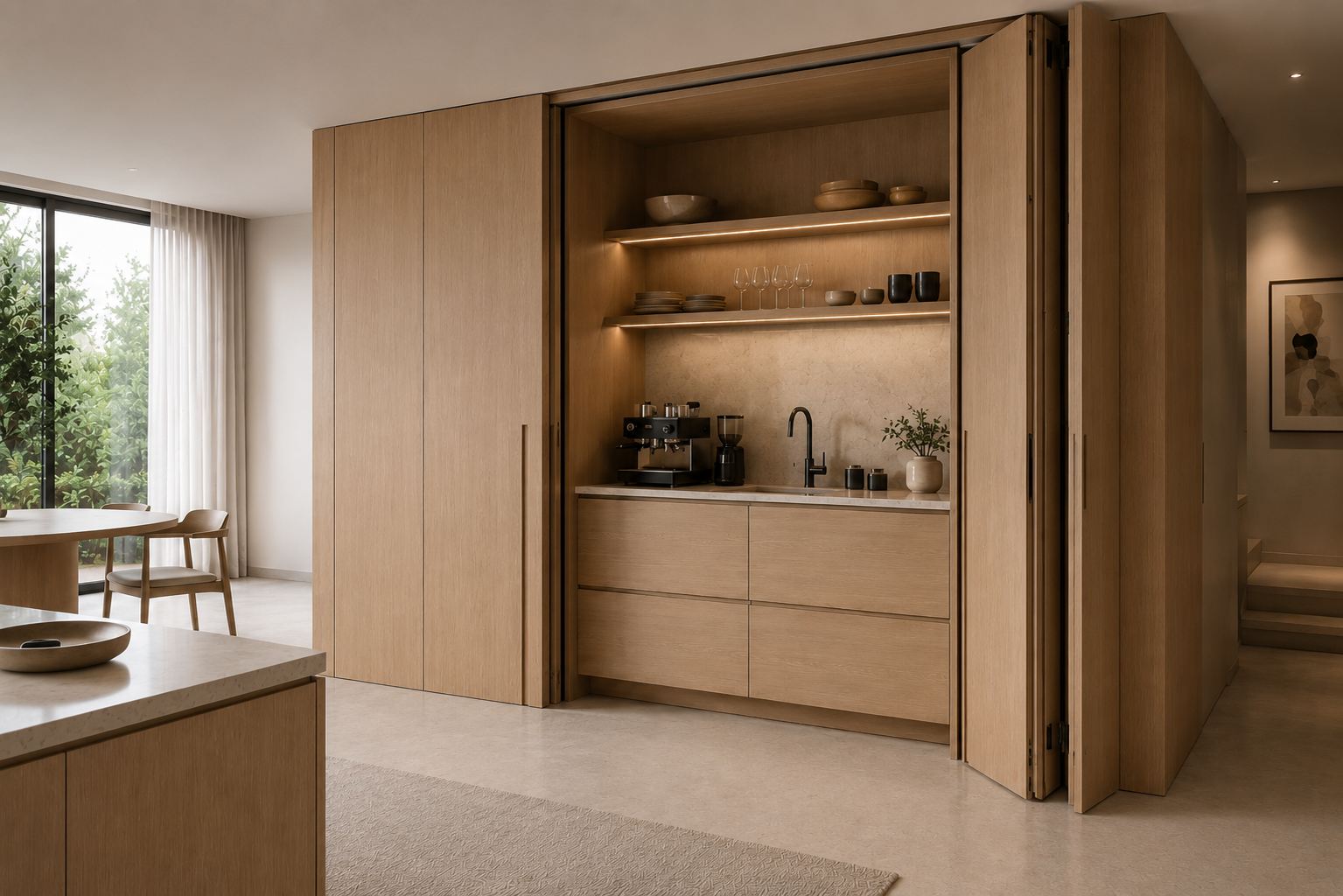
Folding and bi-folding cabinet doors
Concealed sliding systems
Lift-up cabinet mechanisms
Overhead opening systems
Pivoting cabinetry
Rotating mechanisms
Flush and lateral-opening systems
Assisted opening mechanisms
Concealed appliance zones
Retractable work areas
Specialised architectural furniture mechanisms
These systems require the cabinetry and movement hardware to be developed together so the necessary clearances, structural requirements and movement geometry can be incorporated before manufacture.
Pocket & Retractable Door Systems
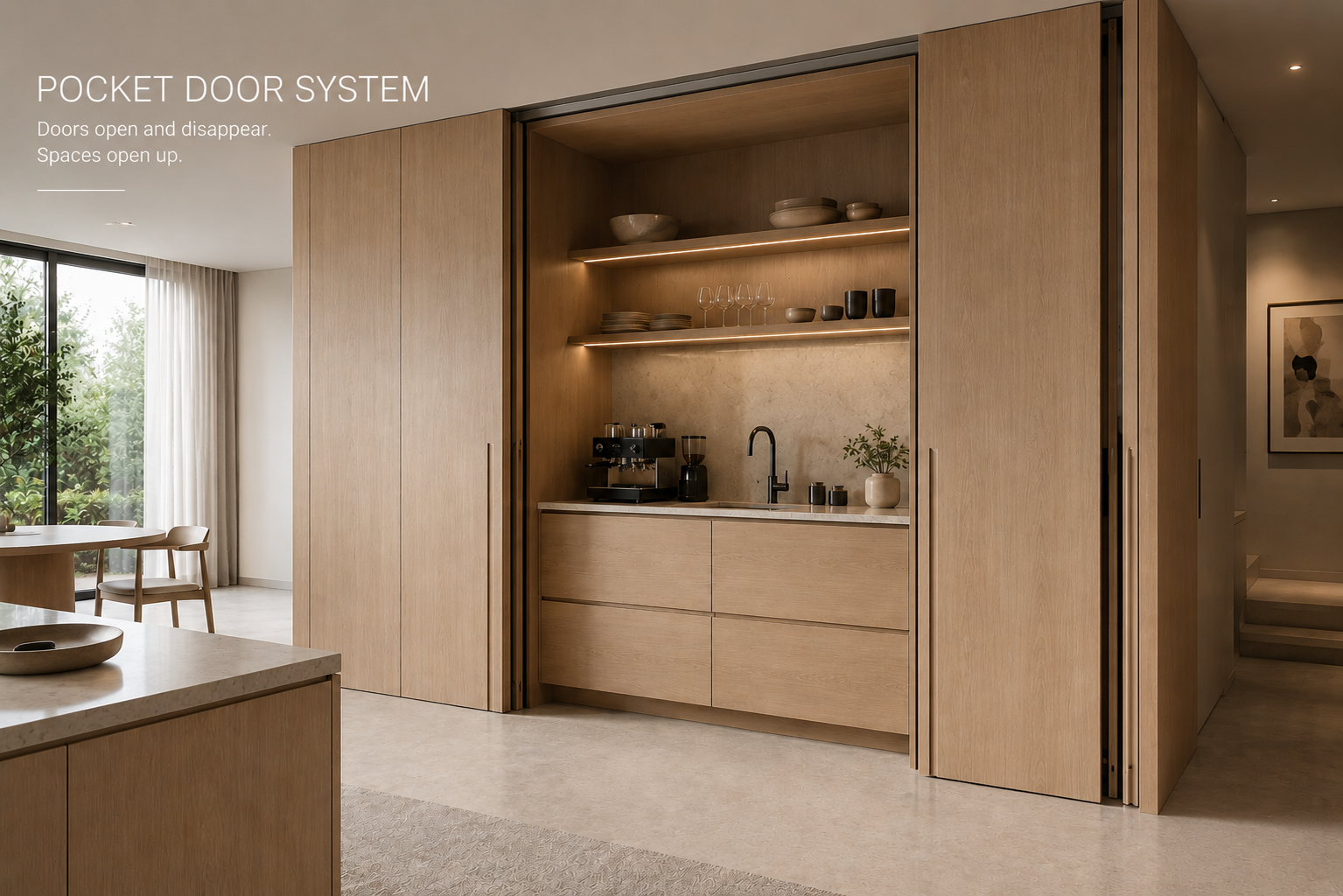
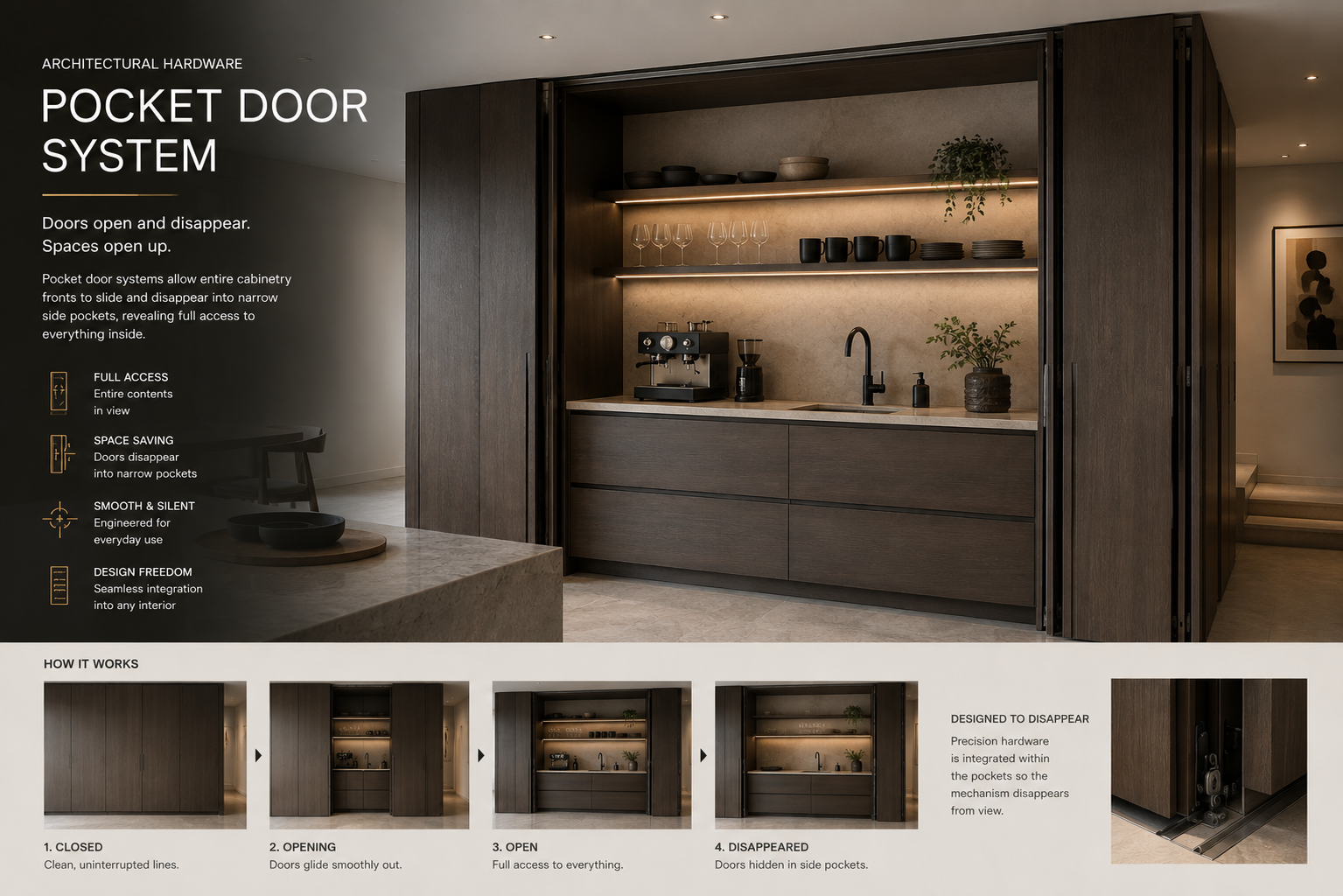
Pocket and retractable door systems allow cabinet fronts to open and move away from the primary working or storage area.
When closed, the cabinetry can present as a clean continuous elevation. When opened, the doors can retract into dedicated side pockets to provide unobstructed access to the space behind.
Applications can include:
Concealed kitchens
Appliance zones
Coffee stations
Home bars
Workstations
Home offices
Wardrobes
Entertainment cabinetry
Utility areas
Feature residential joinery
These systems are particularly useful where the architectural intent requires functional spaces to disappear when they are not being used.
Blum REVEGO Pocket System
Blum REVEGO provides a manufacturer-supported pocket system for cabinetry requiring retractable full-height fronts.
Depending on the selected configuration, single or double fronts can open and retract into dedicated side pockets, allowing larger cabinetry zones to transition between concealed and accessible arrangements.
Applications can include kitchens, appliance areas, coffee stations, bars, workstations, wardrobes and other joinery zones where a clean closed elevation is required.
The cabinetry must be developed around the specific REVEGO configuration, including the required pocket dimensions, front dimensions, hardware clearances and movement requirements.
Final system selection and technical configuration should therefore be confirmed against the applicable manufacturer specification before manufacture.
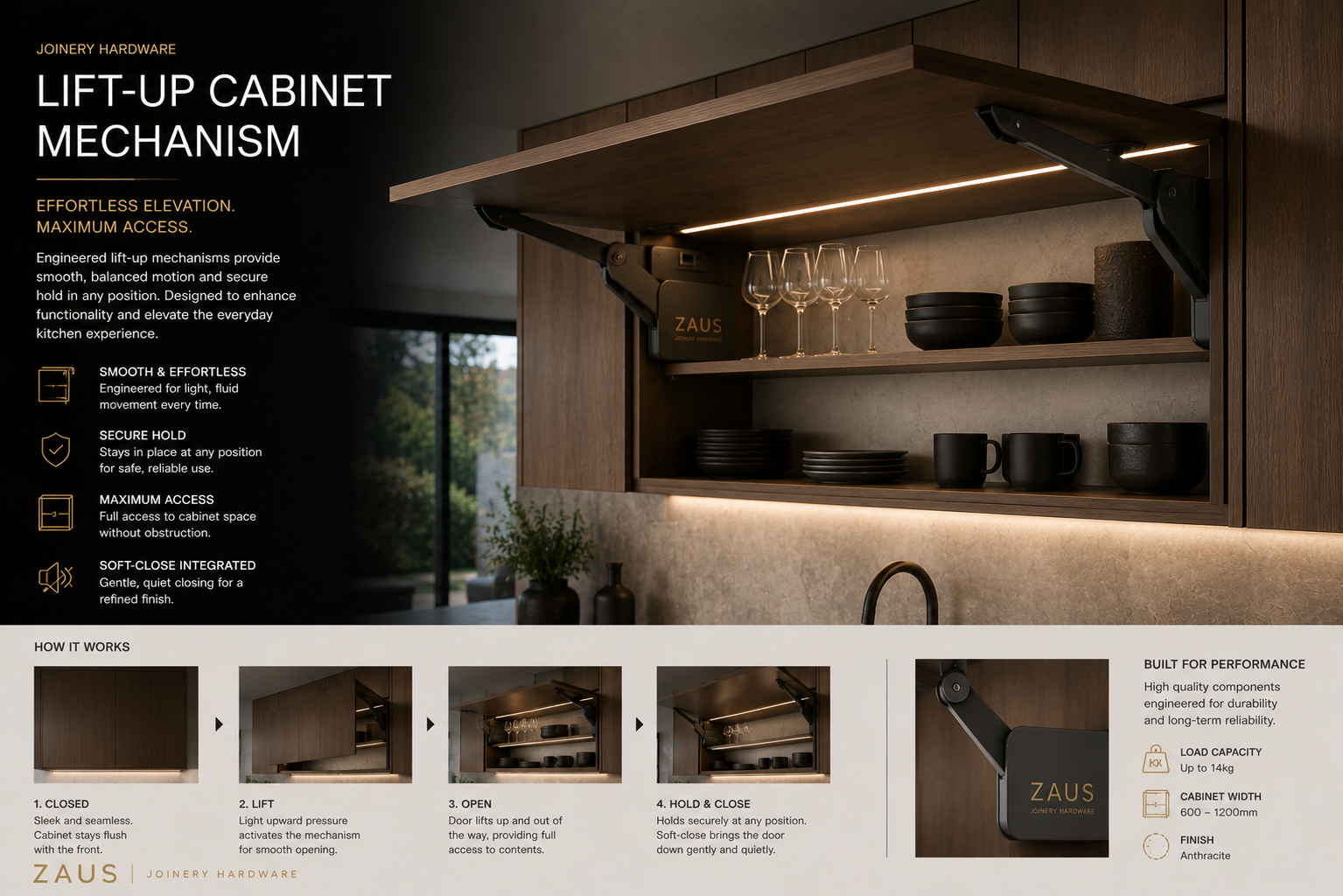
Lift-Up & Overhead Mechanisms
Lift systems provide an alternative to conventional side-hinged doors for overhead and upper cabinetry.
Depending on the selected manufacturer-supported mechanism, cabinet fronts can lift vertically or through a controlled articulated movement to provide access while reducing the intrusion of an open door into the working area.
Applications can include:
Kitchen overhead cabinetry
Appliance cabinetry
Bar cabinetry
Display storage
Entertainment joinery
Selected residential cabinetry
Door dimensions, front weight and available overhead clearance should be considered when selecting the appropriate mechanism.
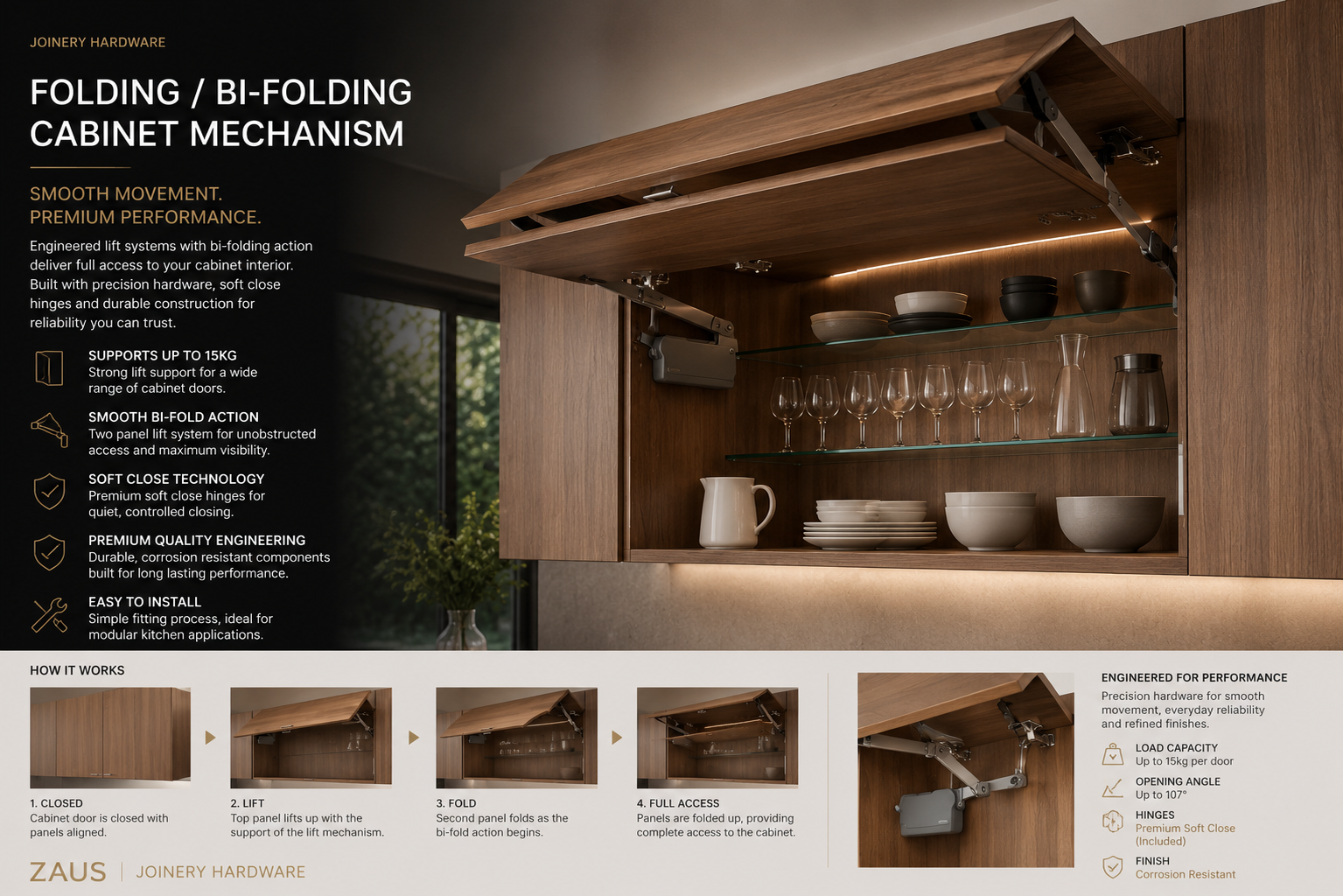
Sliding & Folding Systems
Sliding and folding mechanisms can be incorporated where conventional hinged doors are unsuitable for the intended cabinetry or available circulation space.
Depending on the system, applications can include:
Folding cabinet fronts
Bi-folding doors
Sliding cabinet doors
Concealed storage
Appliance areas
Wardrobe cabinetry
Display cabinetry
Architectural furniture
Tracks, guides, door dimensions and required clearances are coordinated with the cabinetry during design and manufacture.
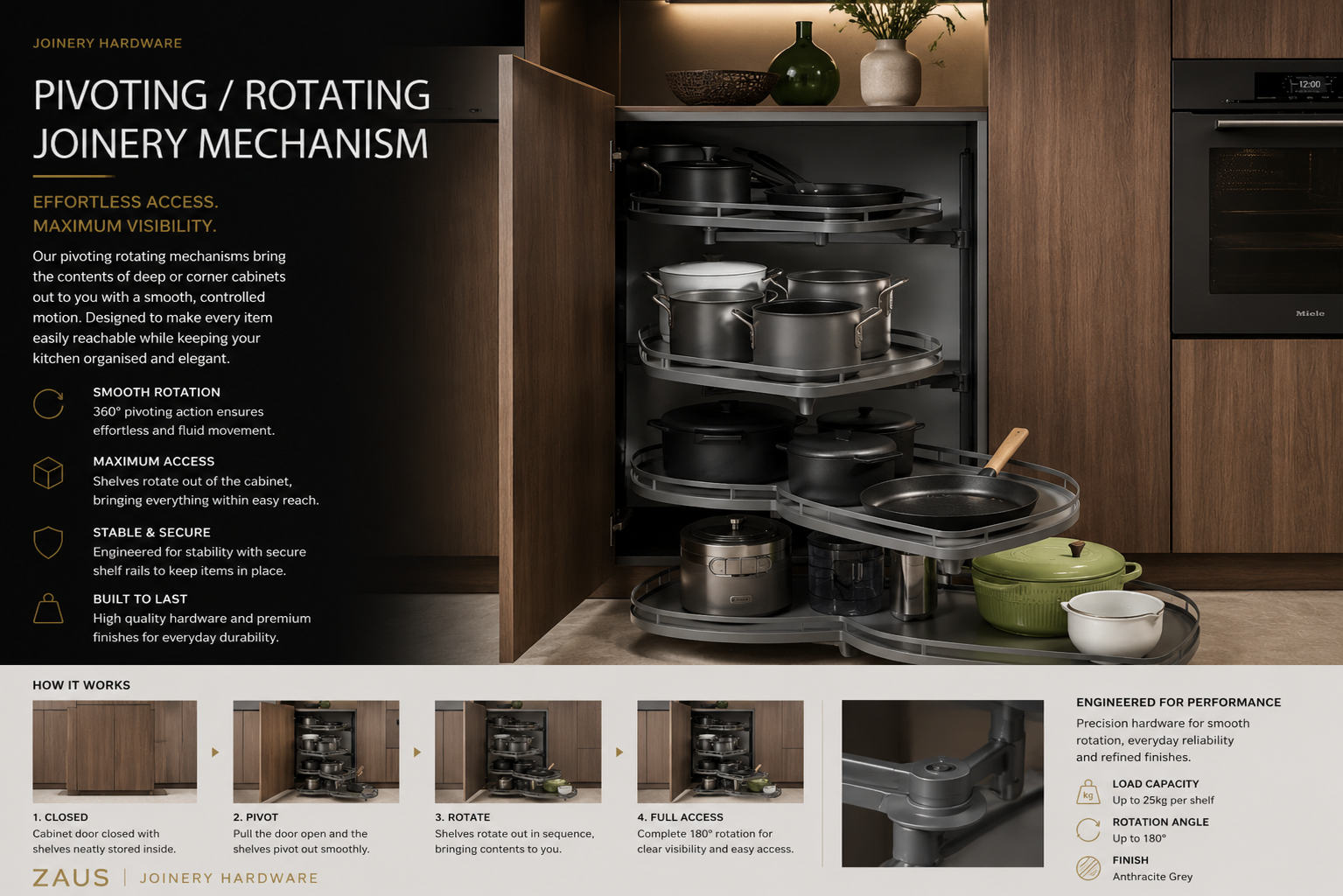
Specialised Movement Hardware
Selected joinery applications may require movement beyond conventional hinged, sliding or drawer operation.
Depending on the manufacturer-supported system and project requirements, specialised hardware can accommodate pivoting, rotating, assisted or other architectural movement.
These mechanisms can be considered for feature cabinetry, concealed storage, architectural furniture and other applications where the movement of the joinery forms part of the design.
Final suitability is determined according to the cabinetry dimensions, loading, construction and applicable hardware specification.
Hardware Brands & Specification Pathways
ZAUS can coordinate manufacturer-supported hardware from established cabinetry hardware manufacturers according to the requirements of the individual project.
Selected systems from Blum, Hettich and DTC are available within supported manufacturing specifications, alongside compatible specialist mechanisms where required.
Hardware does not need to be standardised at one performance level throughout an entire project.
Different hinge, runner and movement systems can be selected according to the function, loading, frequency of use, cabinetry design and project budget of each application.
Hardware Specification
Hardware selection is undertaken alongside the cabinetry design.
Consideration can be given to:
Cabinet construction
Door and drawer dimensions
Front material
Front thickness
Front weight
Opening method
Opening angle
Movement and clearance
Intended use
Storage configuration
Load requirements
Frequency of operation
Integrated accessories
This allows hinges, runners and specialised mechanisms to be resolved during the design and manufacturing process rather than selected after the cabinetry has already been developed.
For more sophisticated systems such as pocket, retractable, folding and sliding fronts, the cabinetry itself is designed around the hardware requirements.
Integration with Cabinet Fronts
Hardware selection can also be coordinated with the selected cabinet-front system.
Applications can include:
Decorative cabinet fronts
PET and UV-finished fronts
Painted cabinetry
Timber and veneer fronts
Aluminium-framed glass cabinet doors
Integrated mirror cabinet doors
Handleless cabinetry
Architectural handles and pulls
Door material, dimensions and weight can influence the compatible hinge, runner or movement system and should therefore be considered before final hardware selection.
Kitchen Applications
Kitchen cabinetry can incorporate different hardware systems according to the function of individual cabinets.
Applications can include:
Base cabinet drawers
Internal drawers
Pantry cabinetry
Overhead cabinets
Appliance cabinetry
Concealed kitchens
Pocket-door appliance zones
Corner mechanisms
Lift-up cabinetry
Handleless cabinet fronts
This allows frequently used kitchen components to be specified according to their individual loading and operational requirements.
Wardrobe & Dressing Room Applications
Wardrobe hardware can be coordinated with conventional cabinetry, open wardrobe systems and specialised storage components.
Applications can include:
Wardrobe hinges
Drawer runners
Internal drawers
Aluminium-framed glass doors
Integrated mirror doors
Pull-out storage
Specialised wardrobe accessories
Concealed and retractable cabinetry
Hardware can be selected according to the individual storage configuration rather than applying a single mechanism across the entire wardrobe.
Whole-of-Project Joinery Coordination
Premium Joinery Hardware can be coordinated throughout the broader ZAUS custom joinery collection.
Custom Kitchen Joinery • Wardrobes & Dressing Rooms • Bathroom Vanities • Aluminium-Framed Glass Cabinet Doors • Integrated Mirror Cabinet Doors • Architectural Post Wardrobe Systems • Wall-Mounted Wardrobe Systems • Custom Residential Joinery
Where appropriate, hardware families and operating characteristics can be coordinated across multiple areas while allowing individual cabinets to receive the mechanisms appropriate to their function.
Project Development & Coordination
ZAUS develops the hardware specification alongside the individual joinery package.
The process can incorporate:
Review Cabinetry Design • Define Opening Methods • Confirm Door & Drawer Dimensions • Confirm Front Materials & Weights • Select Hinges & Runners • Select Specialised Mechanisms • Resolve Movement & Clearances • Coordinate Cabinet Construction • Finalise Shop Drawings • Manufacture • Deliver • Coordinate Installation
Final hardware selections are confirmed against the applicable manufacturer-supported system, cabinetry design and project requirements before production.
Applications
Custom Kitchens • Concealed Kitchens • Wardrobes & Dressing Rooms • Bathroom Vanities • Residential Joinery • Display Cabinetry • Home Bars & Coffee Stations • Home Offices • Entertainment Joinery • Kitchen Storage Systems • Wardrobe Storage Systems • Architectural Furniture • Custom Homes • Luxury Residences • Apartments • Boutique Residential Projects
Movement. Precision. Architectural Function.
ZAUS coordinates joinery hardware as an integral part of the complete cabinetry package rather than treating hinges, runners and movement mechanisms as isolated components.
Define the Cabinetry • Determine the Movement • Confirm Front Dimensions & Weight • Select Hardware • Resolve Clearances • Coordinate Cabinet Construction • Finalise the System • Manufacture & Deliver
The result is a coordinated hardware specification developed around the movement, loading, functionality and architectural requirements of the individual joinery package.
Precision joinery hardware, engineered for smooth movement, reliable performance and architectural integration.
ZAUS Premium Joinery Hardware brings together the functional hardware and specialised movement systems required across bespoke kitchens, wardrobes, bathroom vanities and custom residential joinery.
Each hardware package can be developed alongside the cabinetry itself, allowing hinges, drawer runners, opening mechanisms, pocket systems, lift systems and specialised architectural hardware to be selected according to the cabinet construction, door dimensions, front material, loading requirements and intended movement.
From concealed soft-close hinges and precision drawer runners through to retractable kitchens, pocket doors and space-transforming cabinetry, hardware is coordinated as an integral part of the joinery rather than treated as a collection of components selected after manufacture.
Cabinet Hinges
Concealed hinge systems allow cabinet doors to operate while maintaining clean external cabinetry lines.
Depending on the cabinetry design and selected manufacturer-supported system, configurations can include:
Concealed cabinet hinges
Soft-close hinge systems
Push-to-open applications
Wide-angle hinges
Specialised opening-angle hinges
Adjustable hinge systems
Hinges for different cabinet configurations
Compatible hardware for selected glass and aluminium-framed fronts
Final hinge selection is determined by the cabinet construction, door dimensions, front material, front weight, required opening angle and intended application.
Drawer Runners & Drawer Systems
Drawer hardware can be selected according to the dimensions, loading and intended function of each drawer.
Manufacturer-supported solutions can include:
Concealed drawer runners
Full-extension runner systems
Soft-close mechanisms
Push-to-open systems
Drawer-box systems
Internal and nested drawers
Heavy-duty configurations where supported
Compatible internal organisation accessories
This allows different areas of the same joinery package to use hardware appropriate to their individual performance requirements.
Kitchen cookware drawers, wardrobe accessory drawers, bathroom vanity storage and lighter internal drawers do not necessarily require the same hardware configuration.
Soft-Close & Push-to-Open Systems
Soft-close and push-to-open mechanisms can be incorporated according to the intended cabinetry design and opening method.
Soft-close systems provide controlled closing movement for doors and drawers, while push-to-open systems allow selected cabinetry to operate without conventional external handles.
Depending on the application, these systems can support:
Handleless cabinetry
Concealed storage
Minimal cabinet elevations
Kitchen cabinetry
Wardrobe cabinetry
Bathroom vanities
Entertainment units
Residential built-ins
The appropriate mechanism is selected according to the door or drawer configuration and compatible manufacturer-supported hardware system.
Architectural Cabinet Mechanisms
Specialised architectural hardware can allow sections of cabinetry to lift, fold, slide, retract, pivot or otherwise transform according to how the space is being used.
Depending on the application and selected manufacturer-supported system, configurations can include:
Pocket and retractable door systems
Folding and bi-folding cabinet doors
Concealed sliding systems
Lift-up cabinet mechanisms
Overhead opening systems
Pivoting cabinetry
Rotating mechanisms
Flush and lateral-opening systems
Assisted opening mechanisms
Concealed appliance zones
Retractable work areas
Specialised architectural furniture mechanisms
These systems require the cabinetry and movement hardware to be developed together so the necessary clearances, structural requirements and movement geometry can be incorporated before manufacture.
Pocket & Retractable Door Systems
Pocket and retractable door systems allow cabinet fronts to open and move away from the primary working or storage area.
When closed, the cabinetry can present as a clean continuous elevation. When opened, the doors can retract into dedicated side pockets to provide unobstructed access to the space behind.
Applications can include:
Concealed kitchens
Appliance zones
Coffee stations
Home bars
Workstations
Home offices
Wardrobes
Entertainment cabinetry
Utility areas
Feature residential joinery
These systems are particularly useful where the architectural intent requires functional spaces to disappear when they are not being used.
Blum REVEGO Pocket System
Blum REVEGO provides a manufacturer-supported pocket system for cabinetry requiring retractable full-height fronts.
Depending on the selected configuration, single or double fronts can open and retract into dedicated side pockets, allowing larger cabinetry zones to transition between concealed and accessible arrangements.
Applications can include kitchens, appliance areas, coffee stations, bars, workstations, wardrobes and other joinery zones where a clean closed elevation is required.
The cabinetry must be developed around the specific REVEGO configuration, including the required pocket dimensions, front dimensions, hardware clearances and movement requirements.
Final system selection and technical configuration should therefore be confirmed against the applicable manufacturer specification before manufacture.
Lift-Up & Overhead Mechanisms
Lift systems provide an alternative to conventional side-hinged doors for overhead and upper cabinetry.
Depending on the selected manufacturer-supported mechanism, cabinet fronts can lift vertically or through a controlled articulated movement to provide access while reducing the intrusion of an open door into the working area.
Applications can include:
Kitchen overhead cabinetry
Appliance cabinetry
Bar cabinetry
Display storage
Entertainment joinery
Selected residential cabinetry
Door dimensions, front weight and available overhead clearance should be considered when selecting the appropriate mechanism.
Sliding & Folding Systems
Sliding and folding mechanisms can be incorporated where conventional hinged doors are unsuitable for the intended cabinetry or available circulation space.
Depending on the system, applications can include:
Folding cabinet fronts
Bi-folding doors
Sliding cabinet doors
Concealed storage
Appliance areas
Wardrobe cabinetry
Display cabinetry
Architectural furniture
Tracks, guides, door dimensions and required clearances are coordinated with the cabinetry during design and manufacture.
Specialised Movement Hardware
Selected joinery applications may require movement beyond conventional hinged, sliding or drawer operation.
Depending on the manufacturer-supported system and project requirements, specialised hardware can accommodate pivoting, rotating, assisted or other architectural movement.
These mechanisms can be considered for feature cabinetry, concealed storage, architectural furniture and other applications where the movement of the joinery forms part of the design.
Final suitability is determined according to the cabinetry dimensions, loading, construction and applicable hardware specification.
Hardware Brands & Specification Pathways
ZAUS can coordinate manufacturer-supported hardware from established cabinetry hardware manufacturers according to the requirements of the individual project.
Selected systems from Blum, Hettich and DTC are available within supported manufacturing specifications, alongside compatible specialist mechanisms where required.
Hardware does not need to be standardised at one performance level throughout an entire project.
Different hinge, runner and movement systems can be selected according to the function, loading, frequency of use, cabinetry design and project budget of each application.
Hardware Specification
Hardware selection is undertaken alongside the cabinetry design.
Consideration can be given to:
Cabinet construction
Door and drawer dimensions
Front material
Front thickness
Front weight
Opening method
Opening angle
Movement and clearance
Intended use
Storage configuration
Load requirements
Frequency of operation
Integrated accessories
This allows hinges, runners and specialised mechanisms to be resolved during the design and manufacturing process rather than selected after the cabinetry has already been developed.
For more sophisticated systems such as pocket, retractable, folding and sliding fronts, the cabinetry itself is designed around the hardware requirements.
Integration with Cabinet Fronts
Hardware selection can also be coordinated with the selected cabinet-front system.
Applications can include:
Decorative cabinet fronts
PET and UV-finished fronts
Painted cabinetry
Timber and veneer fronts
Aluminium-framed glass cabinet doors
Integrated mirror cabinet doors
Handleless cabinetry
Architectural handles and pulls
Door material, dimensions and weight can influence the compatible hinge, runner or movement system and should therefore be considered before final hardware selection.
Kitchen Applications
Kitchen cabinetry can incorporate different hardware systems according to the function of individual cabinets.
Applications can include:
Base cabinet drawers
Internal drawers
Pantry cabinetry
Overhead cabinets
Appliance cabinetry
Concealed kitchens
Pocket-door appliance zones
Corner mechanisms
Lift-up cabinetry
Handleless cabinet fronts
This allows frequently used kitchen components to be specified according to their individual loading and operational requirements.
Wardrobe & Dressing Room Applications
Wardrobe hardware can be coordinated with conventional cabinetry, open wardrobe systems and specialised storage components.
Applications can include:
Wardrobe hinges
Drawer runners
Internal drawers
Aluminium-framed glass doors
Integrated mirror doors
Pull-out storage
Specialised wardrobe accessories
Concealed and retractable cabinetry
Hardware can be selected according to the individual storage configuration rather than applying a single mechanism across the entire wardrobe.
Whole-of-Project Joinery Coordination
Premium Joinery Hardware can be coordinated throughout the broader ZAUS custom joinery collection.
Custom Kitchen Joinery • Wardrobes & Dressing Rooms • Bathroom Vanities • Aluminium-Framed Glass Cabinet Doors • Integrated Mirror Cabinet Doors • Architectural Post Wardrobe Systems • Wall-Mounted Wardrobe Systems • Custom Residential Joinery
Where appropriate, hardware families and operating characteristics can be coordinated across multiple areas while allowing individual cabinets to receive the mechanisms appropriate to their function.
Project Development & Coordination
ZAUS develops the hardware specification alongside the individual joinery package.
The process can incorporate:
Review Cabinetry Design • Define Opening Methods • Confirm Door & Drawer Dimensions • Confirm Front Materials & Weights • Select Hinges & Runners • Select Specialised Mechanisms • Resolve Movement & Clearances • Coordinate Cabinet Construction • Finalise Shop Drawings • Manufacture • Deliver • Coordinate Installation
Final hardware selections are confirmed against the applicable manufacturer-supported system, cabinetry design and project requirements before production.
Applications
Custom Kitchens • Concealed Kitchens • Wardrobes & Dressing Rooms • Bathroom Vanities • Residential Joinery • Display Cabinetry • Home Bars & Coffee Stations • Home Offices • Entertainment Joinery • Kitchen Storage Systems • Wardrobe Storage Systems • Architectural Furniture • Custom Homes • Luxury Residences • Apartments • Boutique Residential Projects
Movement. Precision. Architectural Function.
ZAUS coordinates joinery hardware as an integral part of the complete cabinetry package rather than treating hinges, runners and movement mechanisms as isolated components.
Define the Cabinetry • Determine the Movement • Confirm Front Dimensions & Weight • Select Hardware • Resolve Clearances • Coordinate Cabinet Construction • Finalise the System • Manufacture & Deliver
The result is a coordinated hardware specification developed around the movement, loading, functionality and architectural requirements of the individual joinery package.