Kitchen Stone
Natural and engineered stone surfaces, sourced and fabricated around the individual kitchen.
ZAUS Custom Kitchen Stone provides project-specific stone sourcing and fabrication for residential developments, renovations and architect-designed homes.
Rather than limiting a project to a predetermined catalogue of colours and standard benchtop sizes, the stone package can be developed around the architectural intent, cabinetry design, required dimensions, application, performance requirements and project budget.
From natural marble, granite and quartzite through to travertine and selected engineered surfaces, benchtops, islands, splashbacks, waterfall ends and feature stone elements can be considered together as part of the kitchen architecture rather than treating stone as a finish selected independently of the joinery.
Natural Stone Selection
Natural stone introduces genuine geological character into the kitchen, with each slab carrying its own combination of colour, veining, mineral structure, crystalline formations and tonal variation.
Depending on the project, stone families can include:
Marble
Quartzite
Granite
Travertine
Limestone
Dolomite
Other specialist architectural stones
Where a particular stone, colour or geological character has been nominated, available material can be sourced and reviewed before fabrication.
This allows the stone selection to respond to the actual architectural direction of the project rather than requiring the design to conform to a limited predetermined finish range.
Featured Kitchen Stone Collection
The ZAUS featured collection presents 11 natural stone finishes selected to demonstrate the breadth of material directions available for bespoke kitchen applications.
These provide a curated starting point rather than a limitation on the stones that can be sourced for an individual project.
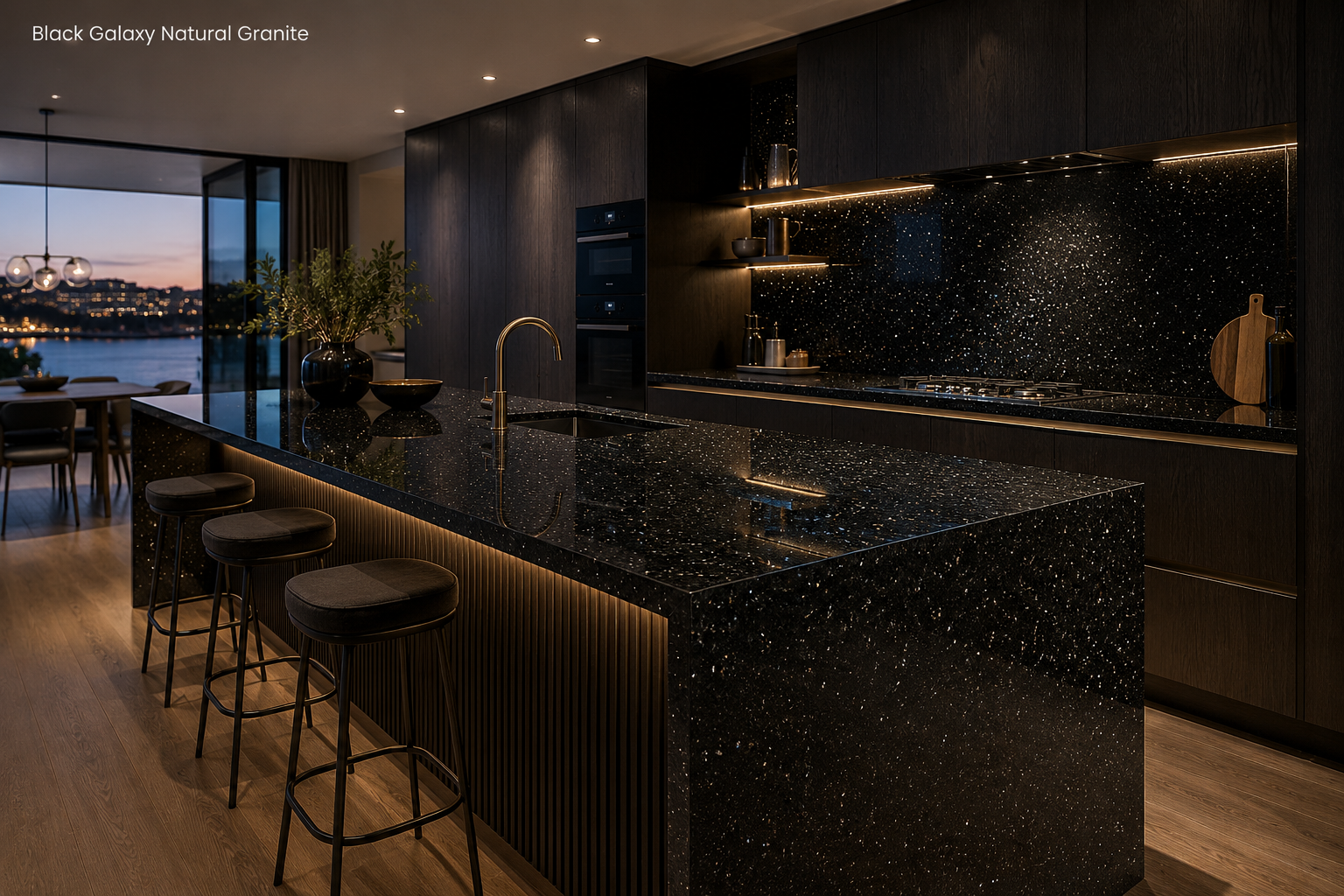
Black Galaxy Natural Granite
A deep black natural granite characterised by fine metallic and mineral inclusions distributed throughout a predominantly dark crystalline background.
Its subtle reflective character becomes more apparent as light moves across the surface, creating depth without relying on conventional marble-style veining.
Black Galaxy is particularly suited to contemporary kitchens where a dark and visually controlled natural stone is required.
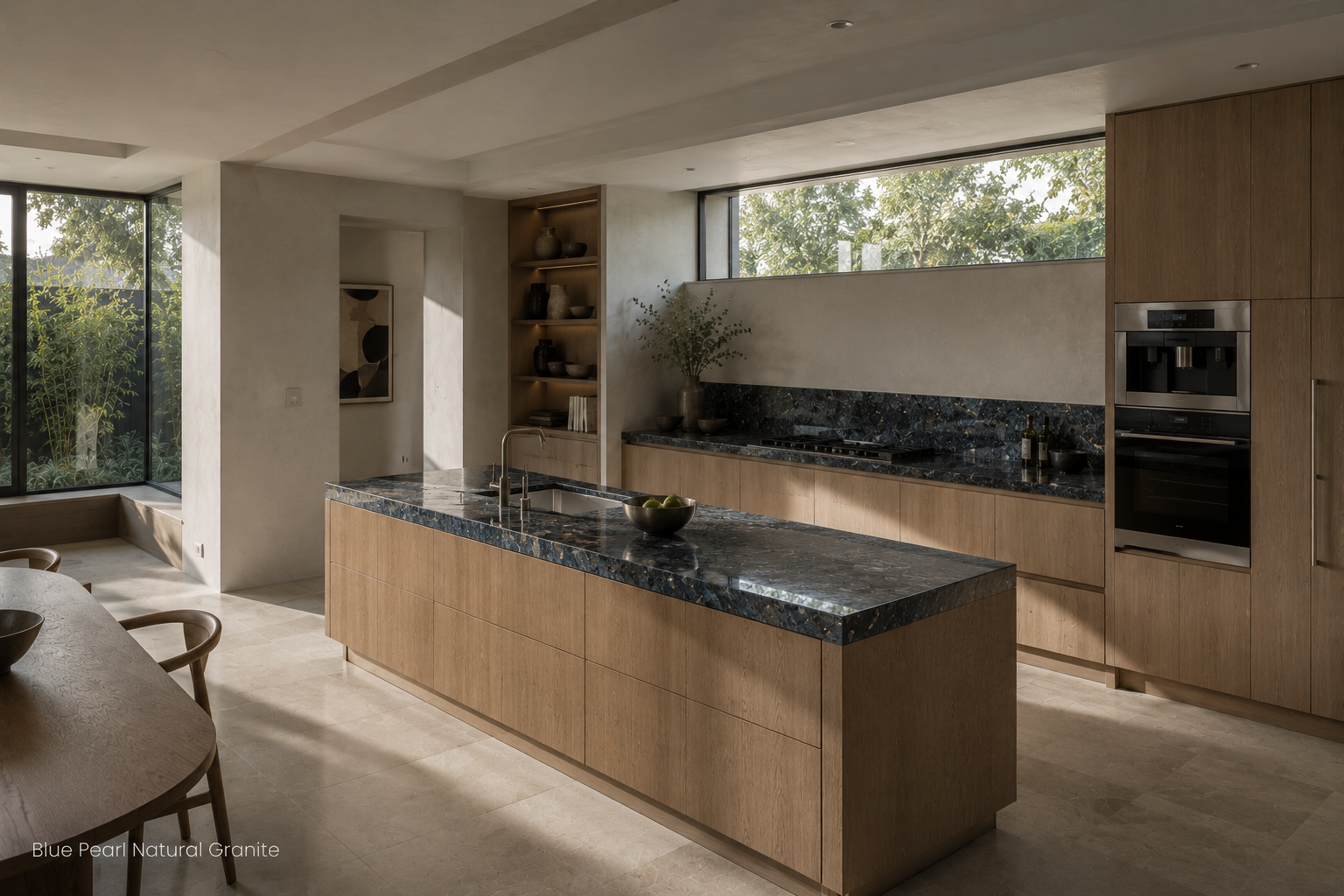
Blue Pearl Natural Granite
A sophisticated Norwegian natural granite with a charcoal to cool blue-grey background and naturally occurring blue-grey, silver and reflective feldspar crystals.
Rather than appearing as a strongly blue surface, its colour is revealed through the interaction between its crystalline mineral structure and changing light.
The result is a distinctive dark granite that can appear restrained from a distance while revealing considerably greater geological detail at closer range.
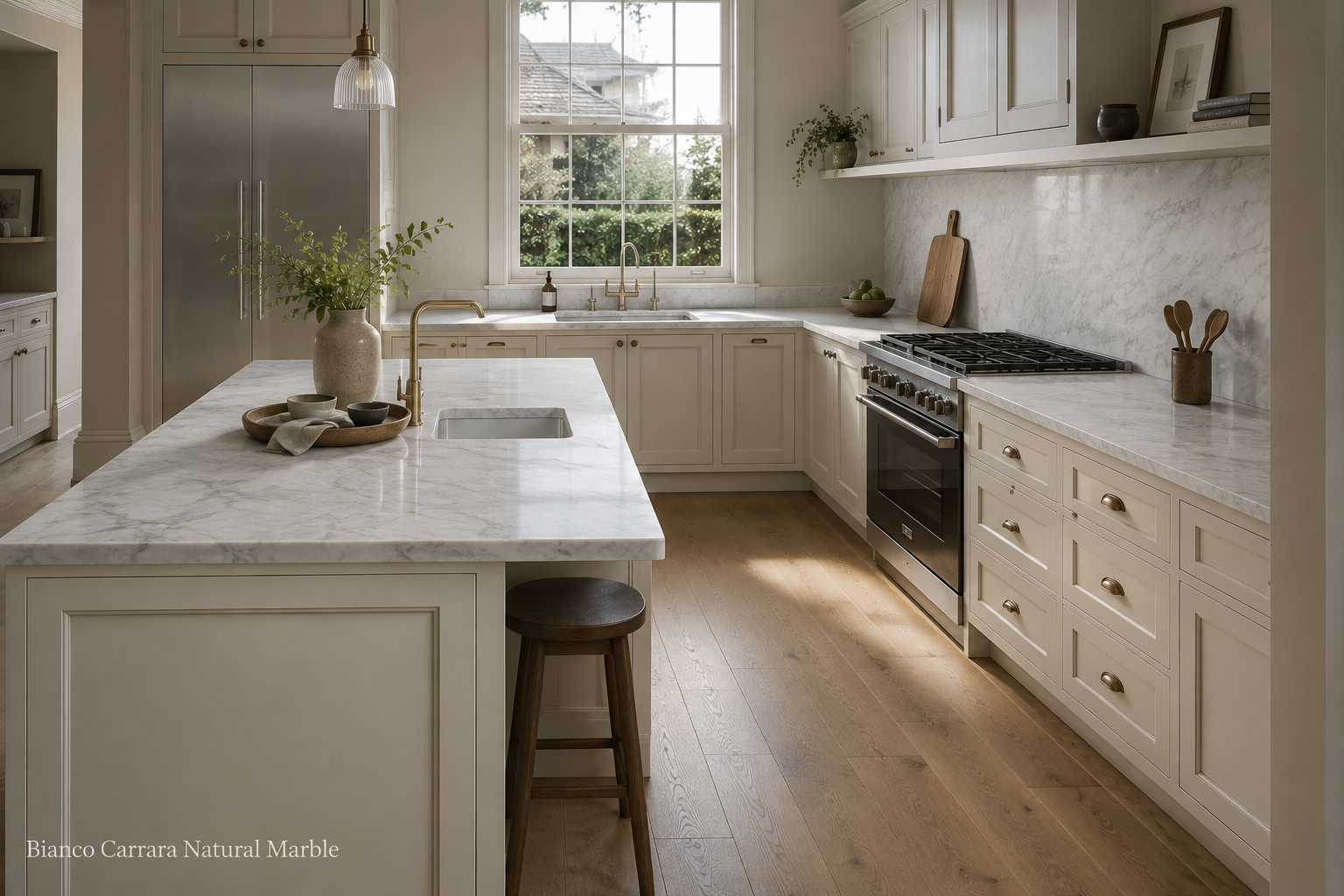
Bianco Carrara Natural Marble
A classic Italian natural marble with a soft white to pale-grey background and fine, naturally irregular grey veining.
Its relatively quiet mineral movement provides a timeless architectural character suited to contemporary, heritage-influenced and more traditional kitchen interiors.
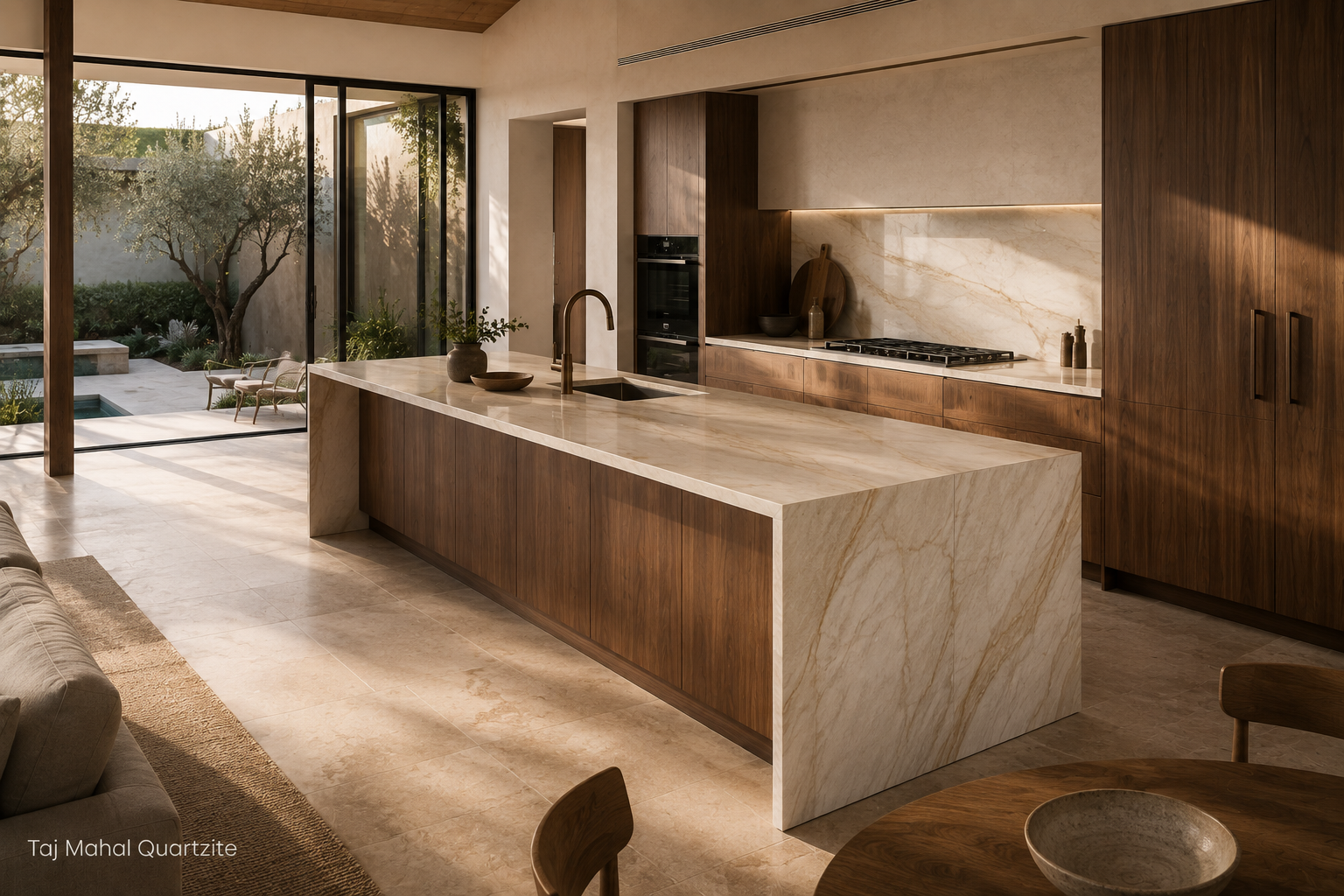
Taj Mahal Quartzite
A refined natural quartzite characterised by a warm ivory-to-cream background with soft beige, taupe and muted caramel mineral movement.
Its long, layered formations provide visual depth without becoming heavily yellow or brown, making it particularly effective alongside natural timber and warm neutral interiors.
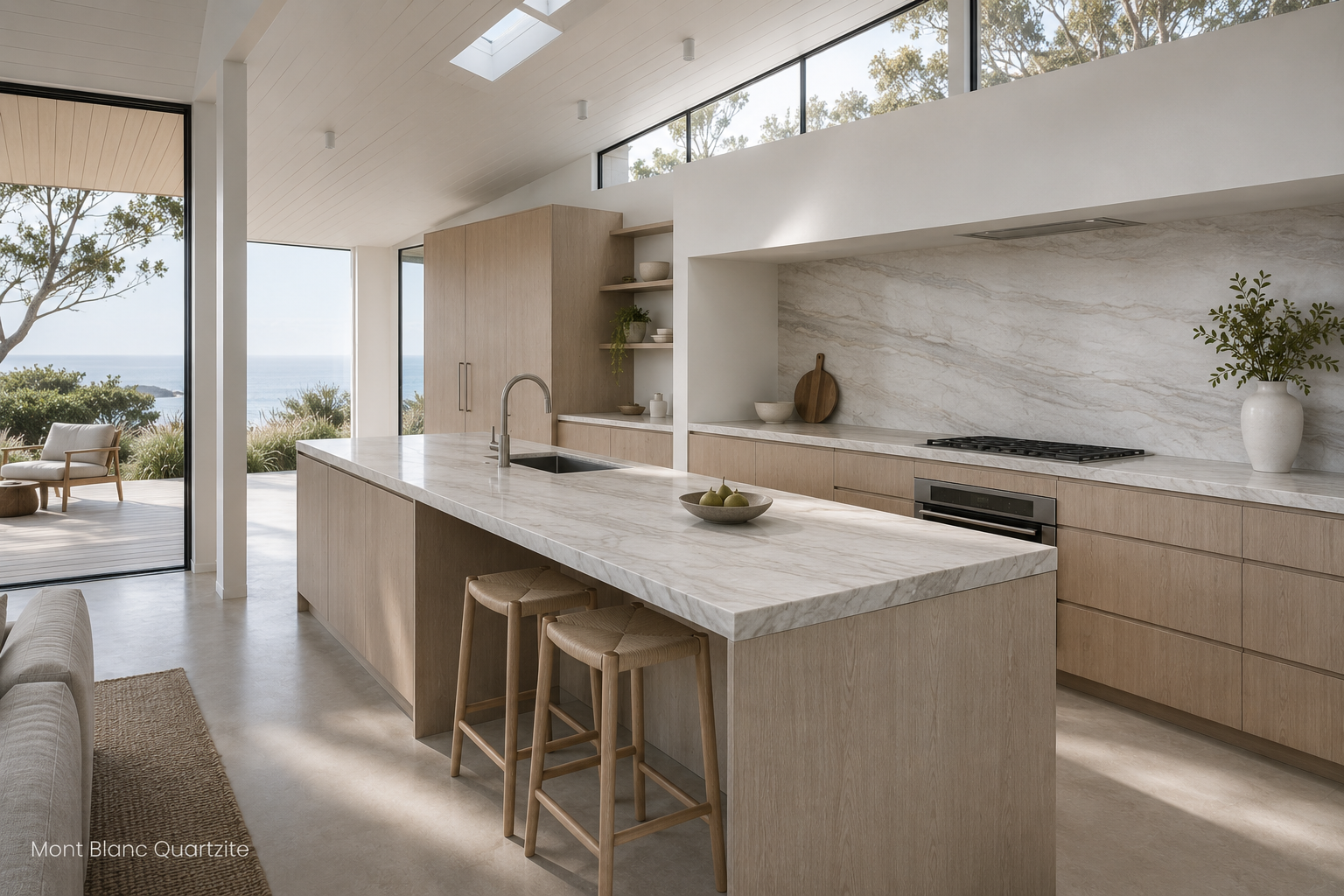
Mont Blanc Quartzite
A light natural quartzite with a soft white to pale-ivory background and flowing grey mineral formations.
Layered, wispy movement and occasional stronger linear markings provide greater depth than a plain white surface while retaining a light and sophisticated overall appearance.
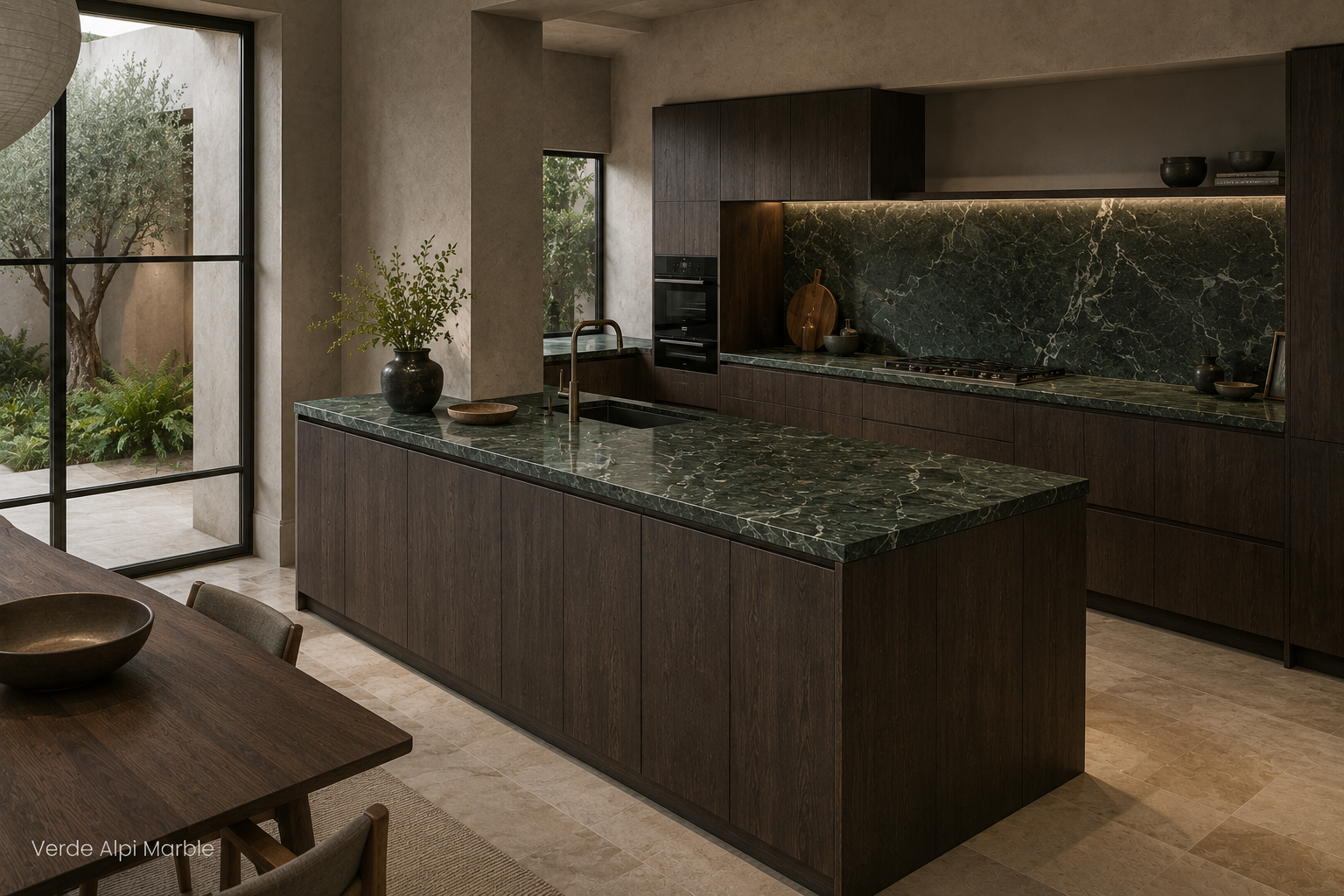
Verde Alpi Marble
A richly coloured Italian natural marble with a deep forest to dark emerald-green base and naturally irregular white and pale-grey mineral fractures.
Areas of relatively quiet green are interrupted by branching calcite movement and stronger geological formations, allowing the stone to become a significant architectural feature within an otherwise restrained kitchen.
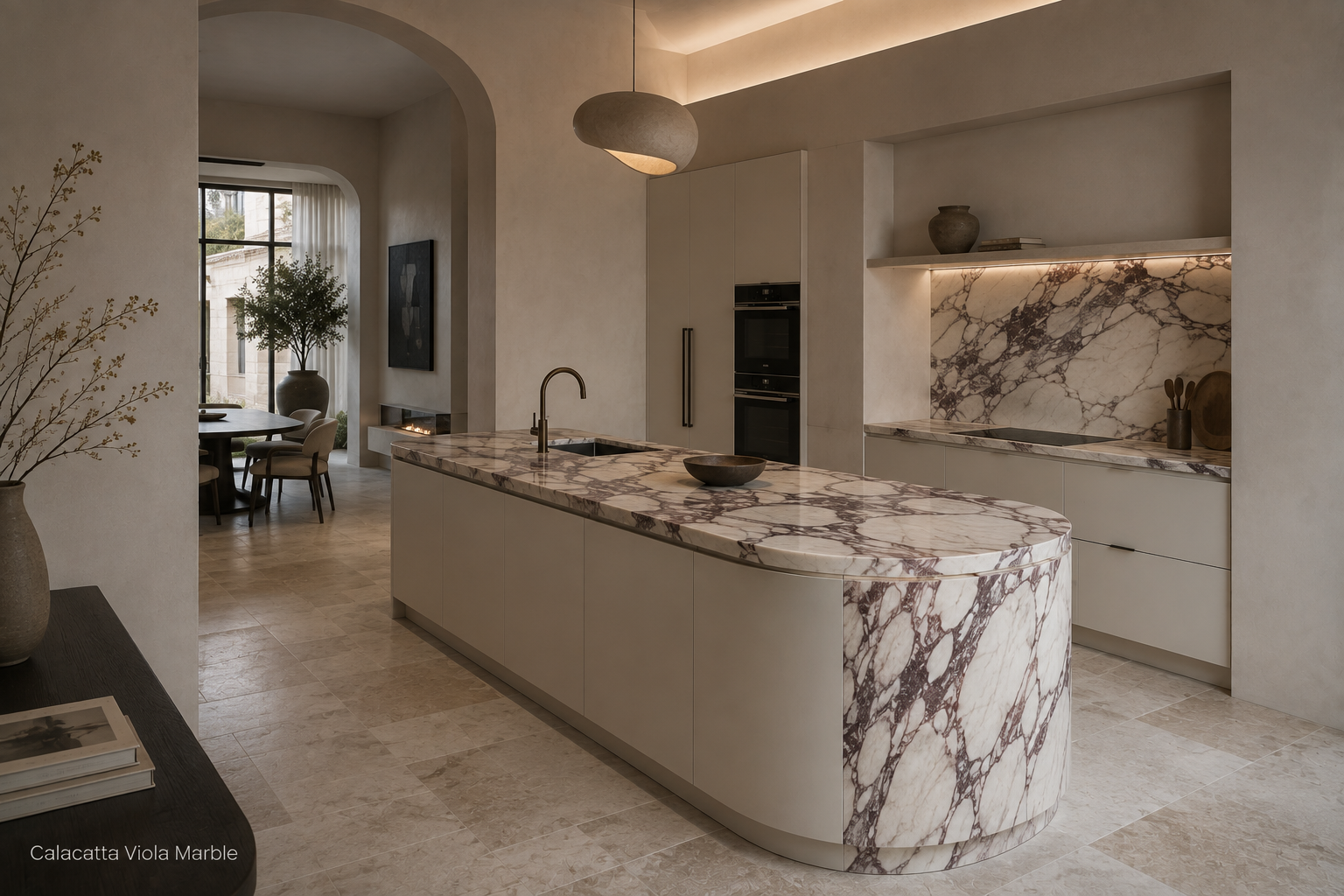
Calacatta Viola Marble
An expressive Italian natural marble combining a warm ivory-to-creamy background with distinctive burgundy, wine-red, plum, grey and taupe mineral formations.
Its fractured and brecciated geology creates areas of concentrated movement balanced by quieter creamy sections of stone.
Calacatta Viola is particularly suited to kitchens where the stone itself is intended to become an important part of the architectural composition.
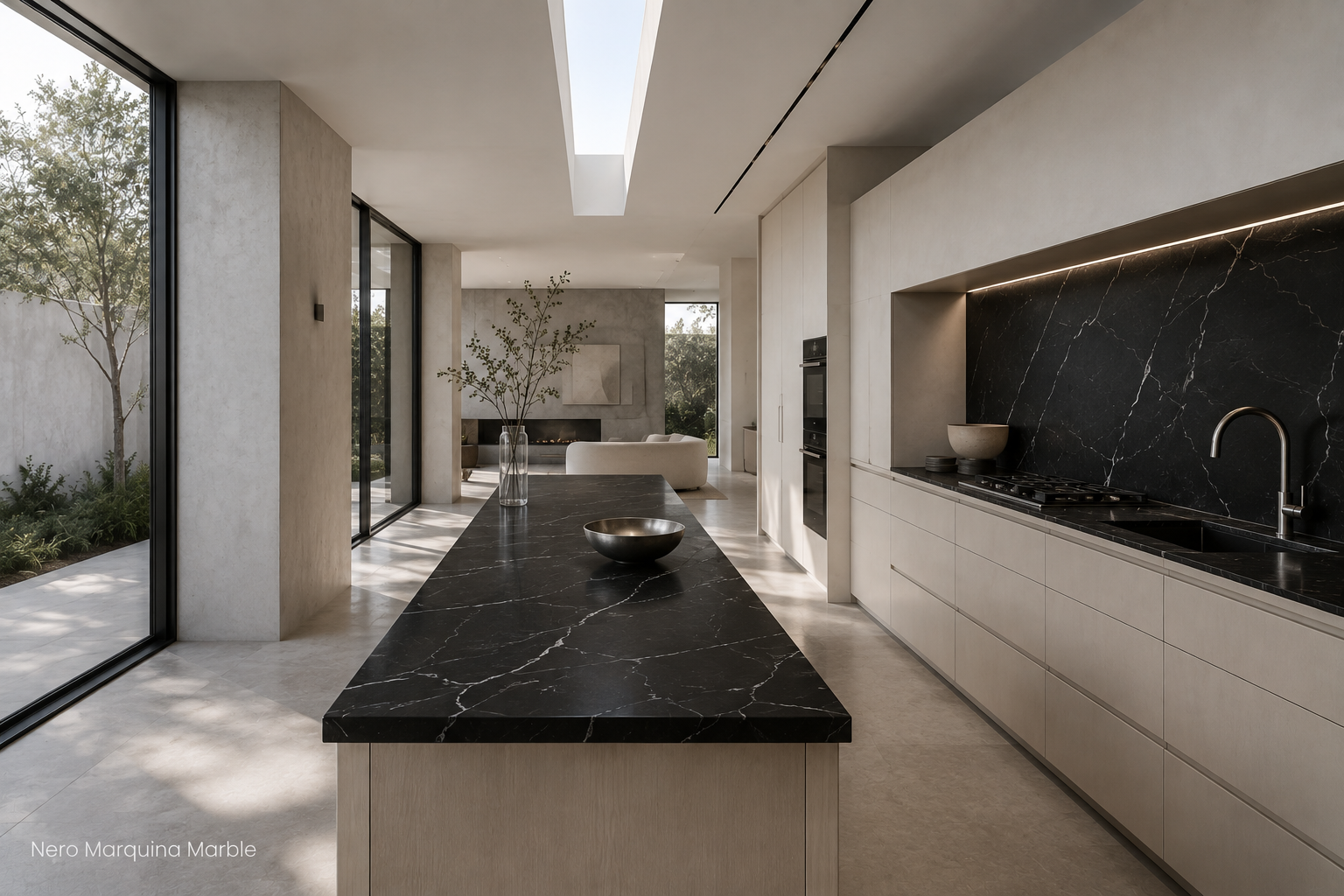
Nero Marquina Marble
A deep black natural marble distinguished by irregular white calcite veining and generous areas of quieter dark stone.
Its strong graphic contrast can create substantial visual impact, particularly when coordinated with pale cabinetry, natural timber, brushed metal or lighter architectural surfaces.
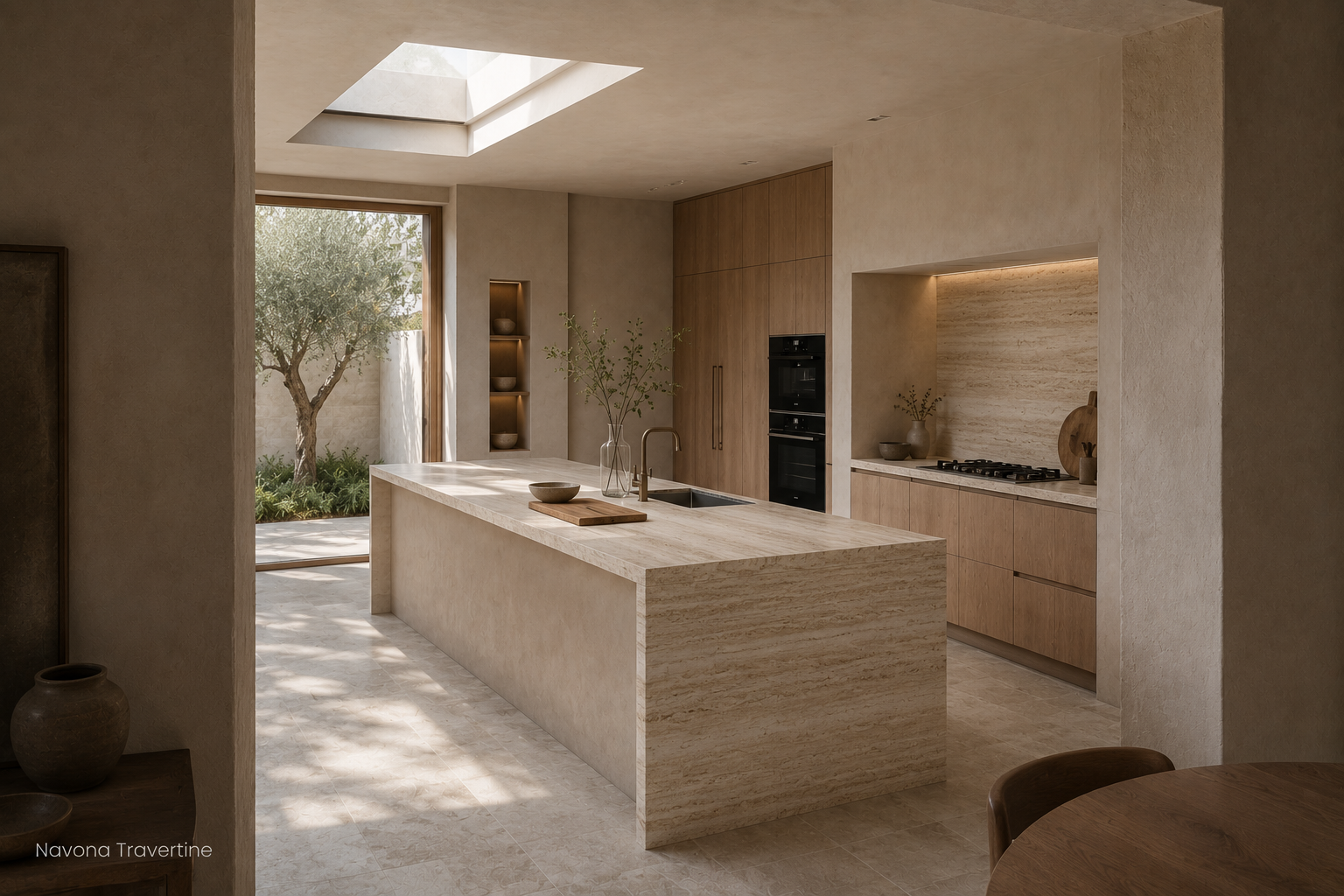
Navona Travertine
A refined light Italian travertine characterised by warm ivory, cream and pale beige tones with fine linear sedimentary banding.
Rather than conventional marble veining, its character comes from geological layering, tonal variation and natural texture, making it particularly suited to warm and materially restrained architectural kitchens.
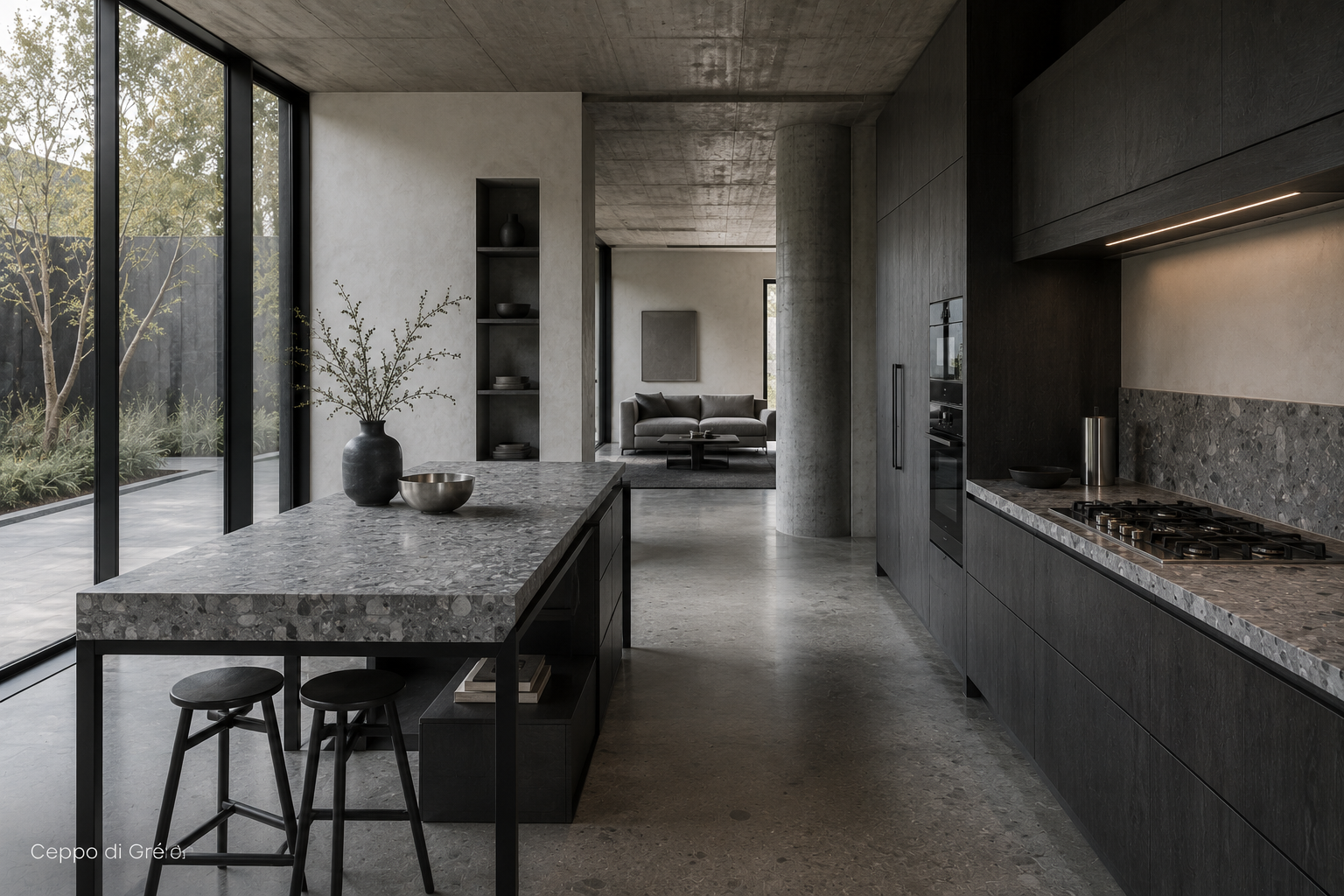
Ceppo di Gré
A distinctive Italian natural stone characterised by a cool medium-grey to blue-grey matrix containing naturally embedded fragments, fossil-like formations and irregular geological inclusions.
Its conglomerate structure creates a dense and highly textural appearance while remaining predominantly grey and architectural.
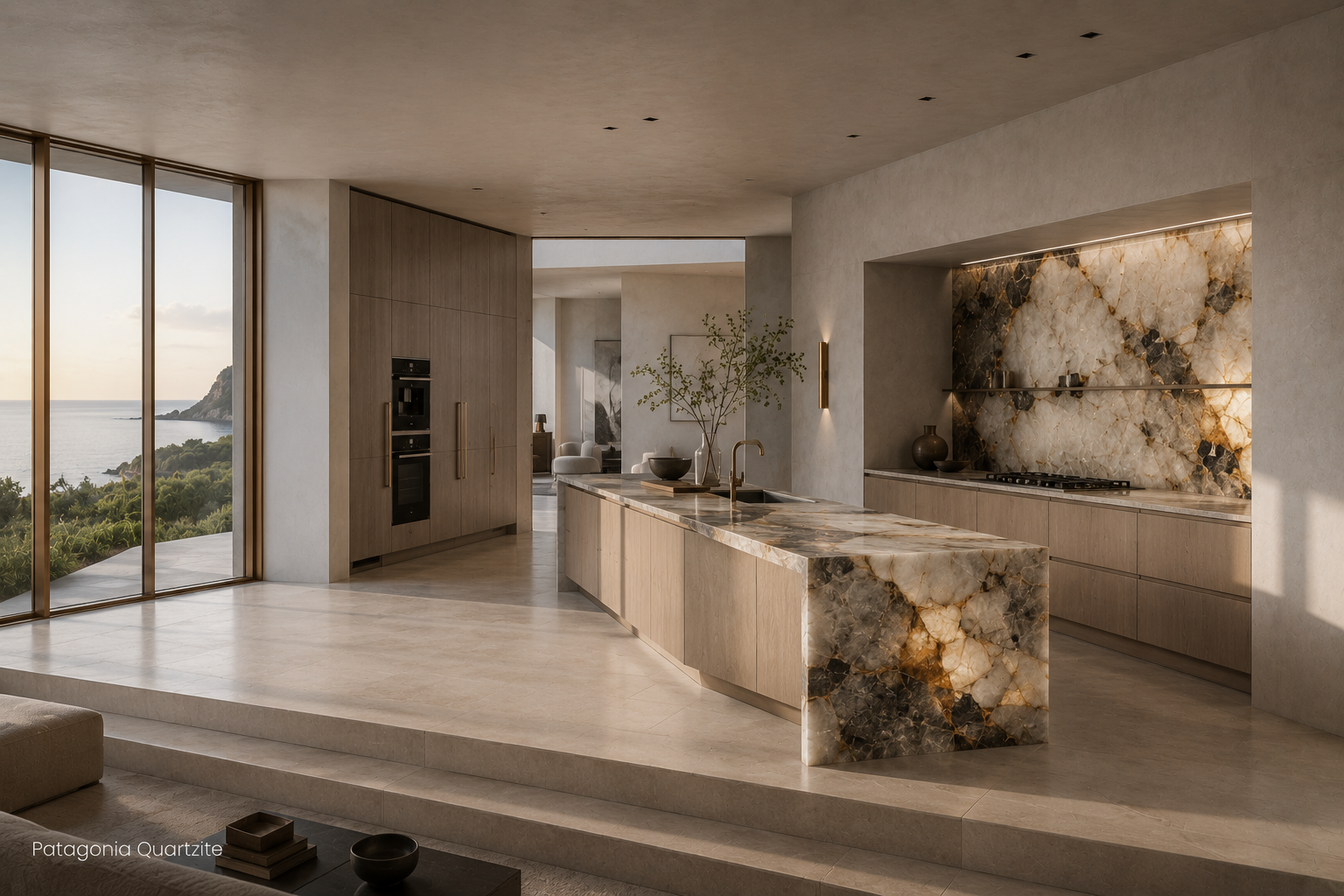
Patagonia Quartzite
A highly expressive natural quartzite combining translucent quartz-rich formations with ivory, grey, charcoal and selective amber-toned mineral movement.
Its geological composition can vary substantially across an individual slab, creating transitions between crystalline, opaque and translucent areas.
Patagonia is particularly suited to feature islands and other applications where the individual slab itself becomes an important component of the kitchen architecture.
These 11 stones represent a curated starting point rather than a fixed collection. Alternative materials, colours and geological characters can be sourced according to the project's architectural direction, availability, performance requirements and budget.
Custom Sizing & Fabrication
Stone can be fabricated around the actual dimensions and configuration of the cabinetry rather than requiring the kitchen to conform to predetermined component sizes.
Subject to slab availability, material characteristics, fabrication requirements and practical transport limitations, applications can include:
Kitchen benchtops
Feature islands
Waterfall ends
Breakfast bars
Perimeter worktops
Splashbacks and upstands
Full-height stone splashbacks
Cooking and preparation zones
Sink and cooktop cut-outs
Integrated stone shelving
Stone end panels
Feature panels
Oversized applications
Custom-format architectural stone elements
Where larger uninterrupted surfaces are required, oversized slab availability and fabrication options can be investigated to reduce unnecessary joints and better preserve the movement of the selected stone.
Slab Selection & Natural Variation
Natural stone is inherently unique.
Colour, veining, crystalline structure, fossils, fissures, mineral concentrations, translucency and tonal movement can vary between individual slabs and across different areas of the same slab.
For feature applications, available slabs can be reviewed before fabrication to consider:
Colour
Pattern distribution
Mineral movement
Vein direction
Crystalline structure
Cut position
Relationship between adjoining pieces
This becomes particularly important with expressive materials such as Patagonia Quartzite, Calacatta Viola and Verde Alpi, where individual cut positions can materially influence the finished appearance.
Architectural Stone Detailing
Stone fabrication can be developed around the architectural and joinery detailing of each kitchen.
Considerations can include:
Finished stone thickness
Edge profiles
Mitred edges
Waterfall detailing
Stone aprons and fascia details
Vein and directional alignment
Bookmatched applications where appropriate
Compositionally aligned slab sections
Sink cut-outs
Cooktop cut-outs
Tap and fixture penetrations
Splashback heights and junctions
Full-height stone panels
Junctions between stone and cabinetry
Feature stone end panels
Matching shelves and ledges
Oversized slab and joint positioning
For expressive natural materials, significant veins, crystalline formations and mineral transitions can be considered when determining cut positions rather than treating the material as a generic repeating surface.
Vein Direction & Material Composition
The orientation of natural stone can materially affect the appearance of the finished kitchen.
Long linear formations can be considered in relation to the direction of an island or benchtop, while splashbacks and waterfall ends can be coordinated with adjoining horizontal surfaces.
Depending on the stone and design, fabrication can consider:
Vein continuity
Directional alignment
Waterfall transitions
Splashback composition
Bookmatching
Feature mineral placement
Not every natural stone should be perfectly matched. In some applications, naturally related but individually different sections can produce a more authentic composition than forcing artificial symmetry.
Oversized Slabs & Feature Islands
Large-format islands can require a different procurement and fabrication strategy from conventional benchtops.
Where the design calls for a substantial uninterrupted surface, available slab dimensions can be investigated with the objective of reducing unnecessary joints where practical.
Considerations can include:
Available raw slab dimensions
Finished island dimensions
Required edge treatments
Sink and fixture penetrations
Structural support
Fabrication tolerances
Transport constraints
Site access
Joint positioning
Waterfall ends and adjoining panels
Where a single-piece application is not practical, joint locations can instead be considered as part of the overall stone and cabinetry composition.
Natural & Engineered Stone Options
ZAUS can source both natural stone and selected engineered or manufactured surfaces where appropriate to the project specification and applicable Australian requirements.
Engineered surfaces can provide greater consistency in colour and pattern and may suit projects where repeatability across multiple kitchens or dwellings is important.
Natural stone provides a different material character through its individual geological formation.
Granite introduces crystalline depth and mineral structure. Marble provides natural veining and tonal movement. Quartzite can combine layered mineral formations with dramatic geological variation, while travertine and other sedimentary stones provide a quieter architectural character through texture and directional banding.
Kitchen & Joinery Coordination
Stone performs best when considered alongside the other components of the kitchen rather than selected as an isolated finish at the end of the design process.
The stone specification can be coordinated with custom kitchen joinery, cabinetry finishes, sinks, tapware, appliances and associated architectural elements so dimensions, penetrations and material junctions can be considered together.
This becomes particularly important for:
Large islands
Waterfall ends
Integrated sinks
Full-height splashbacks
Oversized benchtops
Feature stone applications
Custom cabinetry interfaces
Small dimensional changes elsewhere in the kitchen can affect several adjoining stone components, making early coordination particularly valuable.
Project Development & Coordination
ZAUS develops the kitchen stone package alongside the architectural and joinery requirements of the individual project.
The process can incorporate:
Review Kitchen Design • Define Stone Applications • Establish Material Direction • Source Suitable Stone • Review Available Slabs • Confirm Slab Dimensions • Develop Fabrication Layout • Coordinate Vein Direction • Resolve Edges & Junctions • Coordinate Sink, Cooktop & Fixture Cut-Outs • Confirm Site Access & Transport • Fabricate • Deliver • Coordinate Installation
Final slab selection, dimensions, fabrication details and joint locations are confirmed according to the selected material, available slabs and project requirements before production.
Applications
Kitchen Benchtops • Feature Islands • Waterfall Ends • Breakfast Bars • Perimeter Worktops • Splashbacks • Full-Height Stone Panels • Integrated Stone Shelving • Stone End Panels • Custom Kitchens • Luxury Residences • Apartments • Multi-Residential Developments • Boutique Residential Projects
Material. Geology. Individual Selection.
ZAUS coordinates kitchen stone as part of the broader architectural and joinery package rather than treating the surface as an isolated benchtop selection.
Define the Application • Establish the Material Direction • Source the Stone • Review the Slabs • Develop the Fabrication Layout • Coordinate the Joinery • Resolve Architectural Detailing • Fabricate & Deliver
The result is a project-specific stone package developed around the kitchen architecture, cabinetry dimensions, selected material and individual character of the available stone.
Natural and engineered stone surfaces, sourced and fabricated around the individual kitchen.
ZAUS Custom Kitchen Stone provides project-specific stone sourcing and fabrication for residential developments, renovations and architect-designed homes.
Rather than limiting a project to a predetermined catalogue of colours and standard benchtop sizes, the stone package can be developed around the architectural intent, cabinetry design, required dimensions, application, performance requirements and project budget.
From natural marble, granite and quartzite through to travertine and selected engineered surfaces, benchtops, islands, splashbacks, waterfall ends and feature stone elements can be considered together as part of the kitchen architecture rather than treating stone as a finish selected independently of the joinery.
Natural Stone Selection
Natural stone introduces genuine geological character into the kitchen, with each slab carrying its own combination of colour, veining, mineral structure, crystalline formations and tonal variation.
Depending on the project, stone families can include:
Marble
Quartzite
Granite
Travertine
Limestone
Dolomite
Other specialist architectural stones
Where a particular stone, colour or geological character has been nominated, available material can be sourced and reviewed before fabrication.
This allows the stone selection to respond to the actual architectural direction of the project rather than requiring the design to conform to a limited predetermined finish range.
Featured Kitchen Stone Collection
The ZAUS featured collection presents 11 natural stone finishes selected to demonstrate the breadth of material directions available for bespoke kitchen applications.
These provide a curated starting point rather than a limitation on the stones that can be sourced for an individual project.
Black Galaxy Natural Granite
A deep black natural granite characterised by fine metallic and mineral inclusions distributed throughout a predominantly dark crystalline background.
Its subtle reflective character becomes more apparent as light moves across the surface, creating depth without relying on conventional marble-style veining.
Black Galaxy is particularly suited to contemporary kitchens where a dark and visually controlled natural stone is required.
Blue Pearl Natural Granite
A sophisticated Norwegian natural granite with a charcoal to cool blue-grey background and naturally occurring blue-grey, silver and reflective feldspar crystals.
Rather than appearing as a strongly blue surface, its colour is revealed through the interaction between its crystalline mineral structure and changing light.
The result is a distinctive dark granite that can appear restrained from a distance while revealing considerably greater geological detail at closer range.
Bianco Carrara Natural Marble
A classic Italian natural marble with a soft white to pale-grey background and fine, naturally irregular grey veining.
Its relatively quiet mineral movement provides a timeless architectural character suited to contemporary, heritage-influenced and more traditional kitchen interiors.
Taj Mahal Quartzite
A refined natural quartzite characterised by a warm ivory-to-cream background with soft beige, taupe and muted caramel mineral movement.
Its long, layered formations provide visual depth without becoming heavily yellow or brown, making it particularly effective alongside natural timber and warm neutral interiors.
Mont Blanc Quartzite
A light natural quartzite with a soft white to pale-ivory background and flowing grey mineral formations.
Layered, wispy movement and occasional stronger linear markings provide greater depth than a plain white surface while retaining a light and sophisticated overall appearance.
Verde Alpi Marble
A richly coloured Italian natural marble with a deep forest to dark emerald-green base and naturally irregular white and pale-grey mineral fractures.
Areas of relatively quiet green are interrupted by branching calcite movement and stronger geological formations, allowing the stone to become a significant architectural feature within an otherwise restrained kitchen.
Calacatta Viola Marble
An expressive Italian natural marble combining a warm ivory-to-creamy background with distinctive burgundy, wine-red, plum, grey and taupe mineral formations.
Its fractured and brecciated geology creates areas of concentrated movement balanced by quieter creamy sections of stone.
Calacatta Viola is particularly suited to kitchens where the stone itself is intended to become an important part of the architectural composition.
Nero Marquina Marble
A deep black natural marble distinguished by irregular white calcite veining and generous areas of quieter dark stone.
Its strong graphic contrast can create substantial visual impact, particularly when coordinated with pale cabinetry, natural timber, brushed metal or lighter architectural surfaces.
Navona Travertine
A refined light Italian travertine characterised by warm ivory, cream and pale beige tones with fine linear sedimentary banding.
Rather than conventional marble veining, its character comes from geological layering, tonal variation and natural texture, making it particularly suited to warm and materially restrained architectural kitchens.
Ceppo di Gré
A distinctive Italian natural stone characterised by a cool medium-grey to blue-grey matrix containing naturally embedded fragments, fossil-like formations and irregular geological inclusions.
Its conglomerate structure creates a dense and highly textural appearance while remaining predominantly grey and architectural.
Patagonia Quartzite
A highly expressive natural quartzite combining translucent quartz-rich formations with ivory, grey, charcoal and selective amber-toned mineral movement.
Its geological composition can vary substantially across an individual slab, creating transitions between crystalline, opaque and translucent areas.
Patagonia is particularly suited to feature islands and other applications where the individual slab itself becomes an important component of the kitchen architecture.
These 11 stones represent a curated starting point rather than a fixed collection. Alternative materials, colours and geological characters can be sourced according to the project's architectural direction, availability, performance requirements and budget.
Custom Sizing & Fabrication
Stone can be fabricated around the actual dimensions and configuration of the cabinetry rather than requiring the kitchen to conform to predetermined component sizes.
Subject to slab availability, material characteristics, fabrication requirements and practical transport limitations, applications can include:
Kitchen benchtops
Feature islands
Waterfall ends
Breakfast bars
Perimeter worktops
Splashbacks and upstands
Full-height stone splashbacks
Cooking and preparation zones
Sink and cooktop cut-outs
Integrated stone shelving
Stone end panels
Feature panels
Oversized applications
Custom-format architectural stone elements
Where larger uninterrupted surfaces are required, oversized slab availability and fabrication options can be investigated to reduce unnecessary joints and better preserve the movement of the selected stone.
Slab Selection & Natural Variation
Natural stone is inherently unique.
Colour, veining, crystalline structure, fossils, fissures, mineral concentrations, translucency and tonal movement can vary between individual slabs and across different areas of the same slab.
For feature applications, available slabs can be reviewed before fabrication to consider:
Colour
Pattern distribution
Mineral movement
Vein direction
Crystalline structure
Cut position
Relationship between adjoining pieces
This becomes particularly important with expressive materials such as Patagonia Quartzite, Calacatta Viola and Verde Alpi, where individual cut positions can materially influence the finished appearance.
Architectural Stone Detailing
Stone fabrication can be developed around the architectural and joinery detailing of each kitchen.
Considerations can include:
Finished stone thickness
Edge profiles
Mitred edges
Waterfall detailing
Stone aprons and fascia details
Vein and directional alignment
Bookmatched applications where appropriate
Compositionally aligned slab sections
Sink cut-outs
Cooktop cut-outs
Tap and fixture penetrations
Splashback heights and junctions
Full-height stone panels
Junctions between stone and cabinetry
Feature stone end panels
Matching shelves and ledges
Oversized slab and joint positioning
For expressive natural materials, significant veins, crystalline formations and mineral transitions can be considered when determining cut positions rather than treating the material as a generic repeating surface.
Vein Direction & Material Composition
The orientation of natural stone can materially affect the appearance of the finished kitchen.
Long linear formations can be considered in relation to the direction of an island or benchtop, while splashbacks and waterfall ends can be coordinated with adjoining horizontal surfaces.
Depending on the stone and design, fabrication can consider:
Vein continuity
Directional alignment
Waterfall transitions
Splashback composition
Bookmatching
Feature mineral placement
Not every natural stone should be perfectly matched. In some applications, naturally related but individually different sections can produce a more authentic composition than forcing artificial symmetry.
Oversized Slabs & Feature Islands
Large-format islands can require a different procurement and fabrication strategy from conventional benchtops.
Where the design calls for a substantial uninterrupted surface, available slab dimensions can be investigated with the objective of reducing unnecessary joints where practical.
Considerations can include:
Available raw slab dimensions
Finished island dimensions
Required edge treatments
Sink and fixture penetrations
Structural support
Fabrication tolerances
Transport constraints
Site access
Joint positioning
Waterfall ends and adjoining panels
Where a single-piece application is not practical, joint locations can instead be considered as part of the overall stone and cabinetry composition.
Natural & Engineered Stone Options
ZAUS can source both natural stone and selected engineered or manufactured surfaces where appropriate to the project specification and applicable Australian requirements.
Engineered surfaces can provide greater consistency in colour and pattern and may suit projects where repeatability across multiple kitchens or dwellings is important.
Natural stone provides a different material character through its individual geological formation.
Granite introduces crystalline depth and mineral structure. Marble provides natural veining and tonal movement. Quartzite can combine layered mineral formations with dramatic geological variation, while travertine and other sedimentary stones provide a quieter architectural character through texture and directional banding.
Kitchen & Joinery Coordination
Stone performs best when considered alongside the other components of the kitchen rather than selected as an isolated finish at the end of the design process.
The stone specification can be coordinated with custom kitchen joinery, cabinetry finishes, sinks, tapware, appliances and associated architectural elements so dimensions, penetrations and material junctions can be considered together.
This becomes particularly important for:
Large islands
Waterfall ends
Integrated sinks
Full-height splashbacks
Oversized benchtops
Feature stone applications
Custom cabinetry interfaces
Small dimensional changes elsewhere in the kitchen can affect several adjoining stone components, making early coordination particularly valuable.
Project Development & Coordination
ZAUS develops the kitchen stone package alongside the architectural and joinery requirements of the individual project.
The process can incorporate:
Review Kitchen Design • Define Stone Applications • Establish Material Direction • Source Suitable Stone • Review Available Slabs • Confirm Slab Dimensions • Develop Fabrication Layout • Coordinate Vein Direction • Resolve Edges & Junctions • Coordinate Sink, Cooktop & Fixture Cut-Outs • Confirm Site Access & Transport • Fabricate • Deliver • Coordinate Installation
Final slab selection, dimensions, fabrication details and joint locations are confirmed according to the selected material, available slabs and project requirements before production.
Applications
Kitchen Benchtops • Feature Islands • Waterfall Ends • Breakfast Bars • Perimeter Worktops • Splashbacks • Full-Height Stone Panels • Integrated Stone Shelving • Stone End Panels • Custom Kitchens • Luxury Residences • Apartments • Multi-Residential Developments • Boutique Residential Projects
Material. Geology. Individual Selection.
ZAUS coordinates kitchen stone as part of the broader architectural and joinery package rather than treating the surface as an isolated benchtop selection.
Define the Application • Establish the Material Direction • Source the Stone • Review the Slabs • Develop the Fabrication Layout • Coordinate the Joinery • Resolve Architectural Detailing • Fabricate & Deliver
The result is a project-specific stone package developed around the kitchen architecture, cabinetry dimensions, selected material and individual character of the available stone.