1st Gen 3D Embossed Composite Decking
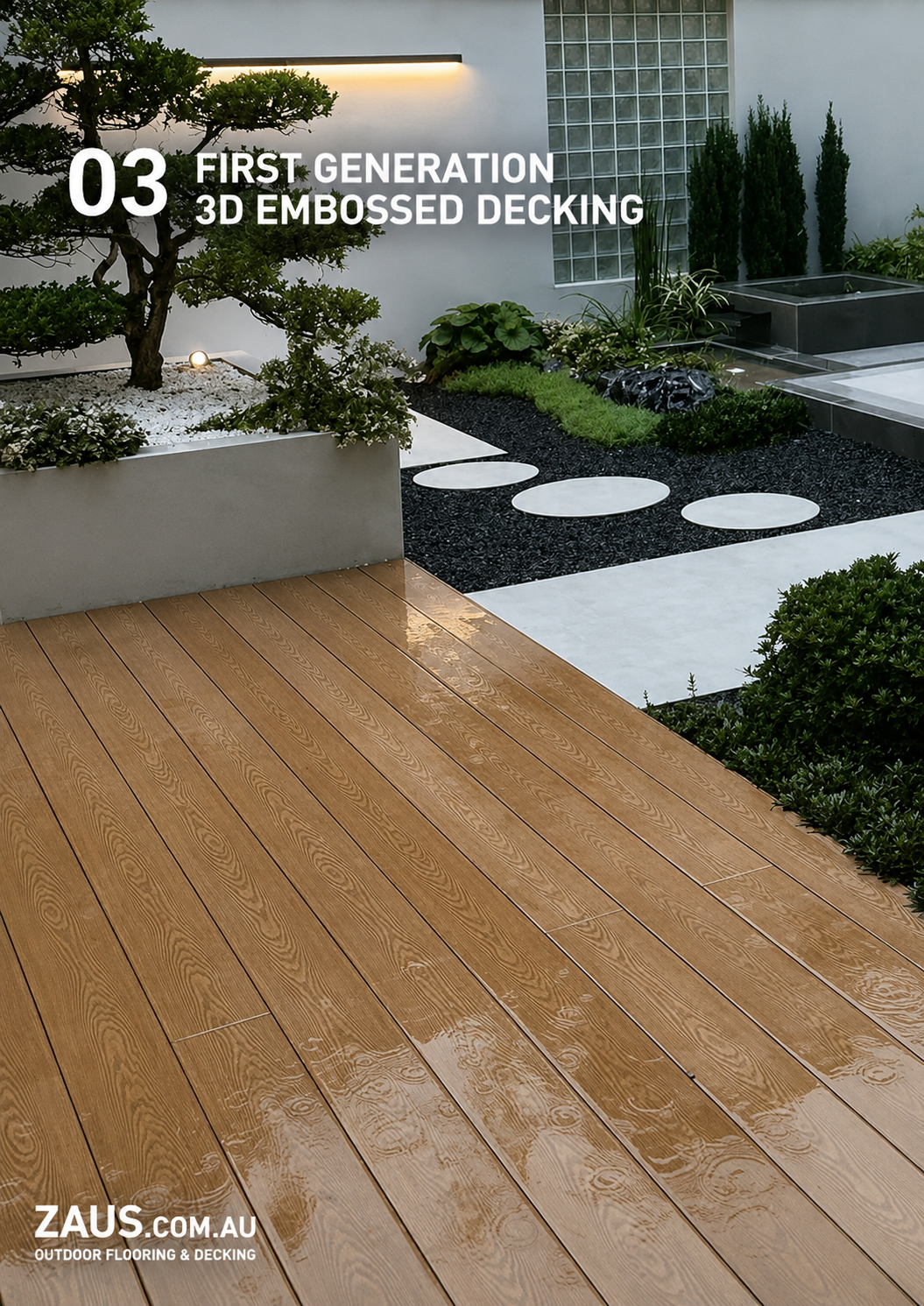
Durable 3D embossed composite decking designed to recreate the texture and visual character of natural timber.
ZAUS 3D Embossed Composite Decking provides a low-maintenance outdoor flooring system combining wood plastic composite construction with a deep embossed timber-grain surface.
Each decking system combines recycled wood fibre, high-density polyethylene and performance additives within a durable exterior board designed for outdoor use. The embossed surface introduces greater visual and tactile depth than a conventional smooth composite board, providing a more natural timber-inspired appearance while retaining the practical benefits of composite construction.
Available across multiple profiles and six documented colours, the system can be coordinated with subframes, concealed fixings and perimeter details as part of a complete ZAUS outdoor decking package.
Wood Plastic Composite Construction
The decking boards use a WPC construction combining recycled wood fibre with high-density polyethylene and performance additives.
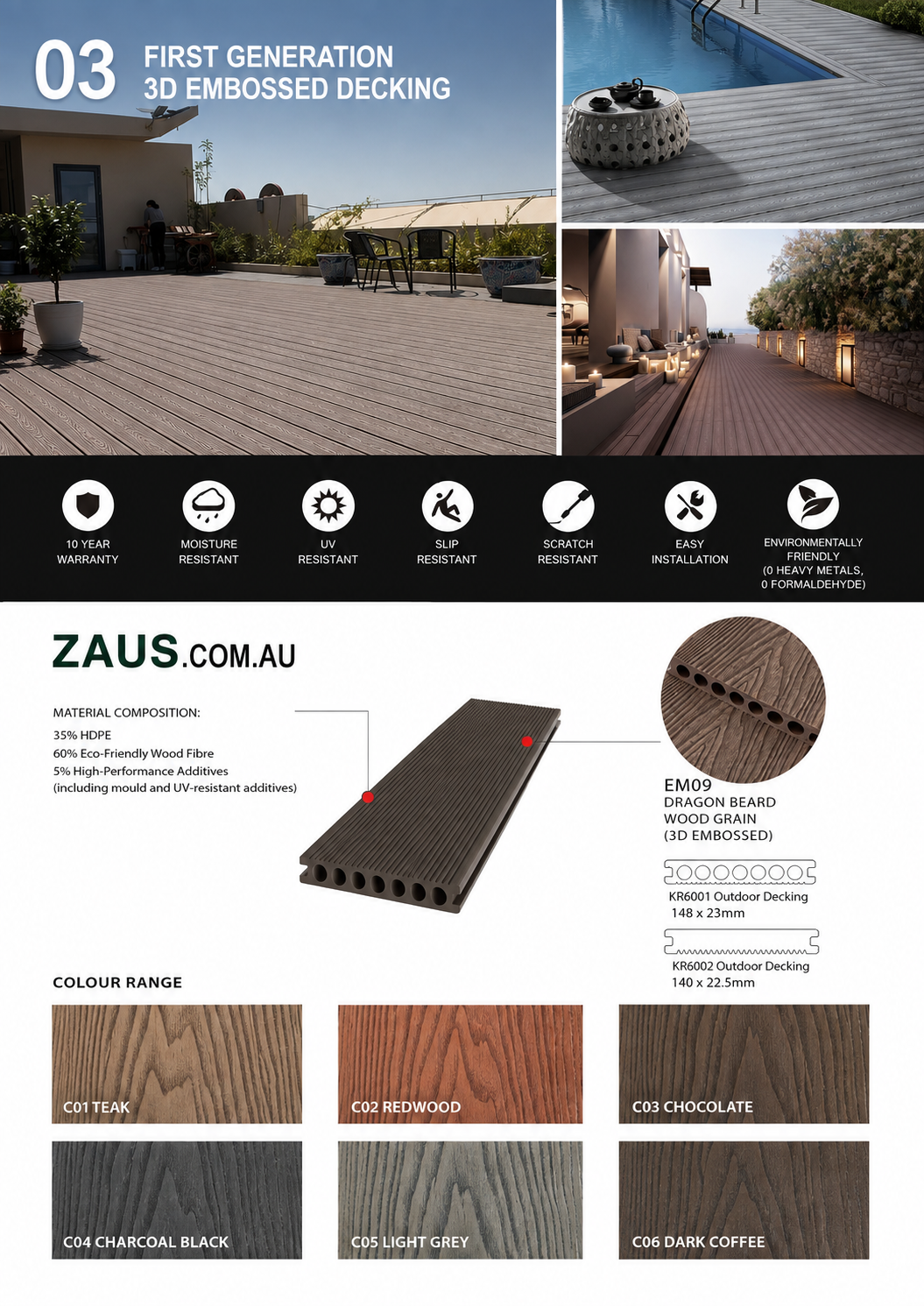
The documented material composition is:
60% eco-friendly wood fibre
35% high-density polyethylene
5% high-performance additives
The additive package includes mould- and UV-resistant components intended to improve suitability for exterior environments.
This construction provides a practical alternative to conventional timber decking while retaining a timber-inspired surface appearance.
3D Embossed Timber Grain
The defining surface treatment within the range is the EM09 Dragon Beard Wood Grain.
This deep 3D embossed pattern is designed to create greater texture and visual variation across the surface of the board.
Unlike a flat printed timber-look finish, the embossed grain introduces physical relief into the surface, helping the board more closely reflect the character of natural timber decking.
The finish can provide:
Greater surface texture
More pronounced timber-grain character
Visual depth
A more natural architectural appearance
Consistent manufactured surface detailing
Final appearance should be reviewed against the applicable manufacturer sample before selection.
EM09 — Dragon Beard Wood Grain
EM09 is the documented 3D embossed surface treatment within the range.
The profile uses a deep timber-inspired grain pattern designed to create a more tactile and visually expressive decking surface.
The embossed texture can coordinate particularly well with outdoor spaces where the decking is intended to retain a natural timber character without using exposed conventional timber boards.
Available Colours
The 3D Embossed Composite Decking range is available in six documented colours:
C01 — Teak
C02 — Redwood
C03 — Chocolate
C04 — Charcoal Black
C05 — Light Grey
C06 — Dark Coffee
The palette ranges from warmer timber-inspired tones through to darker and cooler contemporary finishes.
Final colour selection should be confirmed against applicable manufacturer samples because digital representations can vary from the finished product.
C01 — Teak
Teak provides a warm golden-brown timber direction suited to outdoor spaces seeking a lighter natural wood appearance.
It can coordinate with neutral façades, stone, rendered surfaces and contemporary landscape materials.
C02 — Redwood
Redwood introduces a warmer and richer timber tone with greater reddish character.
It can provide a stronger traditional timber expression while retaining the uniformity and low-maintenance characteristics of composite construction.
C03 — Chocolate
Chocolate provides a deeper brown colour suited to projects where the decking is intended to create a darker and more substantial visual base.
The finish can coordinate well with lighter exterior walls, natural stone and warm architectural materials.
C04 — Charcoal Black
Charcoal Black provides the darkest documented colour within the range.
It creates a contemporary architectural appearance and can be particularly effective alongside dark aluminium, concrete, pale stone and modern monochromatic exterior schemes.
C05 — Light Grey
Light Grey provides a cooler and more restrained alternative to conventional brown timber tones.
The colour can complement contemporary façades, concrete, stone and lighter architectural palettes where a more neutral decking surface is preferred.
C06 — Dark Coffee
Dark Coffee provides a deep warm-brown finish positioned between conventional timber tones and darker contemporary surfaces.
It can be used where the project requires strong timber character without moving into an almost-black finish.
Available Decking Profiles
The range includes two documented decking profiles:
KR6001 — Outdoor Decking
148 × 23 mm
KR6002 — Outdoor Decking
140 × 22.5 mm
The appropriate profile can be selected according to the decking layout, architectural requirements and applicable manufacturer-supported installation system.
KR6001 — Outdoor Decking
KR6001 provides a 148 × 23 mm composite decking profile.
Its wider board proportion creates a substantial decking surface suitable for residential and selected commercial outdoor applications.
Final board layout, joist requirements and fixing method should be confirmed against the applicable installation system.
KR6002 — Outdoor Decking
KR6002 provides a slightly narrower 140 × 22.5 mm decking profile.
The reduced width provides an alternative board proportion while retaining the same broader 3D embossed composite material direction.
The selected profile can be coordinated with the scale of the deck, board direction and overall exterior design.
Exterior Performance
The documented composite construction includes characteristics intended for outdoor use.
Manufacturer-supported features include:
Moisture resistance
UV resistance
Slip resistance
Scratch resistance
Low-maintenance construction
Easy installation
Mould-resistant additives
Final performance should be confirmed against the selected profile and applicable technical documentation, particularly where a project requires a specific tested slip, fire or other regulatory classification.
Moisture Resistance
The WPC construction is designed to provide greater resistance to moisture than conventional untreated timber decking.
This makes the system suitable for general outdoor environments where decking is exposed to changing weather and humidity conditions.
Appropriate drainage, ventilation and installation clearances remain important to the long-term performance of the complete deck.
UV Resistance
The documented additive package includes UV-resistant components intended to assist the decking surface in exterior environments.
As with all exterior finishes, long-term appearance can be influenced by exposure, orientation, climate and maintenance.
Final manufacturer care requirements should therefore be followed after installation.
Slip Resistance
The embossed surface provides texture across the board face and the product range is documented as slip resistant.
Where a project requires a particular slip-resistance classification, the applicable tested result should be confirmed for the selected product before specification.
This is particularly important for pool surrounds, commercial areas and other applications where a specific compliance requirement applies.
Scratch Resistance
The composite surface is designed to provide practical resistance to normal scratching and everyday outdoor use.
The level of resistance can nevertheless depend on the source and severity of the abrasion, and appropriate care should be taken when moving furniture, equipment and other concentrated loads across the finished deck.
Environmental Composition
The documented product range indicates:
0 heavy metals
0 formaldehyde
The boards also incorporate recycled wood fibre as part of the composite material composition.
Any project-specific environmental certification or sustainability requirement should be confirmed against the applicable manufacturer documentation before specification.
Ten-Year Warranty
The documented product range includes a 10-year warranty.
Final warranty terms, applicable conditions, exclusions, installation requirements and maintenance obligations should be reviewed against the manufacturer warranty documentation for the selected product before supply.
Concealed Fixing System
The decking is compatible with the broader ZAUS outdoor subframe and concealed fixing system.
Depending on the selected profile, installation can incorporate:
Supporting joists
Starter clips
Concealed decking clips
Compatible screws
Perimeter finishing components
The concealed fixing arrangement secures the boards through the compatible edge profile rather than relying on visible face fixing across the primary decking surface.
Board Spacing
The documented installation guidance specifies approximately 3–7 mm spacing between adjoining decking boards depending on the selected clip system.
Correct spacing helps accommodate the requirements of the installation system while maintaining consistent drainage and ventilation across the deck.
The selected clip system should be confirmed before set-out because it determines the final board gap.
Wall Clearance
A minimum clearance of 30 mm is documented between the decking and adjoining walls.
Maintaining the required perimeter clearance allows the system to accommodate installation tolerances and expected movement while preventing the boards from being installed directly against surrounding structures.
Joist Centres
The documented installation guidance specifies maximum joist centres of 300 mm.
Joists should be correctly levelled and positioned before decking installation begins.
Additional support is required at applicable board-end joints according to the manufacturer-supported installation method.
Subframe Coordination
The decking can be coordinated with the broader ZAUS outdoor subframe system.
Compatible documented subframe options include:
Hot-dip galvanised steel joists
Aluminium joists
Concealed clips
Starter clips
Stainless or galvanised fixing components
Expansion bolts where applicable
The subframe should be selected according to the substrate, project conditions and selected decking profile.
Edge & Perimeter Finishing
Exposed deck edges can be coordinated with compatible finishing components from the broader outdoor decking accessory range.
Perimeter detailing can consider:
Exposed board ends
Step edges
Deck perimeters
External corners
Changes in level
Junctions with surrounding structures
Where compatible edge trims are used, corners can be mitre-cut to create a cleaner and more continuous finished detail.
Decking Layout
The direction and set-out of the decking boards can influence the overall architectural appearance of the finished outdoor area.
Layout can be developed according to:
Deck dimensions
Primary sightlines
Building orientation
Access points
Steps and level changes
Surrounding façades
Pool or landscape geometry
Board lengths
Required joints
Perimeter conditions
Establishing the board direction before installation also assists with joist layout and material quantity calculations.
Outdoor Material Coordination
ZAUS 3D Embossed Composite Decking can be coordinated with the broader outdoor composite collection.
Composite Decking • Composite Fencing • Privacy Screens • Exterior Wall Cladding • Decking Subframes • Decking Accessories • Edge & Finishing Components
Where multiple systems are incorporated into the same project, colours, timber-look textures and architectural detailing can be considered together to establish a more consistent exterior material language.
Project Development & Coordination
ZAUS develops composite decking packages around the architectural or landscape drawings, decking area and site conditions.
The process can incorporate:
Review Decking Area • Confirm Substrate • Select Decking Profile • Select Colour • Confirm Board Direction • Develop Joist Layout • Select Concealed Fixing System • Resolve Board Spacing & Perimeter Clearances • Coordinate Edge Finishing • Calculate Quantities • Manufacture • Deliver • Coordinate Installation
Final board profile, colour, subframe, fixing system and installation requirements are confirmed against the applicable manufacturer-supported system and project conditions before supply.
Applications
Residential Decking • Terraces • Balconies • Courtyards • Pool Surrounds Where Appropriate • Rooftop Areas • Outdoor Entertaining Areas • Custom Homes • Multi-Residential Developments • Hospitality • Selected Commercial Outdoor Areas
Texture. Durability. Timber-Look Performance.
ZAUS 3D Embossed Composite Decking combines a deep timber-grain surface with engineered WPC construction to create a durable and low-maintenance exterior decking solution.
Select the Profile • Select the Colour • Define the Layout • Coordinate the Subframe • Confirm Board Spacing • Select the Fixings • Resolve the Perimeter • Manufacture & Install
The result is a project-specific outdoor decking system developed around timber-inspired architectural character, exterior durability and practical long-term use.
Durable 3D embossed composite decking designed to recreate the texture and visual character of natural timber.
ZAUS 3D Embossed Composite Decking provides a low-maintenance outdoor flooring system combining wood plastic composite construction with a deep embossed timber-grain surface.
Each decking system combines recycled wood fibre, high-density polyethylene and performance additives within a durable exterior board designed for outdoor use. The embossed surface introduces greater visual and tactile depth than a conventional smooth composite board, providing a more natural timber-inspired appearance while retaining the practical benefits of composite construction.
Available across multiple profiles and six documented colours, the system can be coordinated with subframes, concealed fixings and perimeter details as part of a complete ZAUS outdoor decking package.
Wood Plastic Composite Construction
The decking boards use a WPC construction combining recycled wood fibre with high-density polyethylene and performance additives.
The documented material composition is:
60% eco-friendly wood fibre
35% high-density polyethylene
5% high-performance additives
The additive package includes mould- and UV-resistant components intended to improve suitability for exterior environments.
This construction provides a practical alternative to conventional timber decking while retaining a timber-inspired surface appearance.
3D Embossed Timber Grain
The defining surface treatment within the range is the EM09 Dragon Beard Wood Grain.
This deep 3D embossed pattern is designed to create greater texture and visual variation across the surface of the board.
Unlike a flat printed timber-look finish, the embossed grain introduces physical relief into the surface, helping the board more closely reflect the character of natural timber decking.
The finish can provide:
Greater surface texture
More pronounced timber-grain character
Visual depth
A more natural architectural appearance
Consistent manufactured surface detailing
Final appearance should be reviewed against the applicable manufacturer sample before selection.
EM09 — Dragon Beard Wood Grain
EM09 is the documented 3D embossed surface treatment within the range.
The profile uses a deep timber-inspired grain pattern designed to create a more tactile and visually expressive decking surface.
The embossed texture can coordinate particularly well with outdoor spaces where the decking is intended to retain a natural timber character without using exposed conventional timber boards.
Available Colours
The 3D Embossed Composite Decking range is available in six documented colours:
C01 — Teak
C02 — Redwood
C03 — Chocolate
C04 — Charcoal Black
C05 — Light Grey
C06 — Dark Coffee
The palette ranges from warmer timber-inspired tones through to darker and cooler contemporary finishes.
Final colour selection should be confirmed against applicable manufacturer samples because digital representations can vary from the finished product.
C01 — Teak
Teak provides a warm golden-brown timber direction suited to outdoor spaces seeking a lighter natural wood appearance.
It can coordinate with neutral façades, stone, rendered surfaces and contemporary landscape materials.
C02 — Redwood
Redwood introduces a warmer and richer timber tone with greater reddish character.
It can provide a stronger traditional timber expression while retaining the uniformity and low-maintenance characteristics of composite construction.
C03 — Chocolate
Chocolate provides a deeper brown colour suited to projects where the decking is intended to create a darker and more substantial visual base.
The finish can coordinate well with lighter exterior walls, natural stone and warm architectural materials.
C04 — Charcoal Black
Charcoal Black provides the darkest documented colour within the range.
It creates a contemporary architectural appearance and can be particularly effective alongside dark aluminium, concrete, pale stone and modern monochromatic exterior schemes.
C05 — Light Grey
Light Grey provides a cooler and more restrained alternative to conventional brown timber tones.
The colour can complement contemporary façades, concrete, stone and lighter architectural palettes where a more neutral decking surface is preferred.
C06 — Dark Coffee
Dark Coffee provides a deep warm-brown finish positioned between conventional timber tones and darker contemporary surfaces.
It can be used where the project requires strong timber character without moving into an almost-black finish.
Available Decking Profiles
The range includes two documented decking profiles:
KR6001 — Outdoor Decking
148 × 23 mm
KR6002 — Outdoor Decking
140 × 22.5 mm
The appropriate profile can be selected according to the decking layout, architectural requirements and applicable manufacturer-supported installation system.
KR6001 — Outdoor Decking
KR6001 provides a 148 × 23 mm composite decking profile.
Its wider board proportion creates a substantial decking surface suitable for residential and selected commercial outdoor applications.
Final board layout, joist requirements and fixing method should be confirmed against the applicable installation system.
KR6002 — Outdoor Decking
KR6002 provides a slightly narrower 140 × 22.5 mm decking profile.
The reduced width provides an alternative board proportion while retaining the same broader 3D embossed composite material direction.
The selected profile can be coordinated with the scale of the deck, board direction and overall exterior design.
Exterior Performance
The documented composite construction includes characteristics intended for outdoor use.
Manufacturer-supported features include:
Moisture resistance
UV resistance
Slip resistance
Scratch resistance
Low-maintenance construction
Easy installation
Mould-resistant additives
Final performance should be confirmed against the selected profile and applicable technical documentation, particularly where a project requires a specific tested slip, fire or other regulatory classification.
Moisture Resistance
The WPC construction is designed to provide greater resistance to moisture than conventional untreated timber decking.
This makes the system suitable for general outdoor environments where decking is exposed to changing weather and humidity conditions.
Appropriate drainage, ventilation and installation clearances remain important to the long-term performance of the complete deck.
UV Resistance
The documented additive package includes UV-resistant components intended to assist the decking surface in exterior environments.
As with all exterior finishes, long-term appearance can be influenced by exposure, orientation, climate and maintenance.
Final manufacturer care requirements should therefore be followed after installation.
Slip Resistance
The embossed surface provides texture across the board face and the product range is documented as slip resistant.
Where a project requires a particular slip-resistance classification, the applicable tested result should be confirmed for the selected product before specification.
This is particularly important for pool surrounds, commercial areas and other applications where a specific compliance requirement applies.
Scratch Resistance
The composite surface is designed to provide practical resistance to normal scratching and everyday outdoor use.
The level of resistance can nevertheless depend on the source and severity of the abrasion, and appropriate care should be taken when moving furniture, equipment and other concentrated loads across the finished deck.
Environmental Composition
The documented product range indicates:
0 heavy metals
0 formaldehyde
The boards also incorporate recycled wood fibre as part of the composite material composition.
Any project-specific environmental certification or sustainability requirement should be confirmed against the applicable manufacturer documentation before specification.
Ten-Year Warranty
The documented product range includes a 10-year warranty.
Final warranty terms, applicable conditions, exclusions, installation requirements and maintenance obligations should be reviewed against the manufacturer warranty documentation for the selected product before supply.
Concealed Fixing System
The decking is compatible with the broader ZAUS outdoor subframe and concealed fixing system.
Depending on the selected profile, installation can incorporate:
Supporting joists
Starter clips
Concealed decking clips
Compatible screws
Perimeter finishing components
The concealed fixing arrangement secures the boards through the compatible edge profile rather than relying on visible face fixing across the primary decking surface.
Board Spacing
The documented installation guidance specifies approximately 3–7 mm spacing between adjoining decking boards depending on the selected clip system.
Correct spacing helps accommodate the requirements of the installation system while maintaining consistent drainage and ventilation across the deck.
The selected clip system should be confirmed before set-out because it determines the final board gap.
Wall Clearance
A minimum clearance of 30 mm is documented between the decking and adjoining walls.
Maintaining the required perimeter clearance allows the system to accommodate installation tolerances and expected movement while preventing the boards from being installed directly against surrounding structures.
Joist Centres
The documented installation guidance specifies maximum joist centres of 300 mm.
Joists should be correctly levelled and positioned before decking installation begins.
Additional support is required at applicable board-end joints according to the manufacturer-supported installation method.
Subframe Coordination
The decking can be coordinated with the broader ZAUS outdoor subframe system.
Compatible documented subframe options include:
Hot-dip galvanised steel joists
Aluminium joists
Concealed clips
Starter clips
Stainless or galvanised fixing components
Expansion bolts where applicable
The subframe should be selected according to the substrate, project conditions and selected decking profile.
Edge & Perimeter Finishing
Exposed deck edges can be coordinated with compatible finishing components from the broader outdoor decking accessory range.
Perimeter detailing can consider:
Exposed board ends
Step edges
Deck perimeters
External corners
Changes in level
Junctions with surrounding structures
Where compatible edge trims are used, corners can be mitre-cut to create a cleaner and more continuous finished detail.
Decking Layout
The direction and set-out of the decking boards can influence the overall architectural appearance of the finished outdoor area.
Layout can be developed according to:
Deck dimensions
Primary sightlines
Building orientation
Access points
Steps and level changes
Surrounding façades
Pool or landscape geometry
Board lengths
Required joints
Perimeter conditions
Establishing the board direction before installation also assists with joist layout and material quantity calculations.
Outdoor Material Coordination
ZAUS 3D Embossed Composite Decking can be coordinated with the broader outdoor composite collection.
Composite Decking • Composite Fencing • Privacy Screens • Exterior Wall Cladding • Decking Subframes • Decking Accessories • Edge & Finishing Components
Where multiple systems are incorporated into the same project, colours, timber-look textures and architectural detailing can be considered together to establish a more consistent exterior material language.
Project Development & Coordination
ZAUS develops composite decking packages around the architectural or landscape drawings, decking area and site conditions.
The process can incorporate:
Review Decking Area • Confirm Substrate • Select Decking Profile • Select Colour • Confirm Board Direction • Develop Joist Layout • Select Concealed Fixing System • Resolve Board Spacing & Perimeter Clearances • Coordinate Edge Finishing • Calculate Quantities • Manufacture • Deliver • Coordinate Installation
Final board profile, colour, subframe, fixing system and installation requirements are confirmed against the applicable manufacturer-supported system and project conditions before supply.
Applications
Residential Decking • Terraces • Balconies • Courtyards • Pool Surrounds Where Appropriate • Rooftop Areas • Outdoor Entertaining Areas • Custom Homes • Multi-Residential Developments • Hospitality • Selected Commercial Outdoor Areas
Texture. Durability. Timber-Look Performance.
ZAUS 3D Embossed Composite Decking combines a deep timber-grain surface with engineered WPC construction to create a durable and low-maintenance exterior decking solution.
Select the Profile • Select the Colour • Define the Layout • Coordinate the Subframe • Confirm Board Spacing • Select the Fixings • Resolve the Perimeter • Manufacture & Install
The result is a project-specific outdoor decking system developed around timber-inspired architectural character, exterior durability and practical long-term use.