Architectural Handles & Pulls
Architectural handles and pulls, designed as the tactile finishing layer of bespoke joinery.
ZAUS Architectural Handles & Pulls provide the visible and tactile hardware layer across bespoke kitchens, wardrobes, bathroom vanities and custom residential joinery.
Each handle specification can be developed alongside the cabinetry itself, allowing handle form, dimensions, placement, finish and operating requirements to be coordinated with the cabinet fronts, surrounding materials and broader architectural language of the project.
From restrained edge pulls and minimal architectural grips through to longer-format handles and more expressive feature hardware, the selected handles become an intentional part of the joinery composition rather than an accessory chosen after the cabinetry has been designed.
Handle & Pull Styles
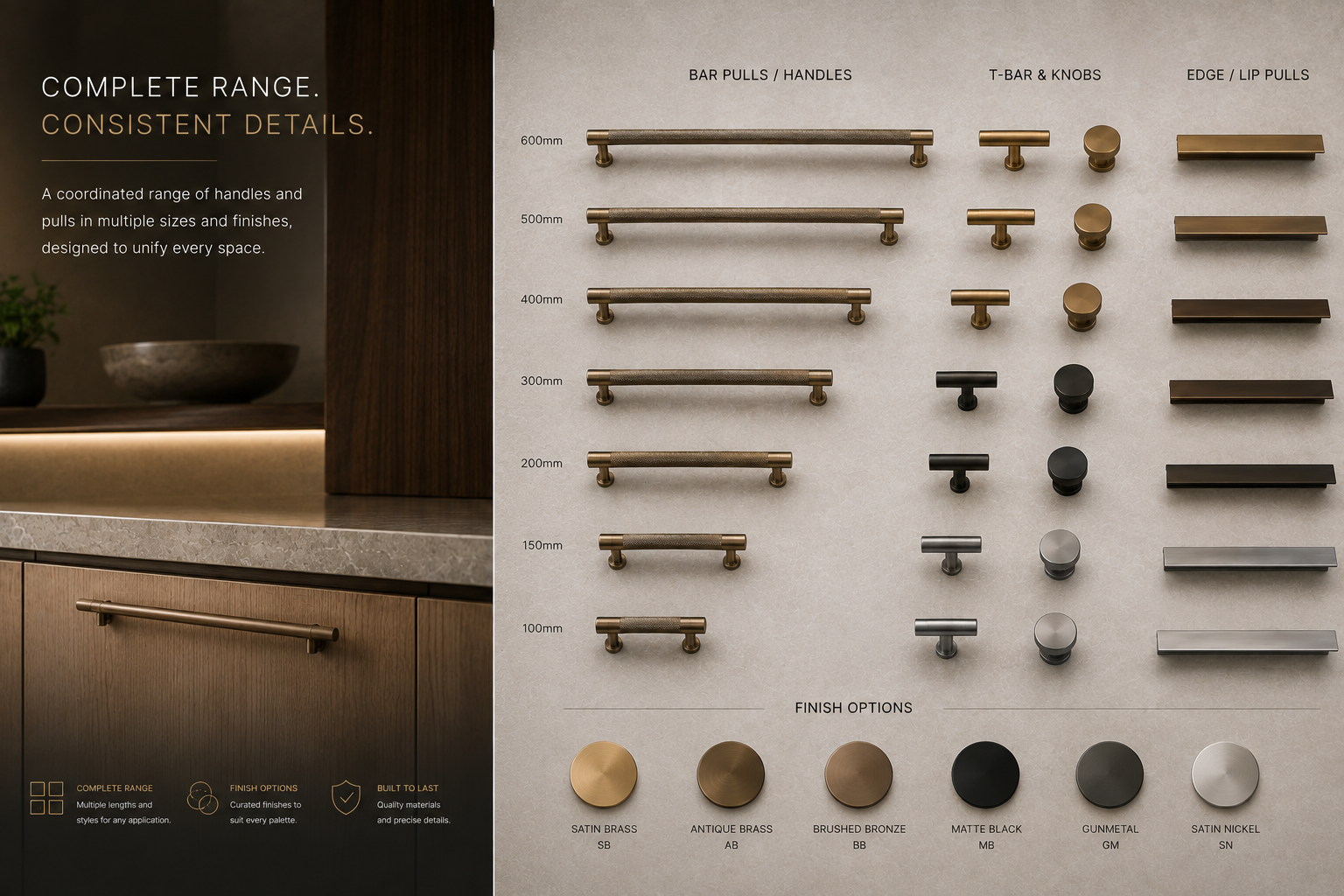
Different handle formats can be selected according to the cabinetry design, door or drawer dimensions and intended architectural expression.
Depending on the selected manufacturer-supported range, configurations can include:
Pull handles
Cabinet knobs
Edge pulls
Lip pulls
Recessed pulls
Flush pulls
Profile handles
Longer-format pulls
Minimal architectural grips
Selected decorative handle designs
Different handle families can also be combined within the same joinery package where individual cabinetry applications require different proportions or operating characteristics.
Pull Handles
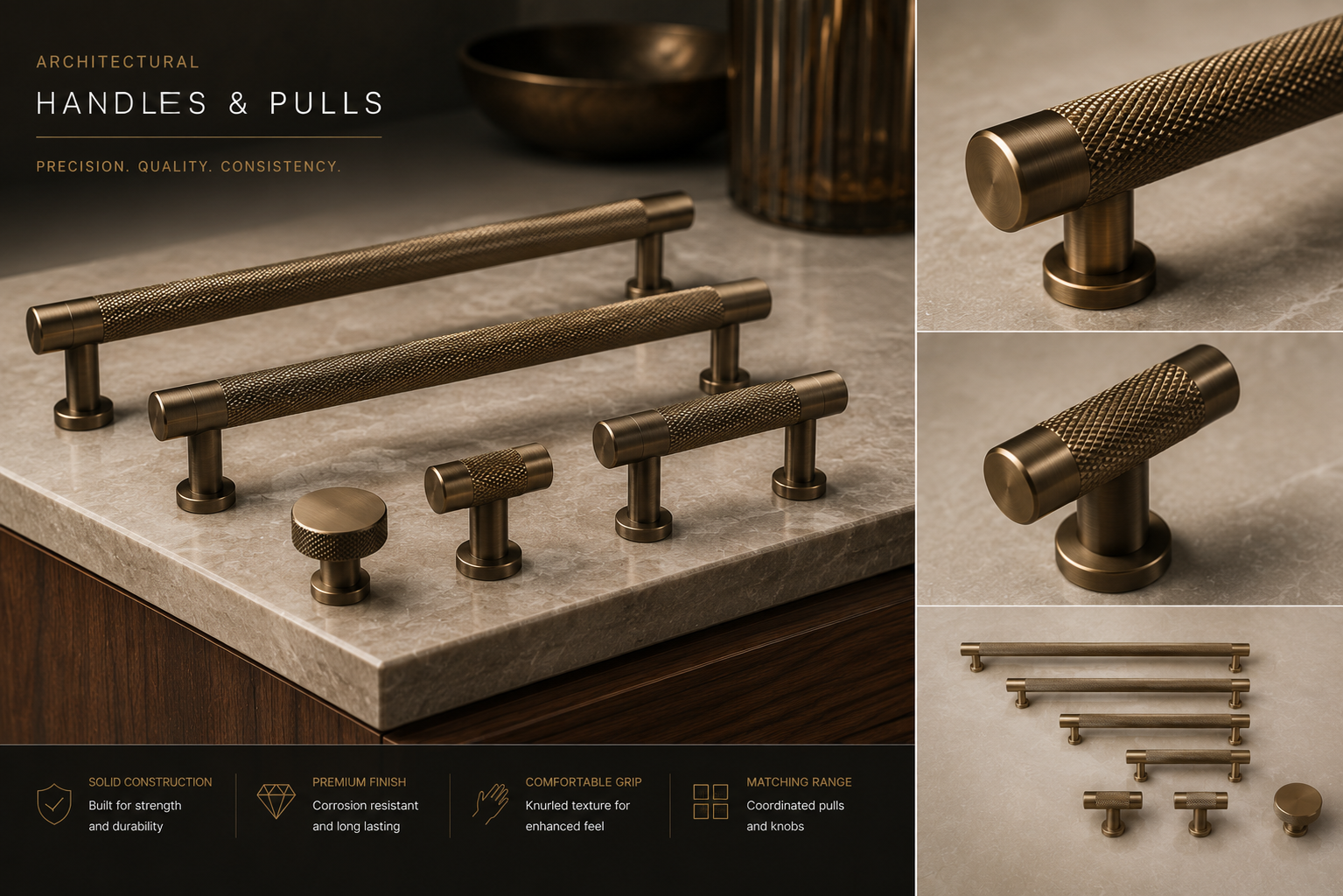
Conventional pull handles provide a direct and practical opening method while allowing the hardware itself to contribute to the visual character of the cabinetry.
Depending on the selected design, pull handles can range from compact and understated forms through to longer architectural profiles.
Applications can include:
Kitchen doors and drawers
Tall cabinetry
Wardrobes
Bathroom vanities
Entertainment cabinetry
Bars
Display cabinetry
Residential built-ins
Handle dimensions and fixing positions should be coordinated with the cabinet-front construction before manufacture.
Cabinet Knobs
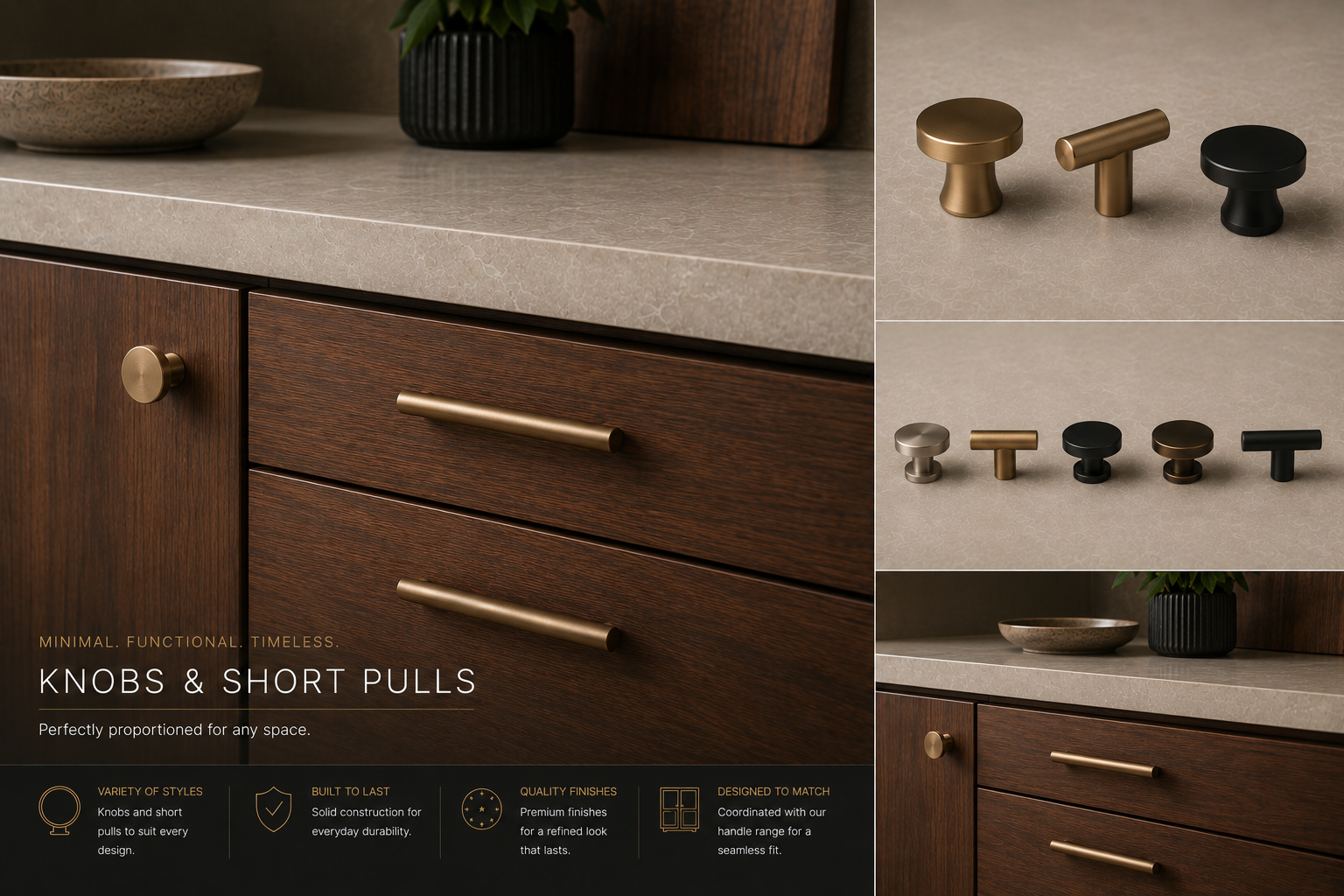
Cabinet knobs provide a smaller and more concentrated hardware detail suited to selected doors, drawers and feature cabinetry.
Depending on the architectural direction, knobs can be used individually or combined with complementary pull handles across a larger cabinetry composition.
Their scale makes them particularly useful where the hardware is intended to remain visually restrained or where a more traditional or furniture-oriented cabinetry expression is required.
Edge & Lip Pulls
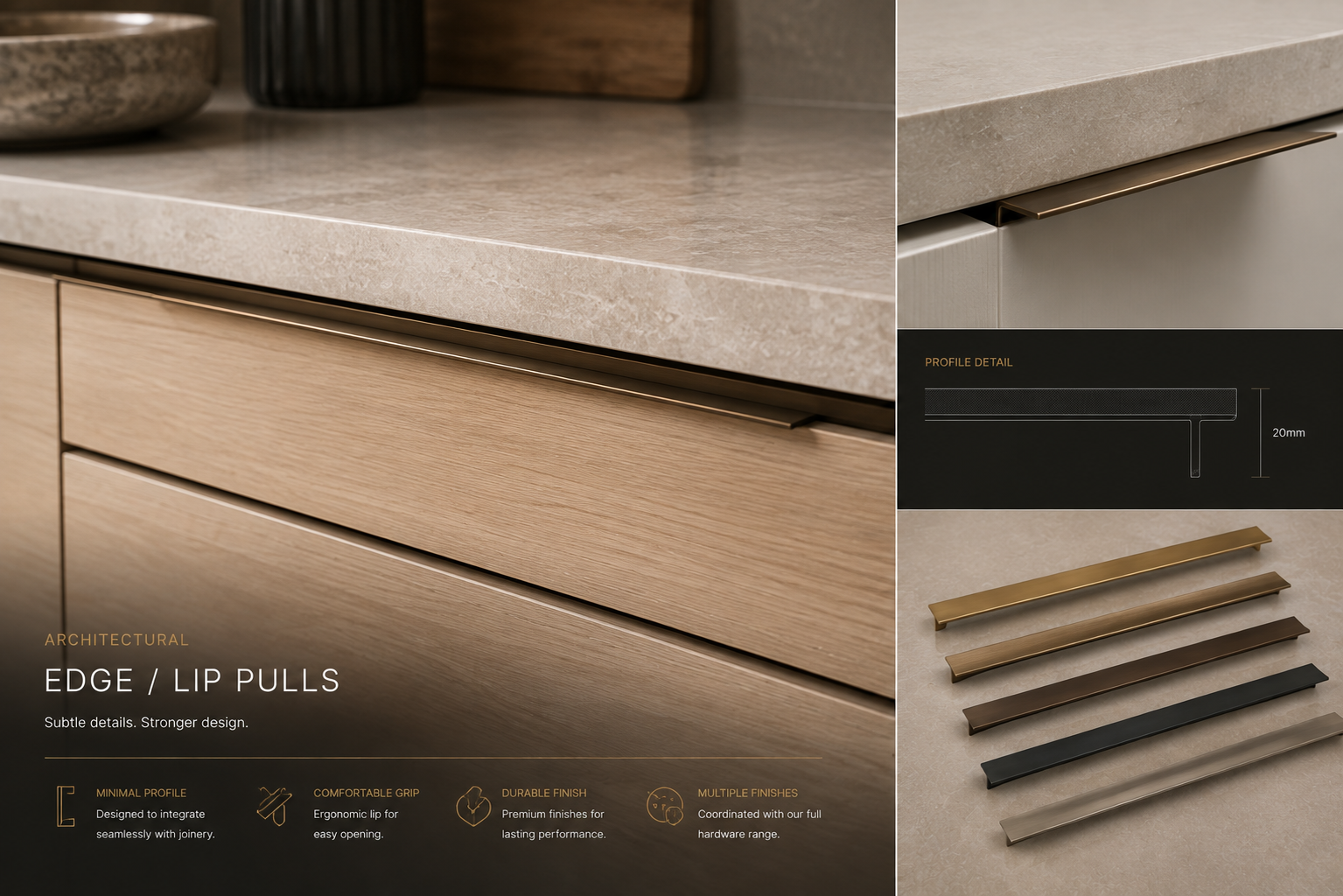
Edge and lip pulls provide a more minimal alternative to conventional face-mounted handles.
Positioned along the edge of the cabinet front, these systems reduce visual interruption across the face of the cabinetry while maintaining a defined physical grip.
They can be particularly effective across:
Contemporary kitchens
Kitchen islands
Wardrobes
Bathroom vanities
Drawer units
Entertainment cabinetry
Minimal residential joinery
Handle profile, cabinet-front thickness and edge conditions should be coordinated together to ensure compatibility with the selected system.
Recessed & Flush Pulls
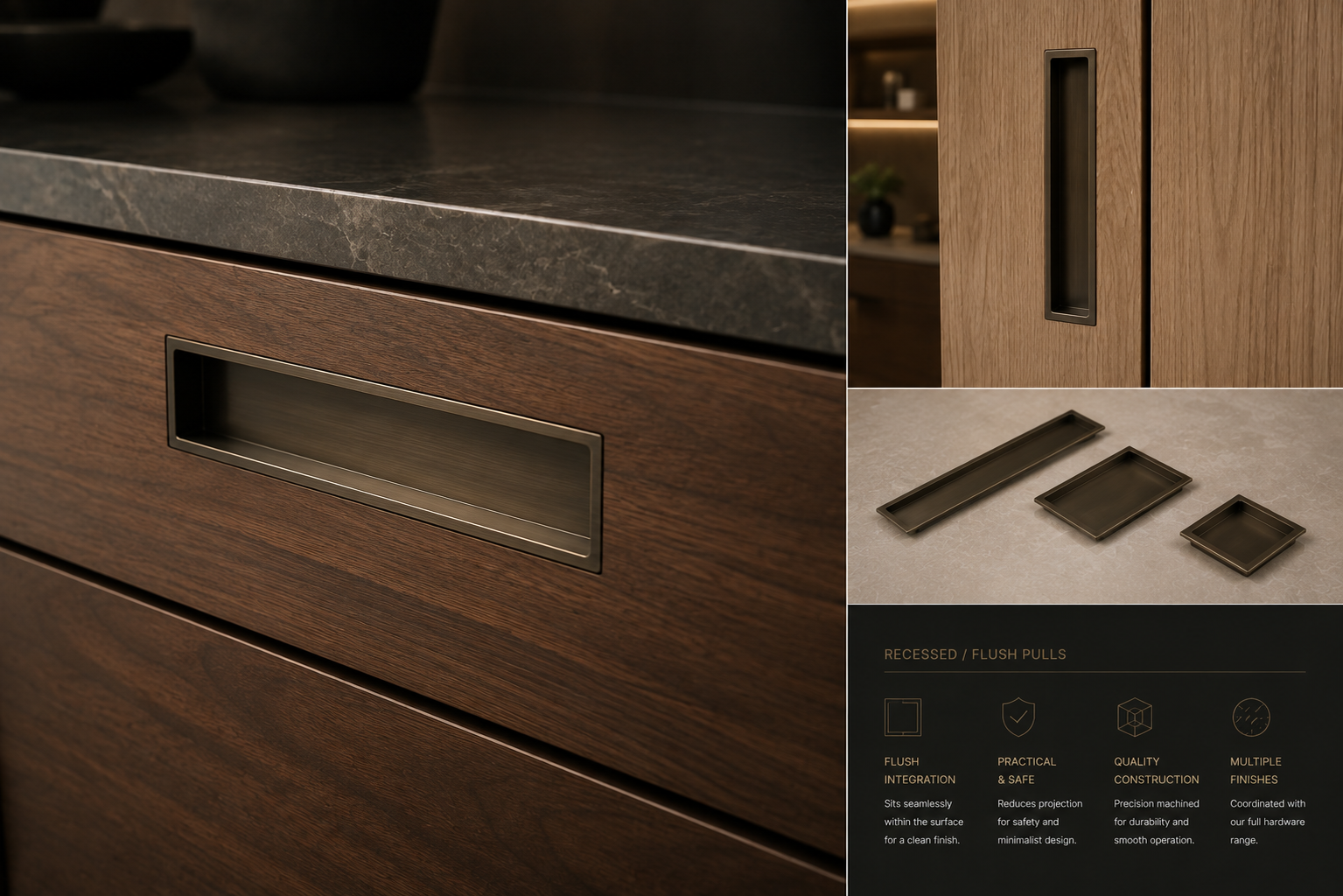
Recessed and flush pull arrangements can provide an even more integrated relationship between the hardware and cabinet front.
Rather than projecting prominently from the cabinetry, the pull can sit within or close to the plane of the front, creating a cleaner overall elevation.
These configurations can be particularly suitable where circulation space, minimal detailing or the architectural design calls for reduced hardware projection.
Final routing, mounting and front-construction requirements should be confirmed against the selected manufacturer-supported handle system before production.
Profile Handles
Profile handles can establish a continuous or repeated architectural line across cabinetry elevations.
Depending on the selected configuration, profiles can be incorporated horizontally or vertically and coordinated with individual doors, drawers or larger groups of cabinetry.
Applications can include:
Base cabinetry
Drawer banks
Tall cabinets
Wardrobes
Kitchen islands
Bathroom vanities
Full-height joinery
Profile dimensions, terminations, junctions and cabinet-front requirements should be considered as part of the overall joinery detailing.
Longer-Format Architectural Pulls
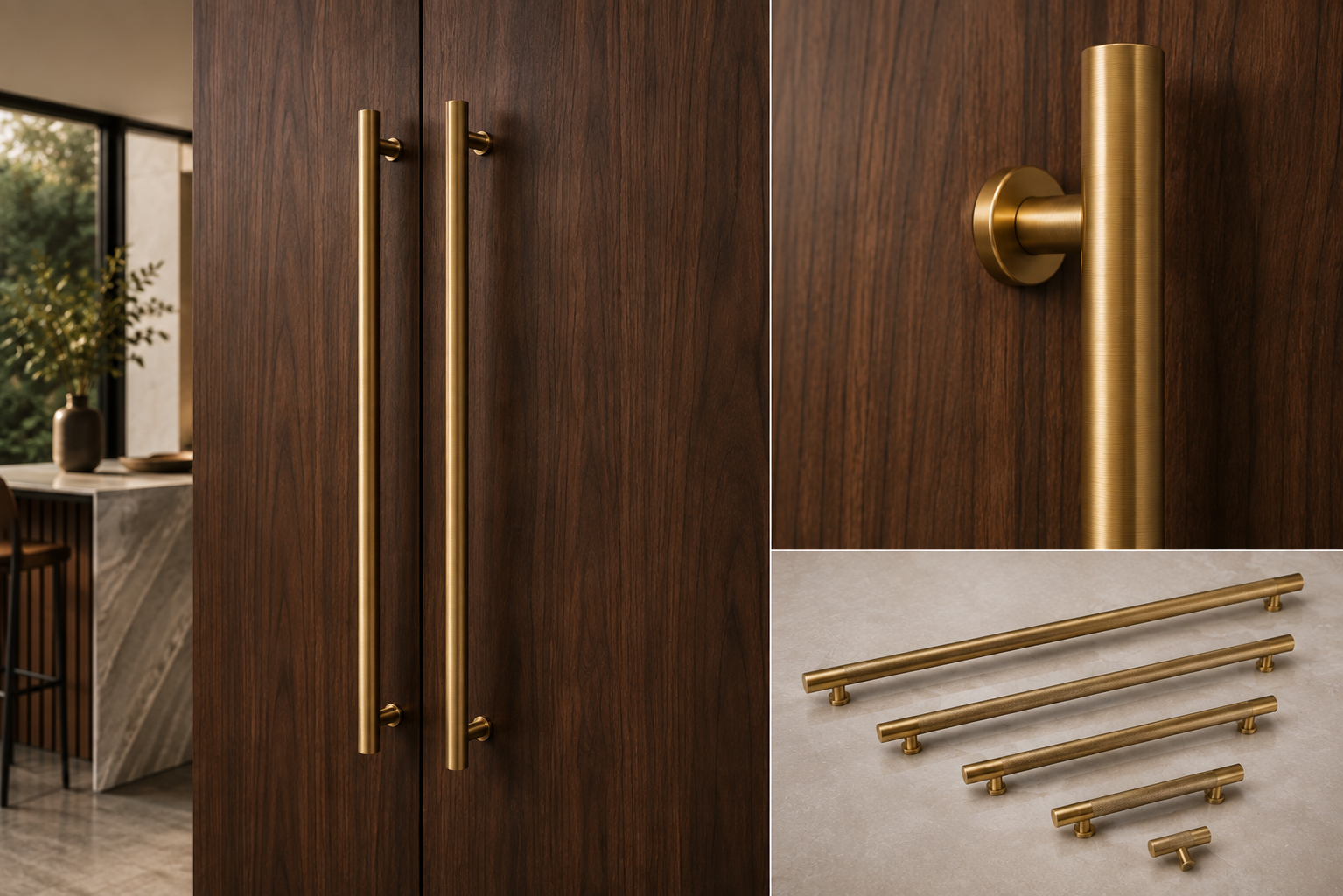
Longer handles can create stronger vertical or horizontal lines across larger cabinet fronts.
These can be particularly effective on:
Full-height pantry doors
Tall kitchen cabinetry
Wardrobes
Integrated appliance cabinetry
Large drawer fronts
Feature cabinets
Longer-format pulls can function as both operating hardware and a deliberate architectural detail, making their scale and positioning particularly important to the finished composition.
Scale & Proportion
Handle selection should respond to the dimensions and function of the cabinetry rather than being treated as a standard detail across every cabinet.
Smaller hardware can provide restrained detailing to compact doors and drawers, while longer pulls can establish stronger lines across tall or oversized fronts.
Selection can consider:
Door dimensions
Drawer dimensions
Cabinet-front proportions
Opening direction
Required grip
Hardware projection
Frequency of use
Adjacent cabinetry
Overall architectural composition
Handle proportion and placement can materially affect both the usability and visual balance of the finished joinery.
Handle Placement
The position of handles can be coordinated across the cabinetry to establish consistent visual lines and comfortable operation.
Depending on the design, handles can be positioned:
Vertically
Horizontally
Centrally
Toward cabinet edges
Along door or drawer profiles
Continuously across grouped cabinetry
Placement should consider both the visual composition and the physical movement required to operate the cabinet.
Architectural Finishes
Handle finishes can be selected to either coordinate with the cabinetry or deliberately provide contrast.
Depending on the applicable manufacturer-supported collection, metallic, dark and other decorative finishes can be coordinated with:
Decorative cabinet fronts
Painted cabinetry
Timber and timber-look surfaces
Natural timber veneer
Aluminium-framed glass doors
Integrated mirror cabinetry
Stone and surrounding interior finishes
Final finish names, colours and surface treatments should be selected from the applicable manufacturer catalogue and physical samples rather than treated as universal options across every handle design.
Material Coordination
Handles can be considered as part of the broader material palette of the room rather than solely in relation to the cabinet front.
Depending on the project, their finish can be coordinated with architectural elements such as tapware, lighting, door hardware, metal detailing and other visible fixtures.
The objective does not necessarily need to be an exact finish match. Hardware can instead be selected to establish a complementary relationship with the surrounding materials and architectural detailing.
Integration with Cabinet Fronts
Handle selection should be considered alongside the construction and finish of the cabinet front.
Architectural Handles & Pulls can be coordinated with:
Decorative cabinet fronts
PET and UV-finished fronts
Vacuum-formed fronts
Painted cabinetry
Profiled doors
Timber and veneer fronts
Aluminium-framed glass cabinet doors
Selected mirrored cabinetry
Front thickness, material, profile and construction can influence the compatible handle type, fixing method and placement.
Minimal & Handleless Joinery
Not every cabinetry application requires a conventional exposed handle.
Where a more minimal architectural expression is preferred, exposed handles can be combined with or replaced by compatible integrated opening arrangements.
Depending on the cabinetry design, these can include:
Edge pulls
Recessed pulls
Profile handles
Integrated finger-pull details
Push-to-open mechanisms
Other manufacturer-supported handleless systems
This allows different levels of visible hardware to be used throughout the same project according to the function and design intent of each cabinetry area.
Coordination with Joinery Hardware
Architectural Handles & Pulls form the visible operating interface of the cabinetry, while ZAUS Premium Joinery Hardware covers the concealed functional mechanisms behind the cabinet fronts.
The two systems can be considered together.
Handle selection, door dimensions and opening method can be coordinated with:
Concealed hinges
Soft-close mechanisms
Drawer runners
Push-to-open systems
Lift mechanisms
Pocket and retractable systems
Sliding and folding mechanisms
This allows the visible and concealed hardware to operate as one coordinated cabinetry system.
Kitchen Applications
Handles can be coordinated across kitchen cabinetry according to the different scale and function of individual fronts.
Applications can include:
Base cabinet doors
Drawer fronts
Kitchen islands
Tall pantry cabinetry
Appliance cabinetry
Overhead cabinets
Feature cabinetry
Different handle formats can be used within the same kitchen where required while maintaining a consistent material and architectural language.
Wardrobe & Dressing Room Applications
Wardrobes and dressing rooms can incorporate handles across solid cabinetry, drawers and selected specialist cabinet fronts.
Longer-format pulls can emphasise the vertical proportions of full-height wardrobe doors, while smaller handles, edge pulls or recessed systems can provide more restrained detailing across internal drawers and accessory storage.
Handle selection can also be coordinated with aluminium-framed glass and mirrored cabinetry where compatible with the selected door system.
Bathroom Vanity Applications
Bathroom vanity handles can be selected according to the scale, material and configuration of the cabinetry.
Compact pulls, edge-mounted systems and minimal profiles can maintain clean vanity elevations, while more expressive hardware can be introduced where the handle is intended to form part of the bathroom's decorative material palette.
Final hardware suitability should be considered alongside the selected cabinetry construction and bathroom application.
Whole-of-Project Joinery Coordination
Architectural Handles & Pulls can be coordinated throughout the broader ZAUS bespoke joinery collection.
Custom Kitchen Joinery • Wardrobes & Dressing Rooms • Bathroom Vanities • Custom Residential Joinery • Custom Cabinet Fronts & Finishes • Aluminium-Framed Glass Cabinet Doors • Integrated Mirror Cabinet Doors • Premium Joinery Hardware
Where appropriate, related handle families, finishes and proportions can be used across multiple areas to establish a consistent hardware language throughout the project.
Project Development & Coordination
ZAUS develops the handle specification alongside the individual joinery package.
The process can incorporate:
Review Cabinetry Design • Select Handle Type • Confirm Cabinet Front Construction • Determine Handle Scale • Define Placement • Select Finish • Coordinate Concealed Hardware • Review Physical Samples Where Applicable • Finalise Shop Drawings • Manufacture • Deliver • Coordinate Installation
Final handle designs, dimensions, finishes, fixing requirements and compatible applications are confirmed against the applicable manufacturer-supported range before production.
Applications
Kitchen Joinery • Kitchen Islands • Wardrobes & Dressing Rooms • Bathroom Vanities • Bars • Entertainment Joinery • Studies & Libraries • Display Cabinetry • Bedroom Joinery • Custom Residential Joinery • Custom Homes • Luxury Residences • Apartments • Boutique Residential Projects
Form. Touch. Architectural Detail.
ZAUS coordinates handles and pulls as the tactile finishing layer of the complete bespoke joinery package rather than treating visible hardware as a last-minute addition.
Define the Cabinetry • Select the Handle Style • Determine Scale & Placement • Select the Finish • Coordinate the Cabinet Front • Coordinate Functional Hardware • Confirm the Detail • Manufacture & Deliver
The result is a considered architectural hardware specification developed around the cabinetry proportions, material palette, functionality and design language of the individual project.
Architectural handles and pulls, designed as the tactile finishing layer of bespoke joinery.
ZAUS Architectural Handles & Pulls provide the visible and tactile hardware layer across bespoke kitchens, wardrobes, bathroom vanities and custom residential joinery.
Each handle specification can be developed alongside the cabinetry itself, allowing handle form, dimensions, placement, finish and operating requirements to be coordinated with the cabinet fronts, surrounding materials and broader architectural language of the project.
From restrained edge pulls and minimal architectural grips through to longer-format handles and more expressive feature hardware, the selected handles become an intentional part of the joinery composition rather than an accessory chosen after the cabinetry has been designed.
Handle & Pull Styles
Different handle formats can be selected according to the cabinetry design, door or drawer dimensions and intended architectural expression.
Depending on the selected manufacturer-supported range, configurations can include:
Pull handles
Cabinet knobs
Edge pulls
Lip pulls
Recessed pulls
Flush pulls
Profile handles
Longer-format pulls
Minimal architectural grips
Selected decorative handle designs
Different handle families can also be combined within the same joinery package where individual cabinetry applications require different proportions or operating characteristics.
Pull Handles
Conventional pull handles provide a direct and practical opening method while allowing the hardware itself to contribute to the visual character of the cabinetry.
Depending on the selected design, pull handles can range from compact and understated forms through to longer architectural profiles.
Applications can include:
Kitchen doors and drawers
Tall cabinetry
Wardrobes
Bathroom vanities
Entertainment cabinetry
Bars
Display cabinetry
Residential built-ins
Handle dimensions and fixing positions should be coordinated with the cabinet-front construction before manufacture.
Cabinet Knobs
Cabinet knobs provide a smaller and more concentrated hardware detail suited to selected doors, drawers and feature cabinetry.
Depending on the architectural direction, knobs can be used individually or combined with complementary pull handles across a larger cabinetry composition.
Their scale makes them particularly useful where the hardware is intended to remain visually restrained or where a more traditional or furniture-oriented cabinetry expression is required.
Edge & Lip Pulls
Edge and lip pulls provide a more minimal alternative to conventional face-mounted handles.
Positioned along the edge of the cabinet front, these systems reduce visual interruption across the face of the cabinetry while maintaining a defined physical grip.
They can be particularly effective across:
Contemporary kitchens
Kitchen islands
Wardrobes
Bathroom vanities
Drawer units
Entertainment cabinetry
Minimal residential joinery
Handle profile, cabinet-front thickness and edge conditions should be coordinated together to ensure compatibility with the selected system.
Recessed & Flush Pulls
Recessed and flush pull arrangements can provide an even more integrated relationship between the hardware and cabinet front.
Rather than projecting prominently from the cabinetry, the pull can sit within or close to the plane of the front, creating a cleaner overall elevation.
These configurations can be particularly suitable where circulation space, minimal detailing or the architectural design calls for reduced hardware projection.
Final routing, mounting and front-construction requirements should be confirmed against the selected manufacturer-supported handle system before production.
Profile Handles
Profile handles can establish a continuous or repeated architectural line across cabinetry elevations.
Depending on the selected configuration, profiles can be incorporated horizontally or vertically and coordinated with individual doors, drawers or larger groups of cabinetry.
Applications can include:
Base cabinetry
Drawer banks
Tall cabinets
Wardrobes
Kitchen islands
Bathroom vanities
Full-height joinery
Profile dimensions, terminations, junctions and cabinet-front requirements should be considered as part of the overall joinery detailing.
Longer-Format Architectural Pulls
Longer handles can create stronger vertical or horizontal lines across larger cabinet fronts.
These can be particularly effective on:
Full-height pantry doors
Tall kitchen cabinetry
Wardrobes
Integrated appliance cabinetry
Large drawer fronts
Feature cabinets
Longer-format pulls can function as both operating hardware and a deliberate architectural detail, making their scale and positioning particularly important to the finished composition.
Scale & Proportion
Handle selection should respond to the dimensions and function of the cabinetry rather than being treated as a standard detail across every cabinet.
Smaller hardware can provide restrained detailing to compact doors and drawers, while longer pulls can establish stronger lines across tall or oversized fronts.
Selection can consider:
Door dimensions
Drawer dimensions
Cabinet-front proportions
Opening direction
Required grip
Hardware projection
Frequency of use
Adjacent cabinetry
Overall architectural composition
Handle proportion and placement can materially affect both the usability and visual balance of the finished joinery.
Handle Placement
The position of handles can be coordinated across the cabinetry to establish consistent visual lines and comfortable operation.
Depending on the design, handles can be positioned:
Vertically
Horizontally
Centrally
Toward cabinet edges
Along door or drawer profiles
Continuously across grouped cabinetry
Placement should consider both the visual composition and the physical movement required to operate the cabinet.
Architectural Finishes
Handle finishes can be selected to either coordinate with the cabinetry or deliberately provide contrast.
Depending on the applicable manufacturer-supported collection, metallic, dark and other decorative finishes can be coordinated with:
Decorative cabinet fronts
Painted cabinetry
Timber and timber-look surfaces
Natural timber veneer
Aluminium-framed glass doors
Integrated mirror cabinetry
Stone and surrounding interior finishes
Final finish names, colours and surface treatments should be selected from the applicable manufacturer catalogue and physical samples rather than treated as universal options across every handle design.
Material Coordination
Handles can be considered as part of the broader material palette of the room rather than solely in relation to the cabinet front.
Depending on the project, their finish can be coordinated with architectural elements such as tapware, lighting, door hardware, metal detailing and other visible fixtures.
The objective does not necessarily need to be an exact finish match. Hardware can instead be selected to establish a complementary relationship with the surrounding materials and architectural detailing.
Integration with Cabinet Fronts
Handle selection should be considered alongside the construction and finish of the cabinet front.
Architectural Handles & Pulls can be coordinated with:
Decorative cabinet fronts
PET and UV-finished fronts
Vacuum-formed fronts
Painted cabinetry
Profiled doors
Timber and veneer fronts
Aluminium-framed glass cabinet doors
Selected mirrored cabinetry
Front thickness, material, profile and construction can influence the compatible handle type, fixing method and placement.
Minimal & Handleless Joinery
Not every cabinetry application requires a conventional exposed handle.
Where a more minimal architectural expression is preferred, exposed handles can be combined with or replaced by compatible integrated opening arrangements.
Depending on the cabinetry design, these can include:
Edge pulls
Recessed pulls
Profile handles
Integrated finger-pull details
Push-to-open mechanisms
Other manufacturer-supported handleless systems
This allows different levels of visible hardware to be used throughout the same project according to the function and design intent of each cabinetry area.
Coordination with Joinery Hardware
Architectural Handles & Pulls form the visible operating interface of the cabinetry, while ZAUS Premium Joinery Hardware covers the concealed functional mechanisms behind the cabinet fronts.
The two systems can be considered together.
Handle selection, door dimensions and opening method can be coordinated with:
Concealed hinges
Soft-close mechanisms
Drawer runners
Push-to-open systems
Lift mechanisms
Pocket and retractable systems
Sliding and folding mechanisms
This allows the visible and concealed hardware to operate as one coordinated cabinetry system.
Kitchen Applications
Handles can be coordinated across kitchen cabinetry according to the different scale and function of individual fronts.
Applications can include:
Base cabinet doors
Drawer fronts
Kitchen islands
Tall pantry cabinetry
Appliance cabinetry
Overhead cabinets
Feature cabinetry
Different handle formats can be used within the same kitchen where required while maintaining a consistent material and architectural language.
Wardrobe & Dressing Room Applications
Wardrobes and dressing rooms can incorporate handles across solid cabinetry, drawers and selected specialist cabinet fronts.
Longer-format pulls can emphasise the vertical proportions of full-height wardrobe doors, while smaller handles, edge pulls or recessed systems can provide more restrained detailing across internal drawers and accessory storage.
Handle selection can also be coordinated with aluminium-framed glass and mirrored cabinetry where compatible with the selected door system.
Bathroom Vanity Applications
Bathroom vanity handles can be selected according to the scale, material and configuration of the cabinetry.
Compact pulls, edge-mounted systems and minimal profiles can maintain clean vanity elevations, while more expressive hardware can be introduced where the handle is intended to form part of the bathroom's decorative material palette.
Final hardware suitability should be considered alongside the selected cabinetry construction and bathroom application.
Whole-of-Project Joinery Coordination
Architectural Handles & Pulls can be coordinated throughout the broader ZAUS bespoke joinery collection.
Custom Kitchen Joinery • Wardrobes & Dressing Rooms • Bathroom Vanities • Custom Residential Joinery • Custom Cabinet Fronts & Finishes • Aluminium-Framed Glass Cabinet Doors • Integrated Mirror Cabinet Doors • Premium Joinery Hardware
Where appropriate, related handle families, finishes and proportions can be used across multiple areas to establish a consistent hardware language throughout the project.
Project Development & Coordination
ZAUS develops the handle specification alongside the individual joinery package.
The process can incorporate:
Review Cabinetry Design • Select Handle Type • Confirm Cabinet Front Construction • Determine Handle Scale • Define Placement • Select Finish • Coordinate Concealed Hardware • Review Physical Samples Where Applicable • Finalise Shop Drawings • Manufacture • Deliver • Coordinate Installation
Final handle designs, dimensions, finishes, fixing requirements and compatible applications are confirmed against the applicable manufacturer-supported range before production.
Applications
Kitchen Joinery • Kitchen Islands • Wardrobes & Dressing Rooms • Bathroom Vanities • Bars • Entertainment Joinery • Studies & Libraries • Display Cabinetry • Bedroom Joinery • Custom Residential Joinery • Custom Homes • Luxury Residences • Apartments • Boutique Residential Projects
Form. Touch. Architectural Detail.
ZAUS coordinates handles and pulls as the tactile finishing layer of the complete bespoke joinery package rather than treating visible hardware as a last-minute addition.
Define the Cabinetry • Select the Handle Style • Determine Scale & Placement • Select the Finish • Coordinate the Cabinet Front • Coordinate Functional Hardware • Confirm the Detail • Manufacture & Deliver
The result is a considered architectural hardware specification developed around the cabinetry proportions, material palette, functionality and design language of the individual project.